
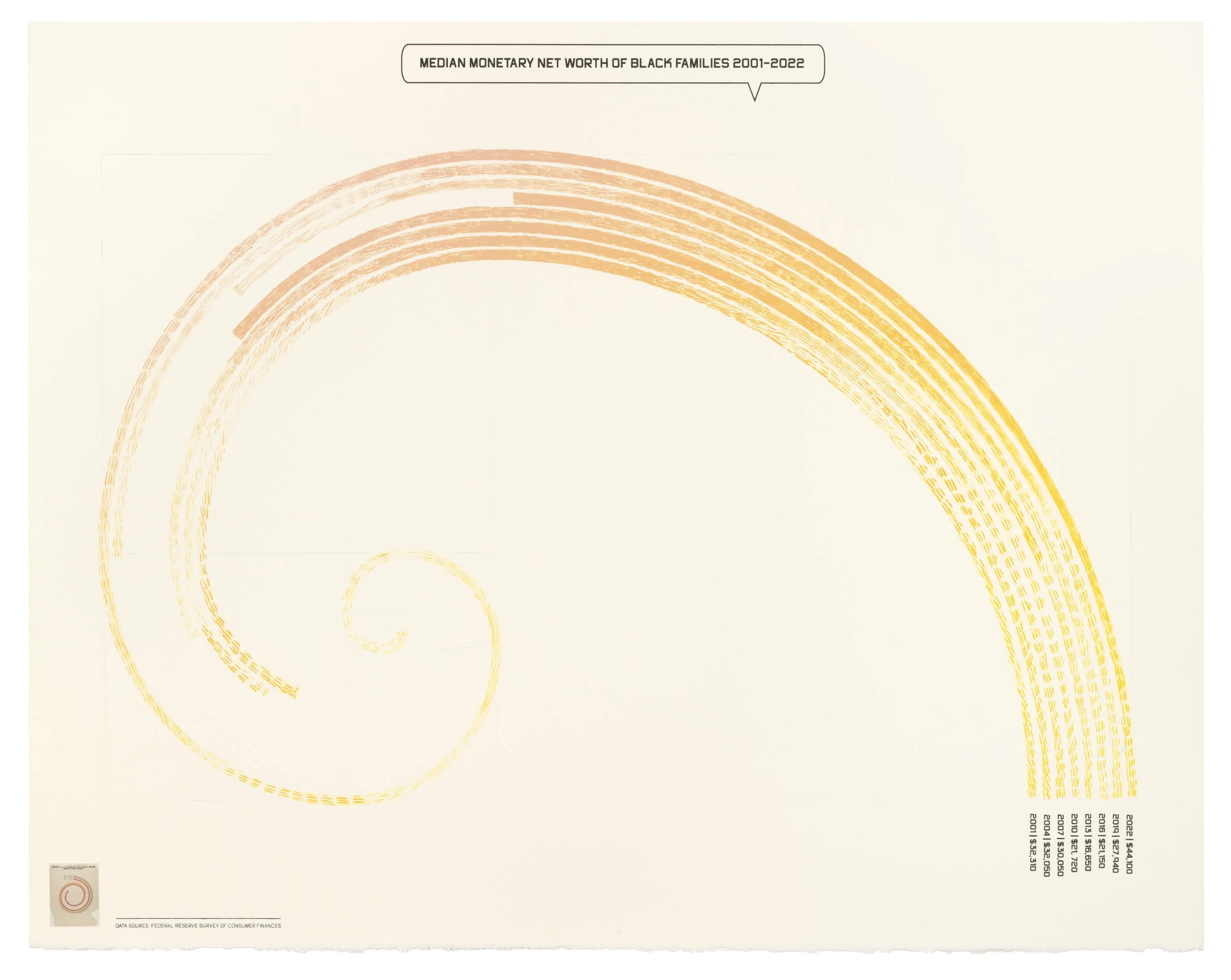
Portfolio four “OWNERSHIP” is published by Highpoint Editions in Minneapolis, MN. Portfolio four updates and reimagines 5 original Du Bois data portraits within the group of works. The Ownership portfolio focuses on aspects of Black proprietorship offering insights into the wealth gap between Black Americans and others as well as concerns of ownership local to the Twin Cities.
William Villalongo and Shraddha Ramani, Median Monetary Net Worth of Black Families 2001–2022, 2026. Lithograph and collage. 22 x 28 in. Edition of 20. Printed and published by Highpoint Editions, Minneapolis, MN. © Villalongo Studio LLC. Courtesy William Villalongo, Shraddha Ramani and Highpoint Editions, Minneapolis, MN.
MEDIAN MONETARY WORTH OF BLACK FAMILIES 2001-2022
Without access to data about the financial status of Black families and Black generational wealth, in 1900, Du Bois sampled a range of towns in Georgia by issuing paper surveys door-to-door to collect data. Thanks in part to the generation Du Bois focused on, we are now able to approach this information with a historical lens. In 1900, Du Bois measured Black wealth by objects of value such as “household and kitchen furniture,” as his original work is titled. These objects would have been significant purchases, well cared for and passed down to younger generations. Today, Black wealth lives within the normative definitions: savings, investments, equity and assets. Median Monetary Net Worth of Black Families 2001–2022 was updated using a national survey conducted by the Federal Reserve. Villalogo and Ramani reimagined Du Bois’s dynamic spiral in the form of a “Golden Ratio” diagram. The Golden Ratio is a mathematical ratio found in various natural structures and patterns. The update reveals the precarious nature of Black wealth, as we see it retract in step with recent economic recessions.
William Villalongo and Shraddha Ramani, Debt-to-Asset Ratio of U.S. Families by Race & Ethnicity, 2026. Relief, lithograph, chine collé, and collage. 22 x 28 in. Edition of 20. Printed and published by Highpoint Editions, Minneapolis, MN. © Villalongo Studio LLC. Courtesy William Villalongo, Shraddha Ramani and Highpoint Editions, Minneapolis, MN.
DEBT-TO-ASSET RATIO OF U.S. FAMILIES BY RACE AND ETHNICITY
When considering Du Bois’ original data portrait Value of Land Owned by Georgia Negroes, Villalogo and Ramani came to realize that land ownership was the highest value asset and possibly the only asset of real value for some families at the time. Updating this visualization for the 21st Century within a U.S. economic system that is radically different, and for which Black families participate dynamically, Villalogo and Ramani concluded that debt may be the most significant factor in an economic portrait; it is particularly important when looking at Black families today, where credit and credit worthiness may be more consequential than actual funds. The visualization shows how far “underwater” U.S. families are, and what they have to buoy themselves, particularly in difficult economic times. In the image we see money bags from Du Bois’ original work afloat at sea— each accounting for the total assets of families, with the water line denoting the severity of debt. The use of wood block relief evokes the turbulent seas of Hokusai’s The Great Wave off Kanagawa.
William Villalongo and Shraddha Ramani, Mortgage Interest Rates of Black and White Homeowners, 2026. Lithograph and collage 22 x 28 in. Edition of 20. Printed and published by Highpoint Editions, Minneapolis, MN. © Villalongo Studio LLC. Courtesy William Villalongo, Shraddha Ramani and Highpoint Editions, Minneapolis, MN.
MORTGAGE INTEREST RATES OF BLACK AND WHITE HOMEOWNERS
Throughout their research, Villalogo and Ramani witnessed the trend of Black families increasingly moving out of cities and moving to the suburbs, many chasing the American Dream of homeownership and more space for their children to play and grow. In many towns in the U.S., historical redlining created a significant barrier to this dream for most Black families. Jim Crow era covenant laws, zoning laws and infrastructure development have all played a part in this. While Black families still struggle through the sometimes obscure hangovers of the past, there are clear signs of this damage. While digging into the barriers to homeownership, the disparities present within mortgage interest rates were a significant signal of how this issue manifests today. On average, Black families pay higher interest rates in order to have the same dream as white families, and while the percentage of Black families that outright own their homes is less than that of white families, the disparity is not extreme. However, the ceiling for white families with mortgages is 7% with the majority paying under 4%. Black families pay rates as high as 8% with nearly half of those with mortgages paying over 4%. In this print, the picket fence dissipates to white as the hurdles to the dream get higher and the specter of the red line implies historical challenges anew.
William Villalongo and Shraddha Ramani, Black Owned Business in the Twin Cities, 2026. Lithograph, screenprint, and collage. 22 x 28 in. Edition of 20. Printed and published by Highpoint Editions, Minneapolis, MN. © Villalongo Studio LLC. Courtesy William Villalongo, Shraddha Ramani and Highpoint Editions, Minneapolis, MN.
BLACK OWNED BUSINESSES IN THE TWIN CITIES
Black Owned Businesses in the Twin Cities is an update of Du Bois’ original Negro Buisness Men in the U.S., by way of an activist project in the Twin Cities. The MSP BIPOC Business Map, created by Atharv Kulkarni in 2023, is a website and open source map that allows users to find minority owned businesses in the Twin Cities. Users can add to the map, which Kulkarni has paired with social media presence on LinkedIn, Instagram and TikTok. The highly successful approach creates a significant sample of BIPOC Businesses that is constantly updated. Kulkarni started the project as a way to invigorate local BIPOC solidarity initiated by the Black Lives Matter protests in the wake of George Floyd’s murder by police in Minneapolis in 2020. The image expresses a flourishing of Black businesses in the Twin Cities as it heals from these still resonate events. Villalongo uses his iconic floral motifs to illuminate businesses against MSP geography. Where and what the businesses are reflect the needs and industriousness of its communities, and conversely, where Black owned businesses are not located exposes difficult truths between the hope of Black entrepreneurship and historically underserved Black communities.
William Villalongo and Shraddha Ramani, Characteristics of Black and African American Farmers in Minnesota, 2026. Lithograph. 22 x 28 in. Edition of 20. Printed and published by Highpoint Editions, Minneapolis, MN. © Villalongo Studio LLC. Courtesy William Villalongo, Shraddha Ramani and Highpoint Editions, Minneapolis, MN.
CHARACTERISTICS OF BLACK AND AFRICAN AMERICAN FARMERS IN MINNESOTA
The story of Black farming in the U.S. is one of dramatic decline. Consecutive decades of disenfranchisement: from deed theft, to being denied subsidies and loans offered to white farmers, have pushed Black farming to the margins. When Du Bois made his original data portraits, Black farming and farm industry work accounted for the largest portion of occupations and land ownership for Black families. The 1990 Farm Bill attempted to address this historical discrimination by including grants and other resources for “minority farmers”. In 2022 the Biden Administration authorized $2 billion in payments to Black farmers intended to address historical discrimination by USDA lending programs. This came as an answer to still unresolved issues in the Pigman v. Glickman settlement, a class action lawsuit by Black farmers against the USDA which was first settled in 1999. These efforts made an impact on some Black farmers, but were poorly implemented, leaving many farmers with denied claims and having to navigate a difficult administrative process.
Villalogo and Ramani’s conversations with local artist and activist Whitney Terrill explored her activism and advocacy for Black and minority farmers and her own experience being a farmer. This led to considering the various characteristics of Black farmers in the state to get a sense of where they are and what they produce.