Printing in Black America: Du Bois's Data Portraits in the 21st Century

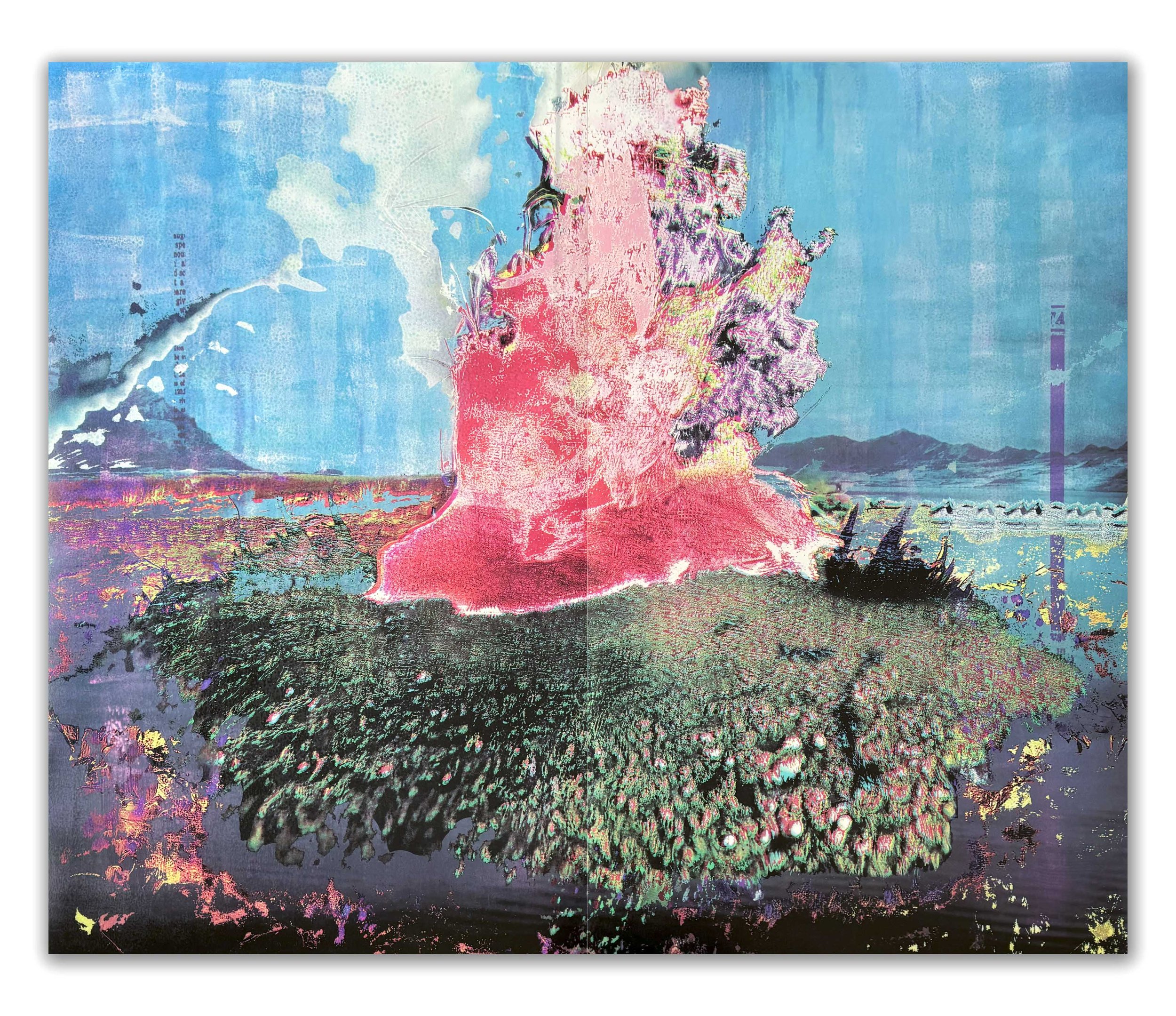
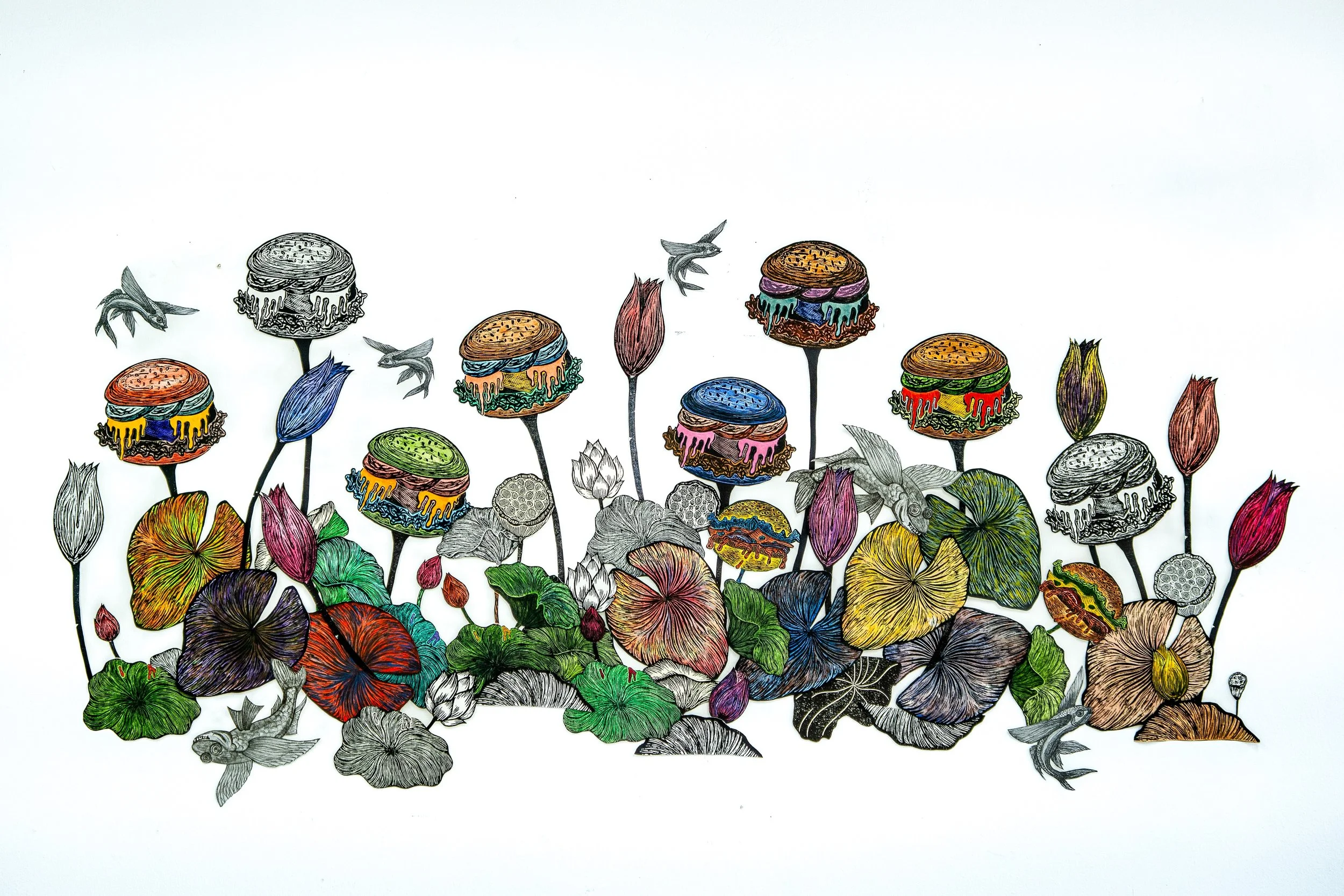
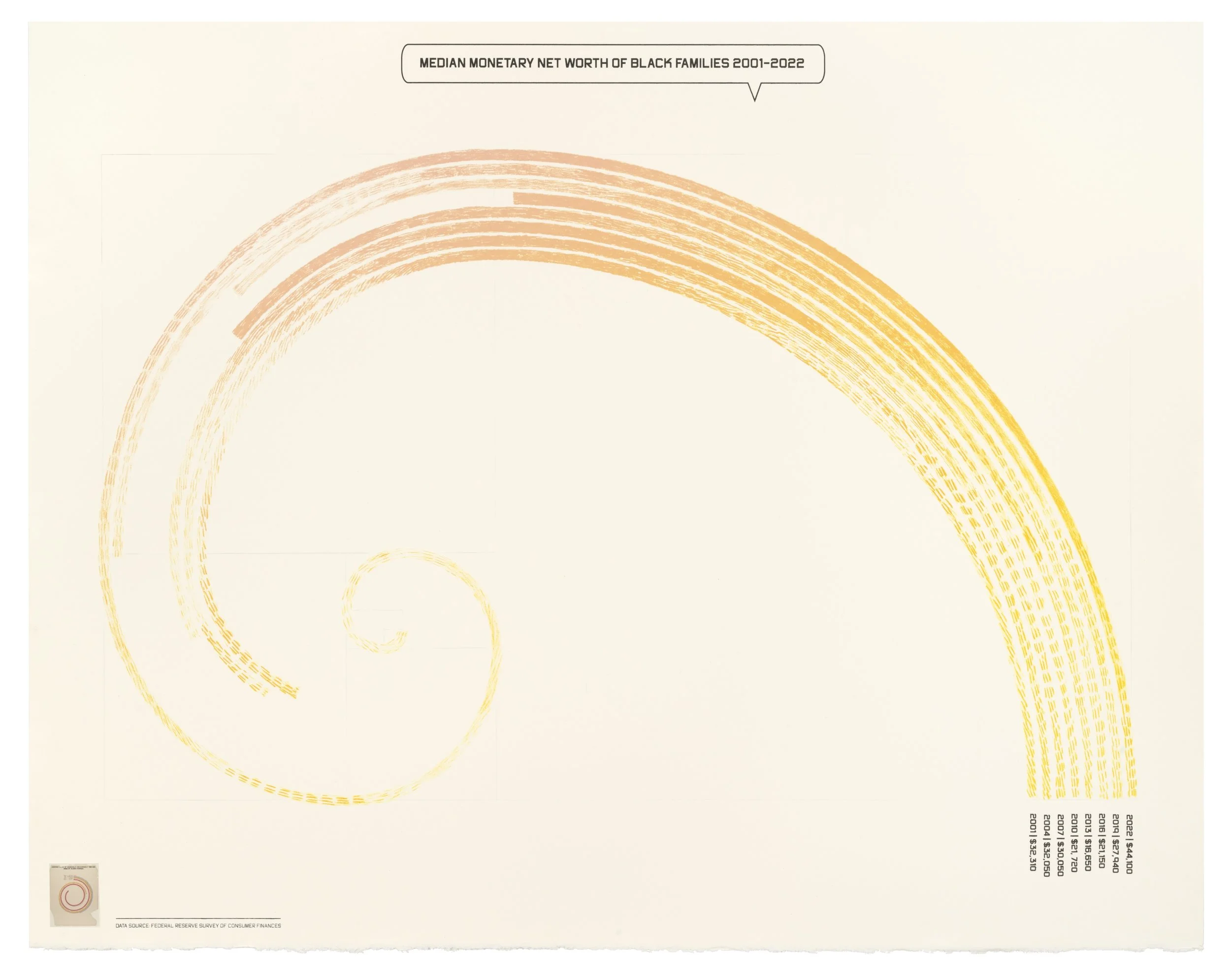
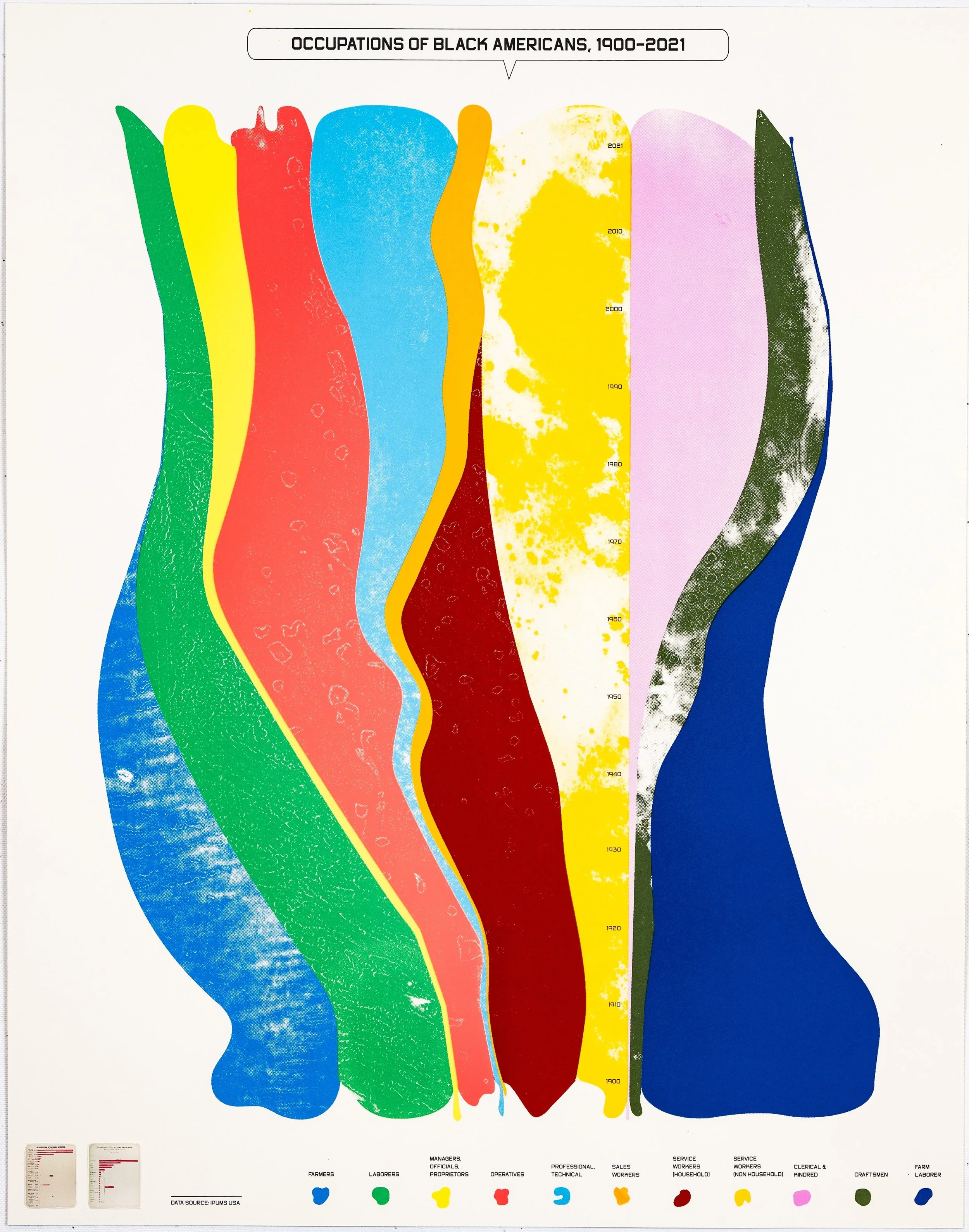
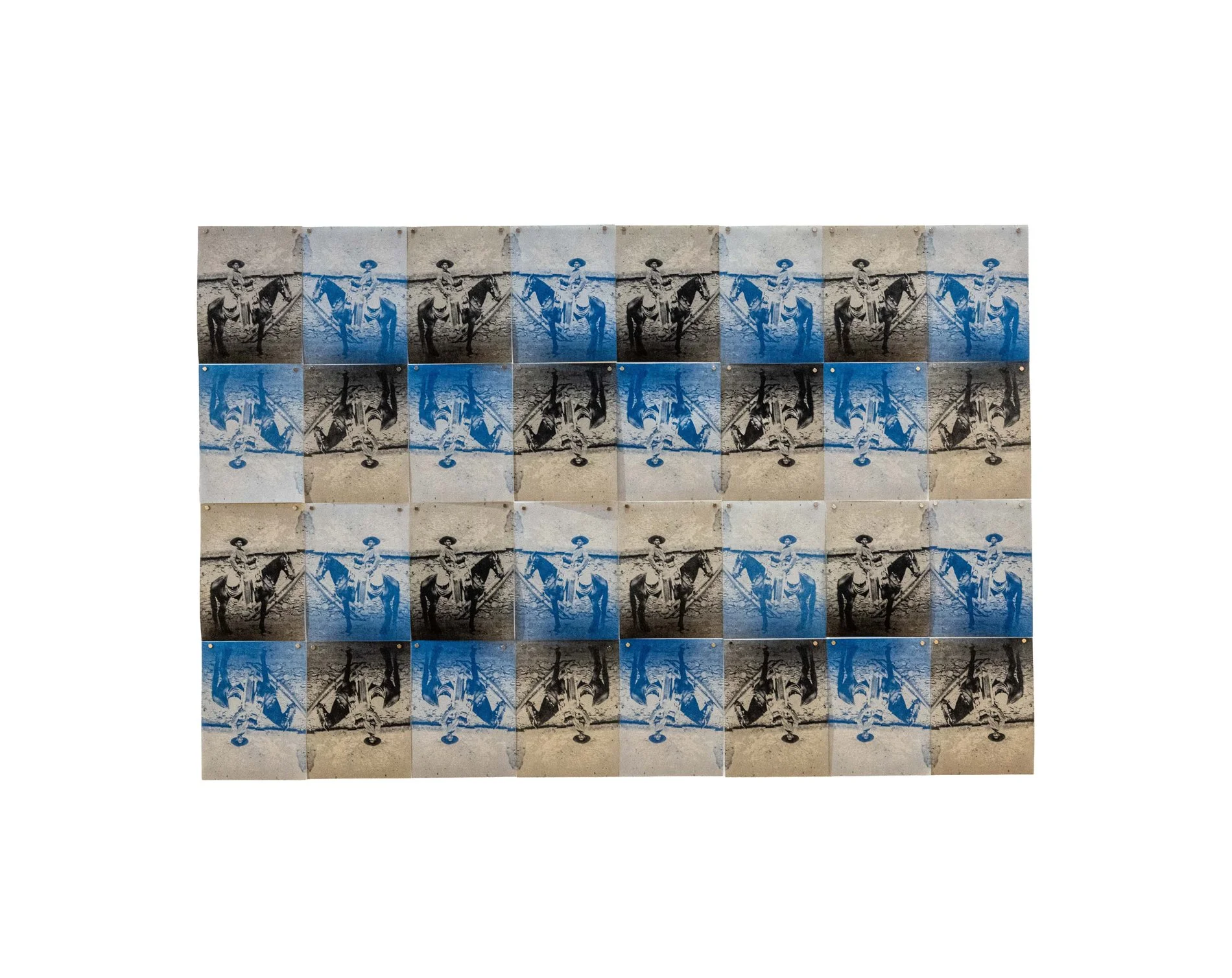
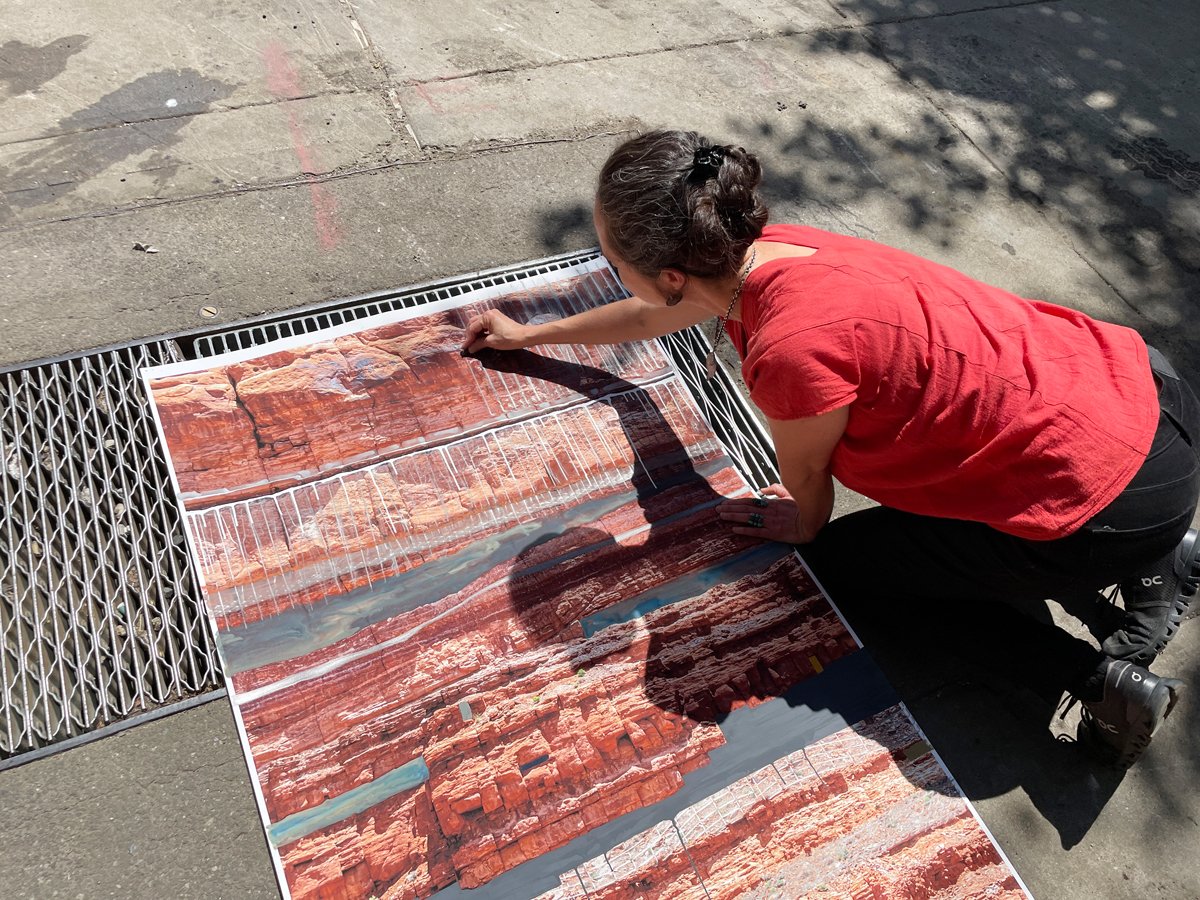
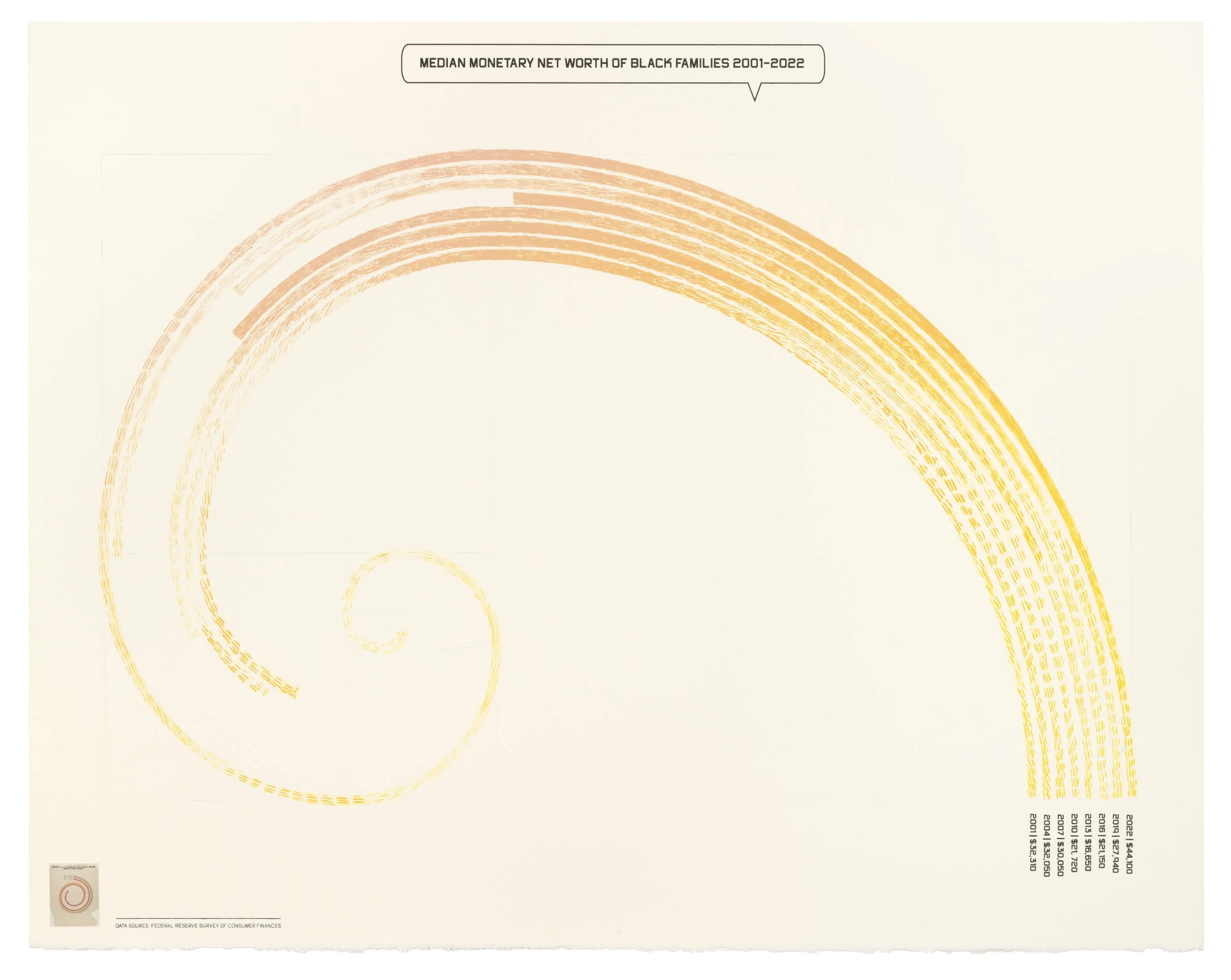
William Villalongo and Shraddha Ramani, Median Net Monetary Worth of Black Families 2001–2022, 2025. Lithograph and collage. 22 x 28 in. Edition of 20. Printed and published by Highpoint Editions, Minneapolis, MN. © Villalongo Studio LLC. Courtesy William Villalongo, Shraddha Ramani and Highpoint Editions, Minneapolis, MN.

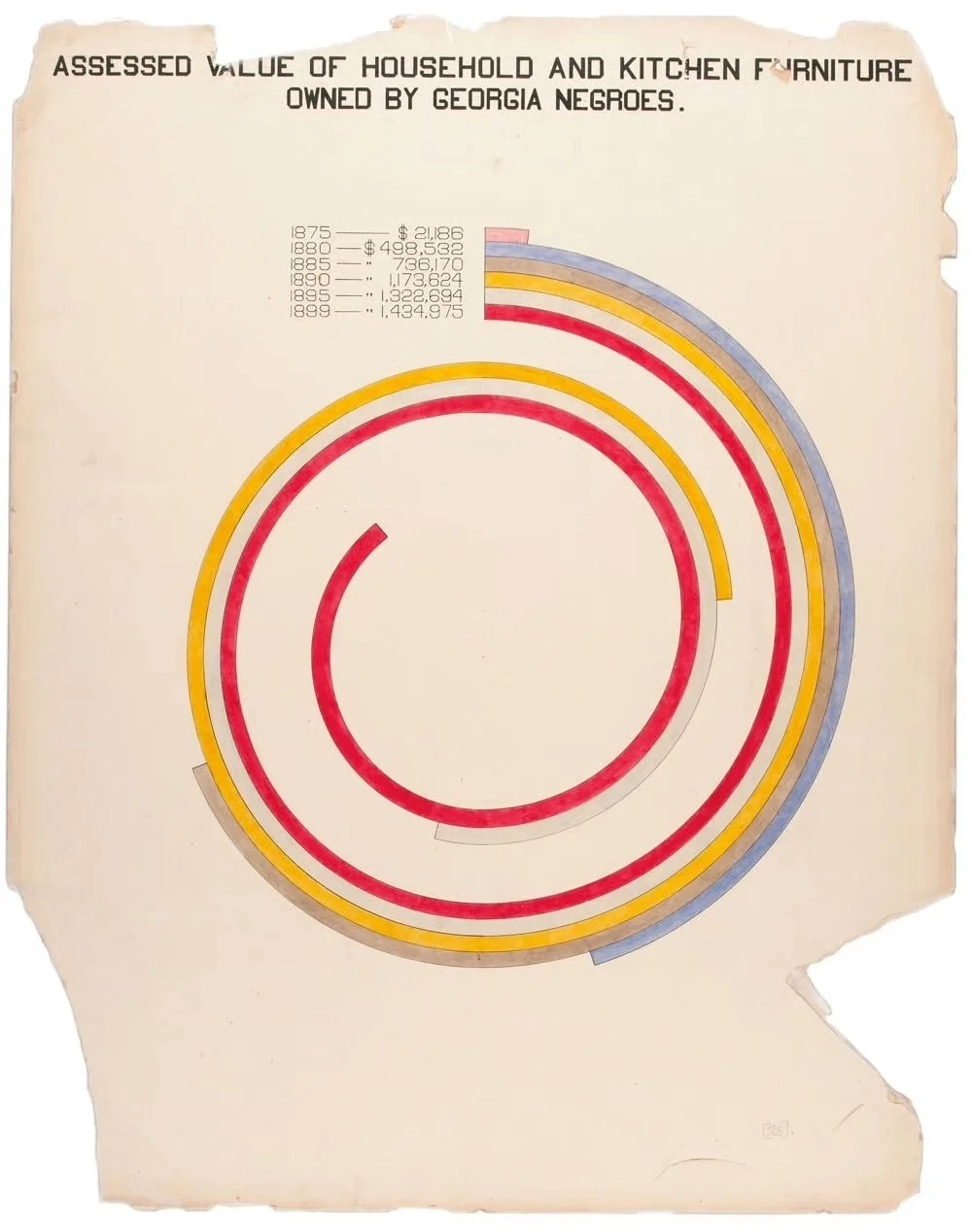
Assessed Value of Household and Kitchen Furniture Owned by Georgia Negroes. Image courtesy of the Library of Congress, Prints & Photographs Division, LC-DIG-ppmsca-33887. Inspiration for the print above.

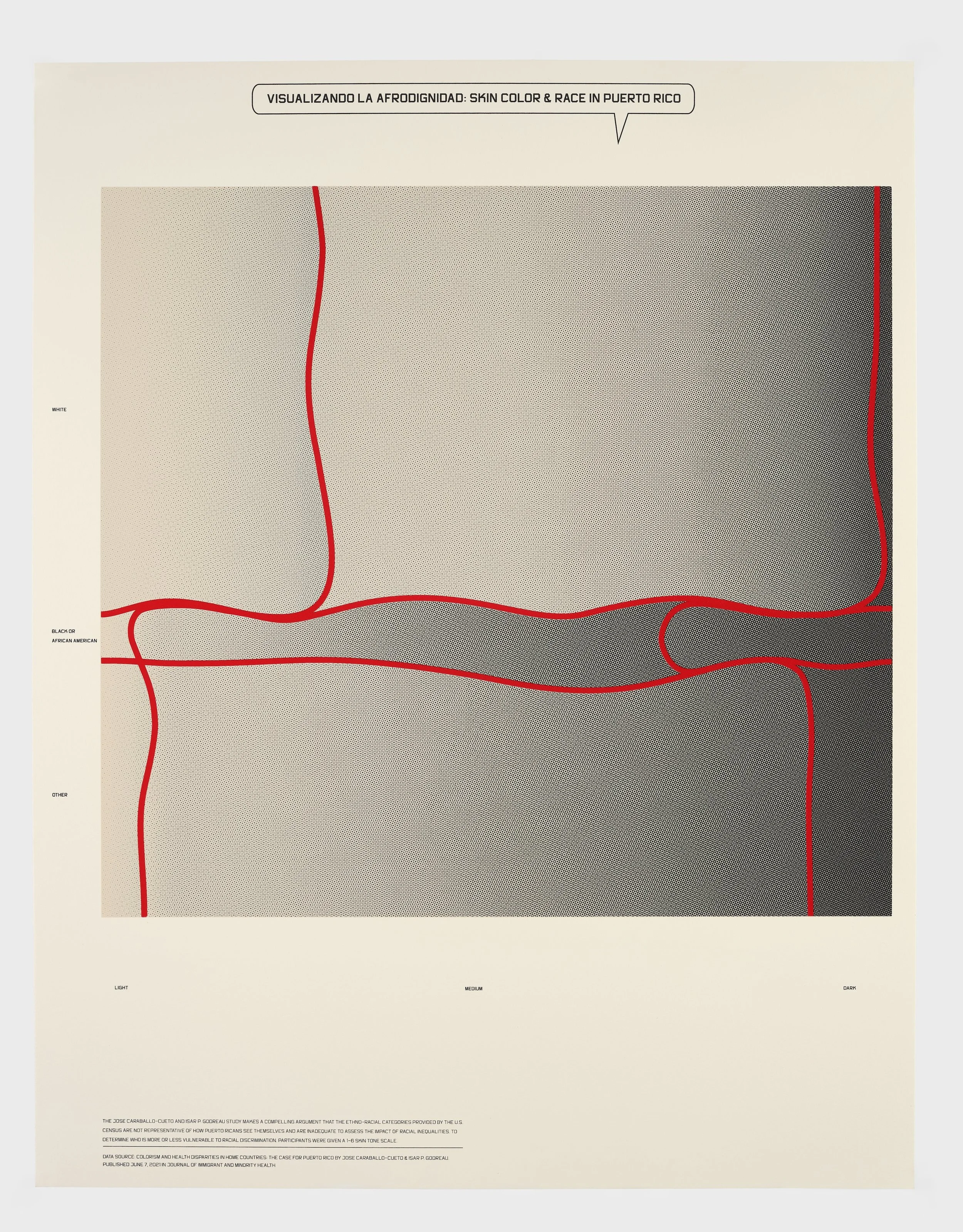
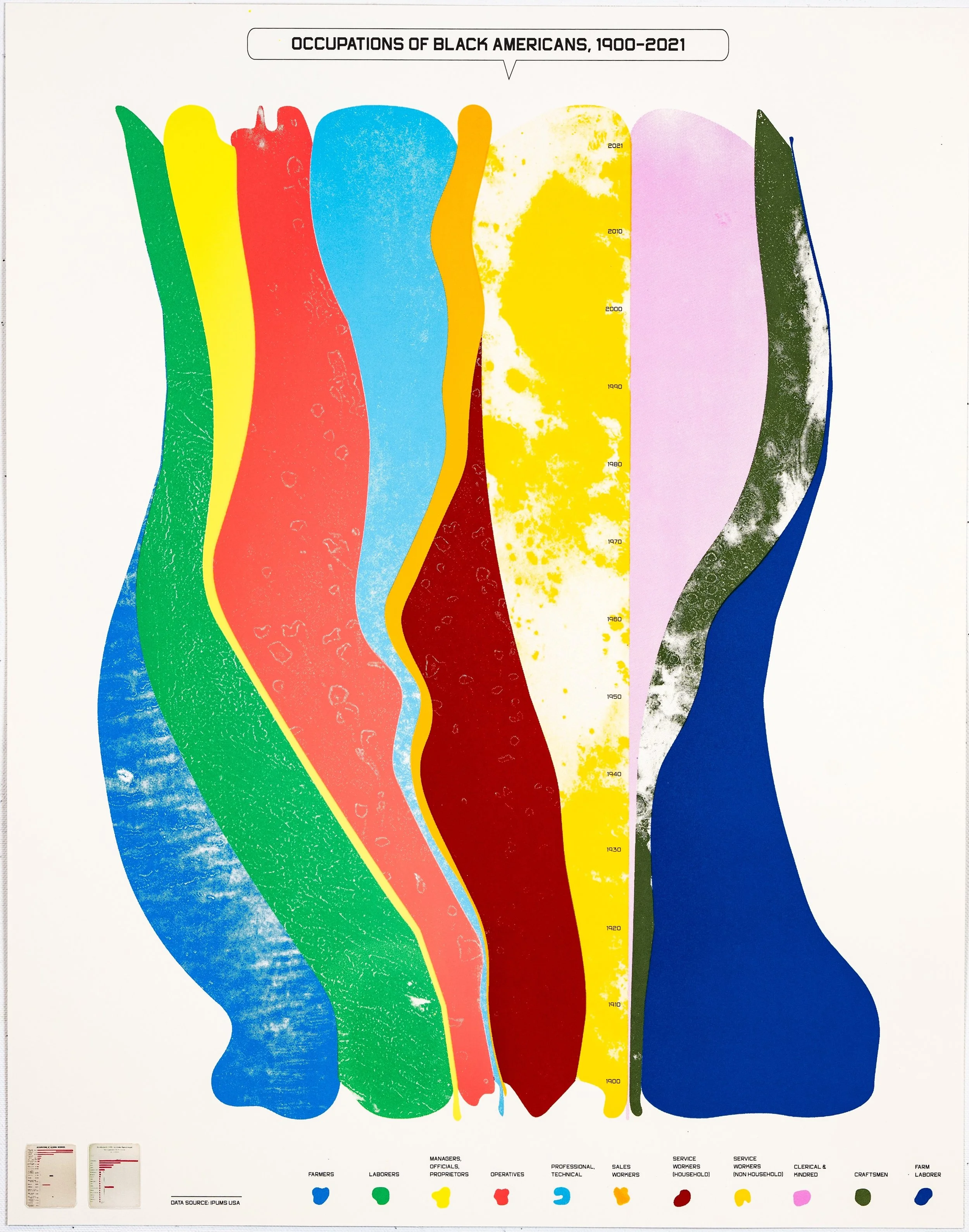
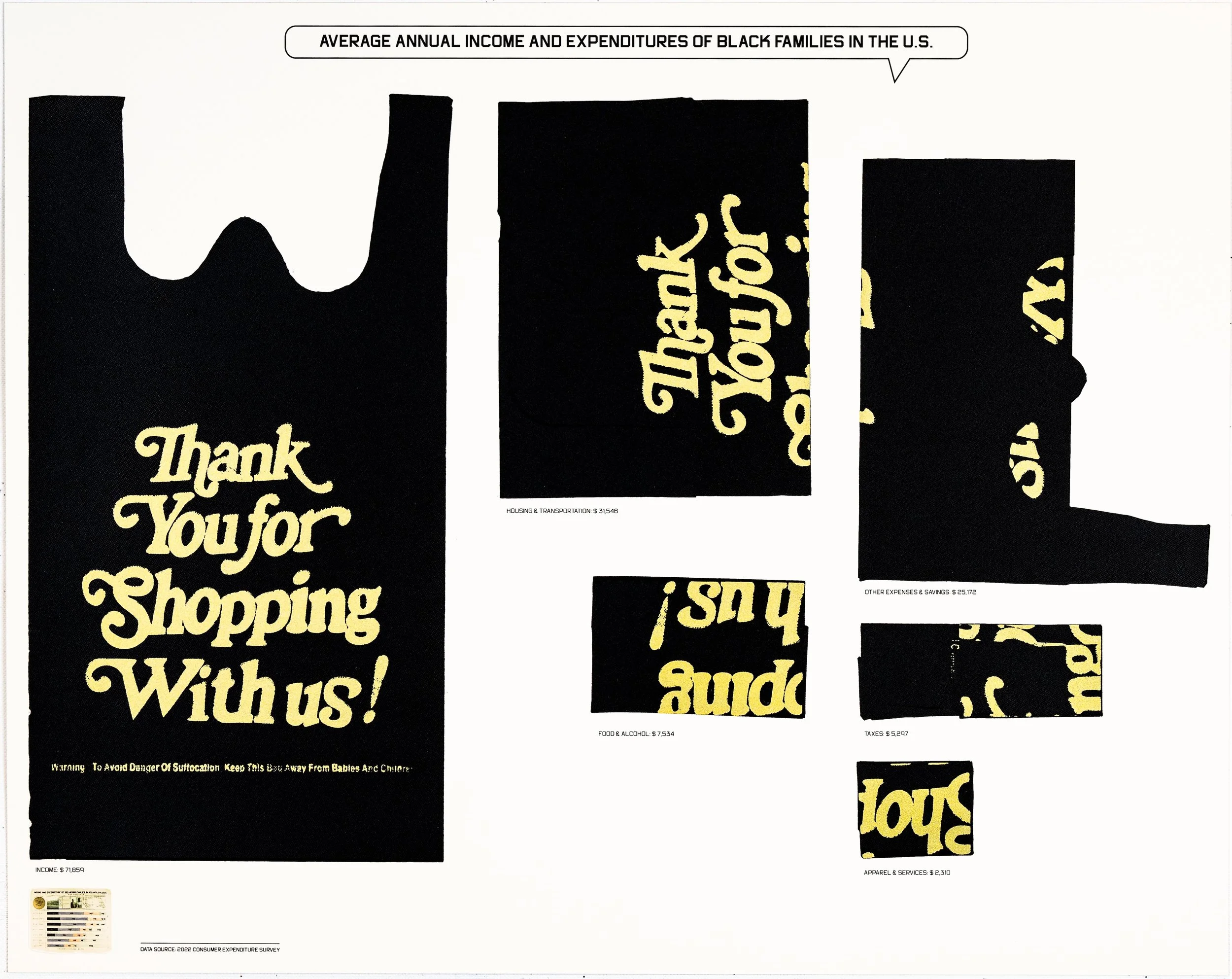
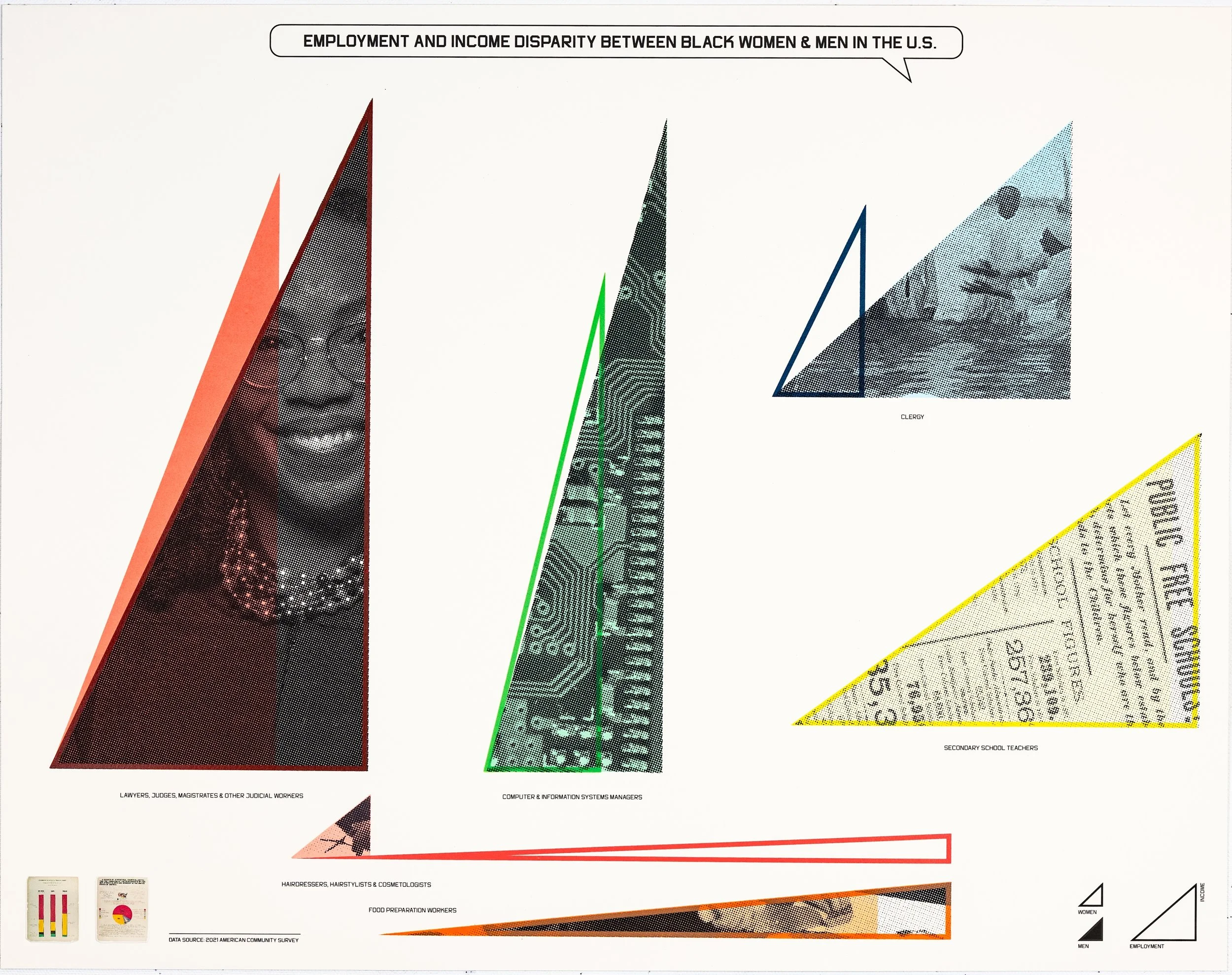
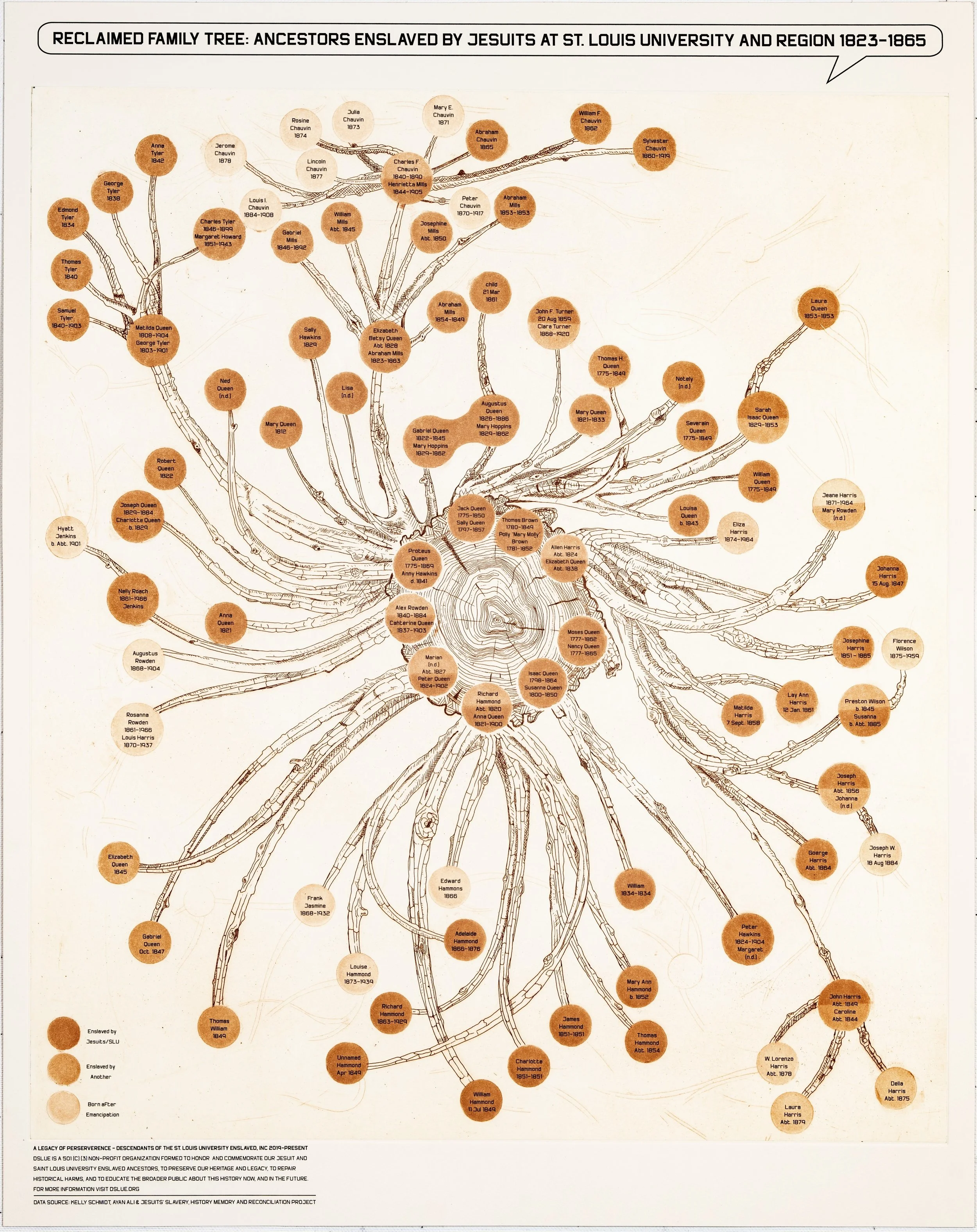
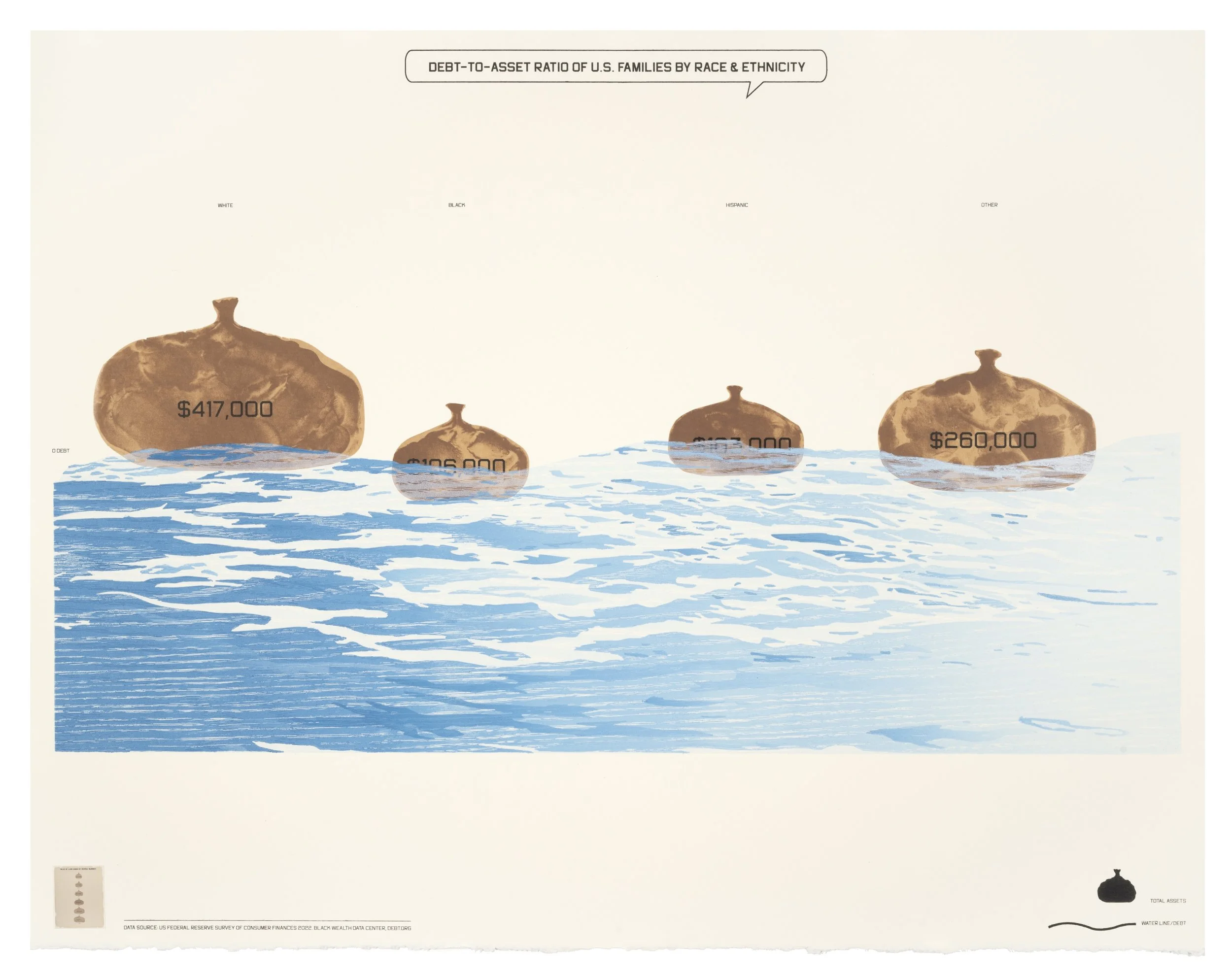
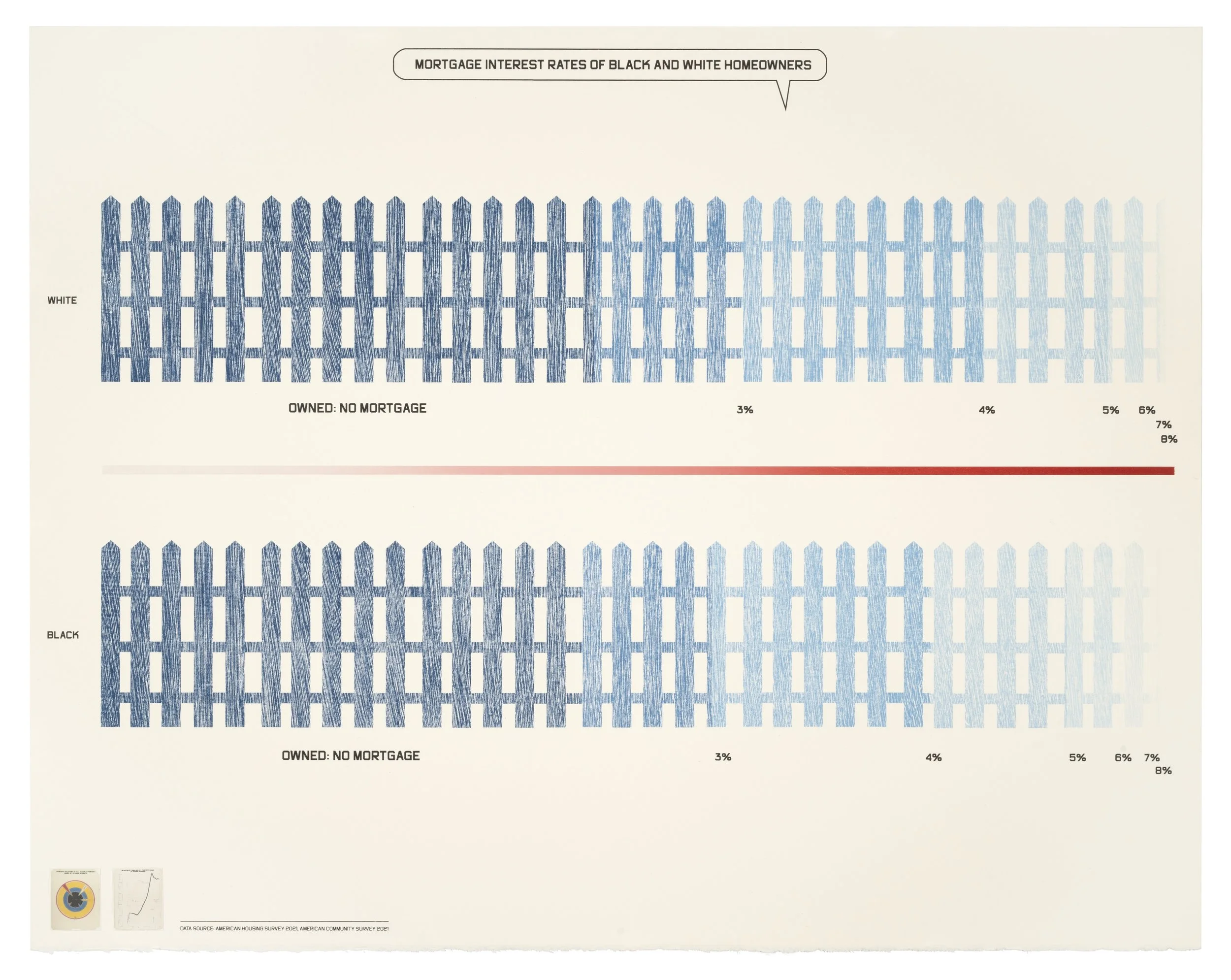
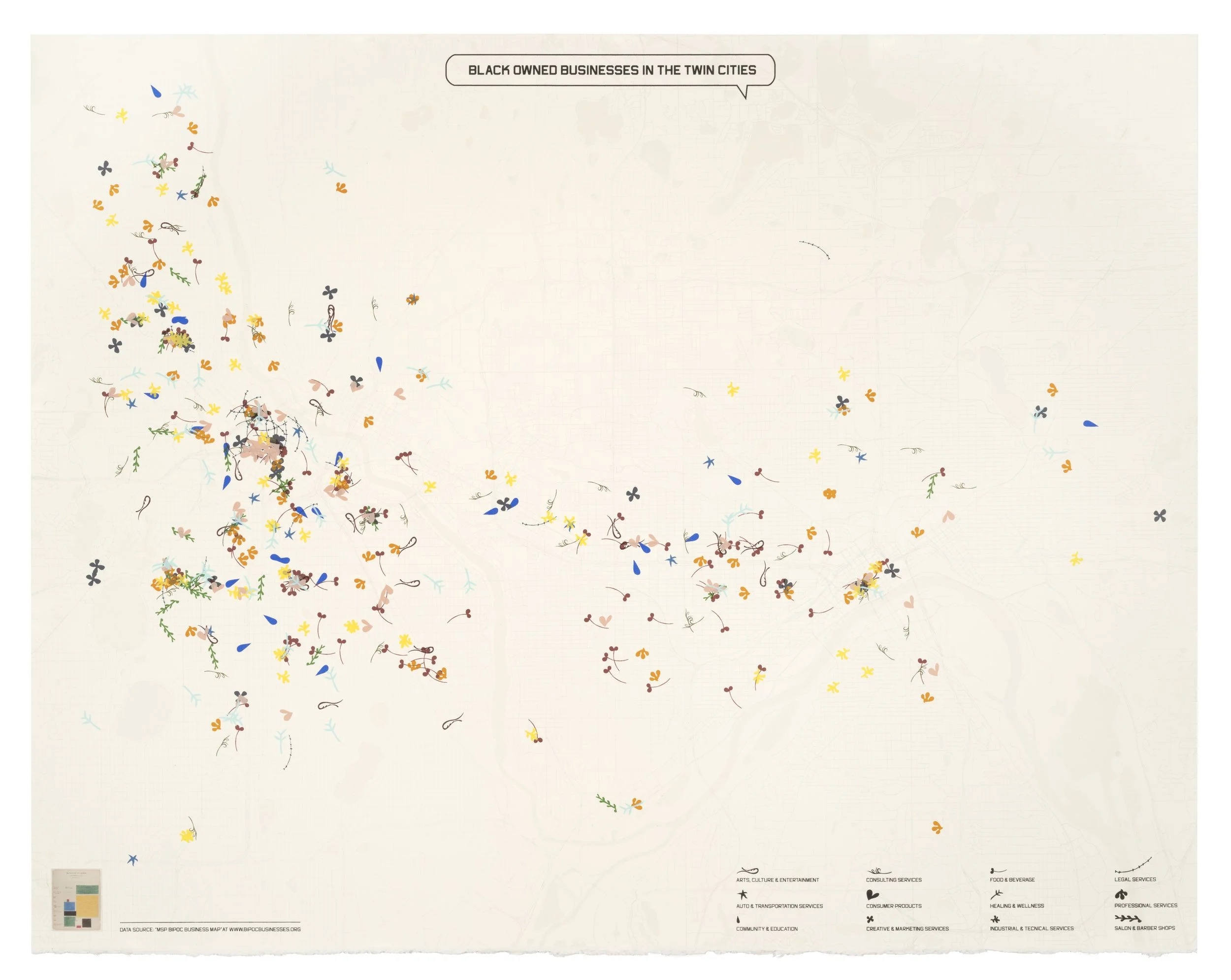
In 1900, W.E.B. Du Bois organized a series of infographics on the progress of Black peoples after Emancipation, to be displayed as part of the American Negro Exhibit in the 1900 Paris Exposition world's fair. Using the still-developing field of data visualization, the American Negro Exhibit worked to upend the conceit of Western superiority and inevitable "progress" of industrialization by rendering in stark relief the dynamic participation of Black peoples in American social and economic life, and their global participation in science, literature, and art.

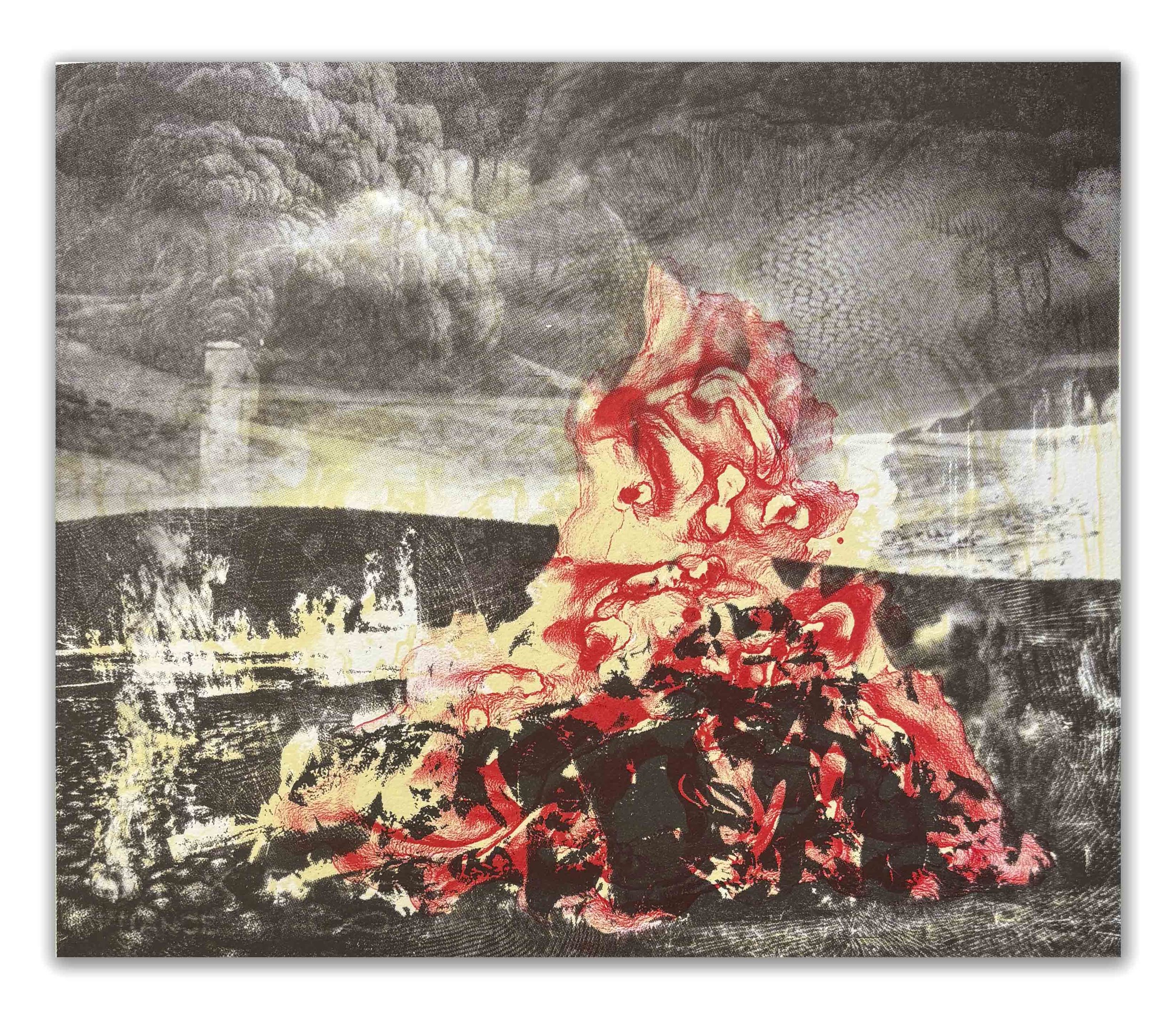
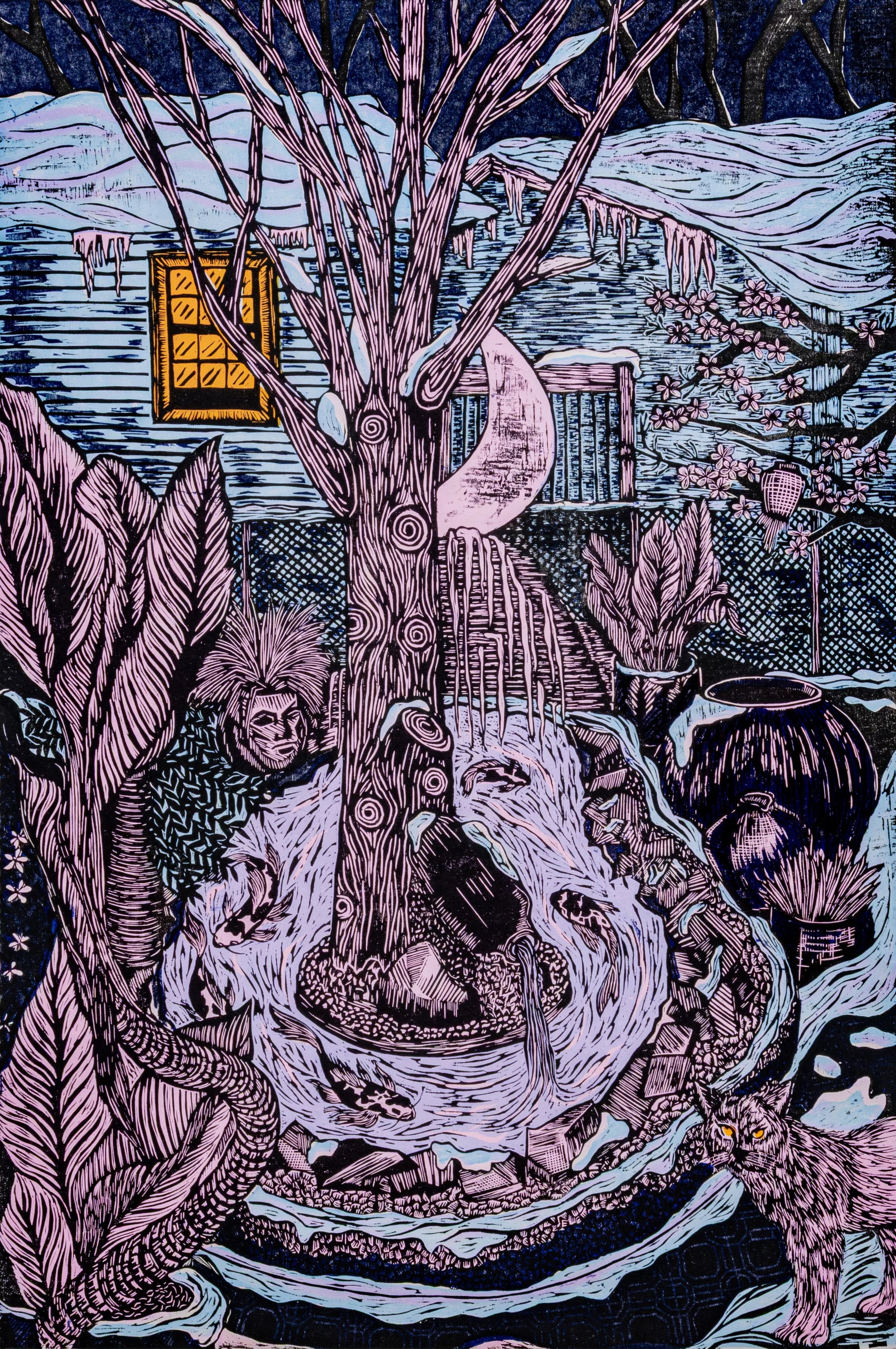
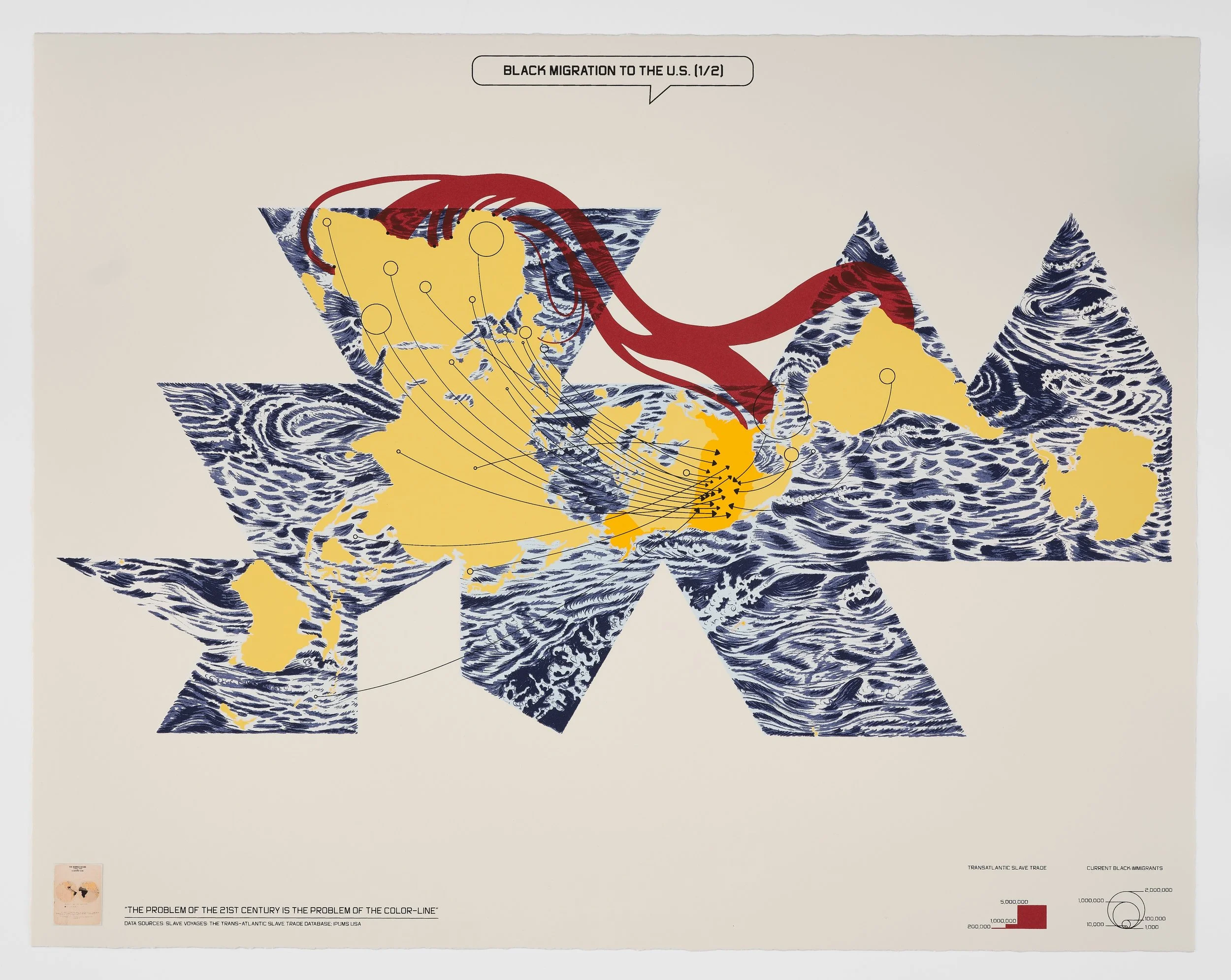
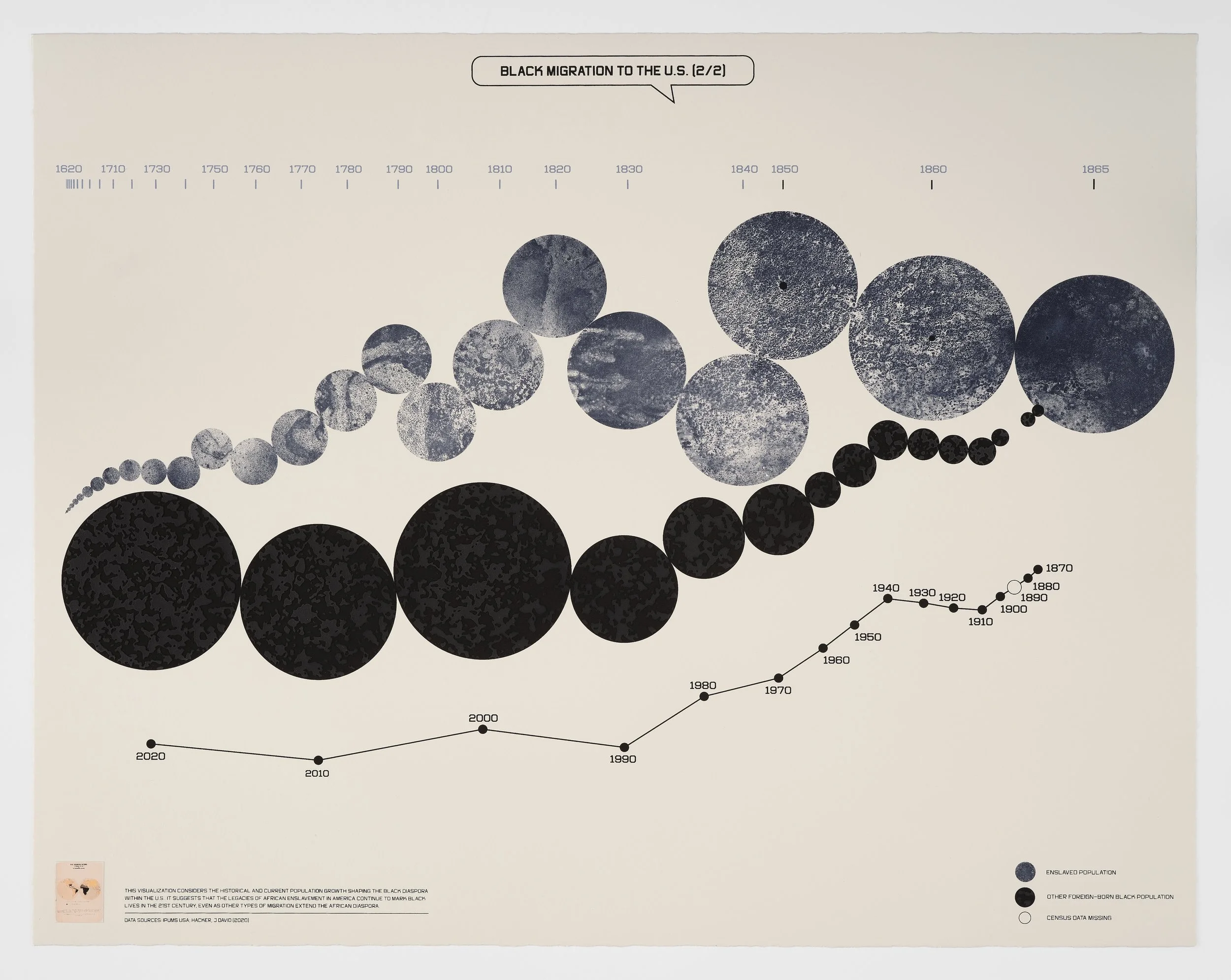
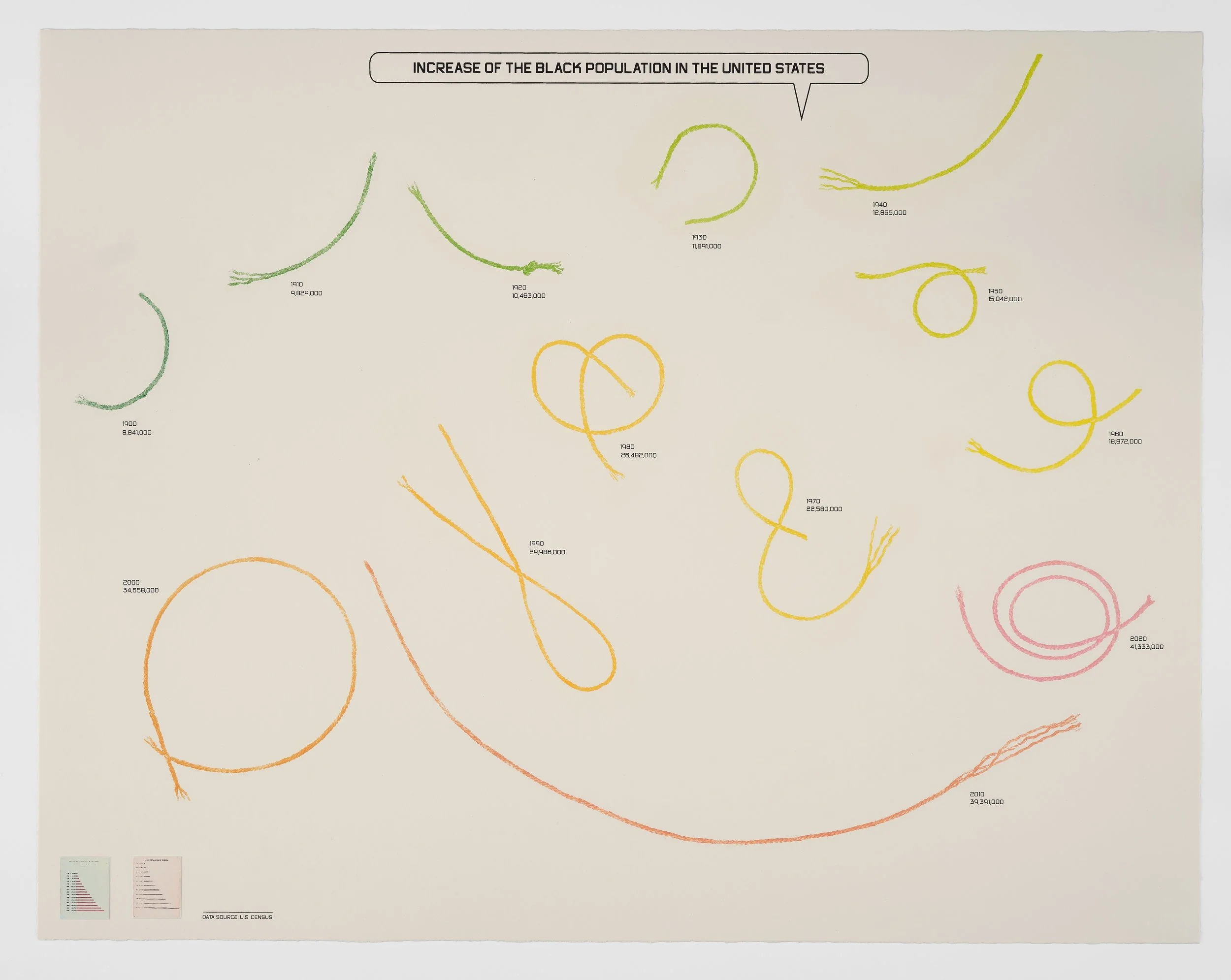
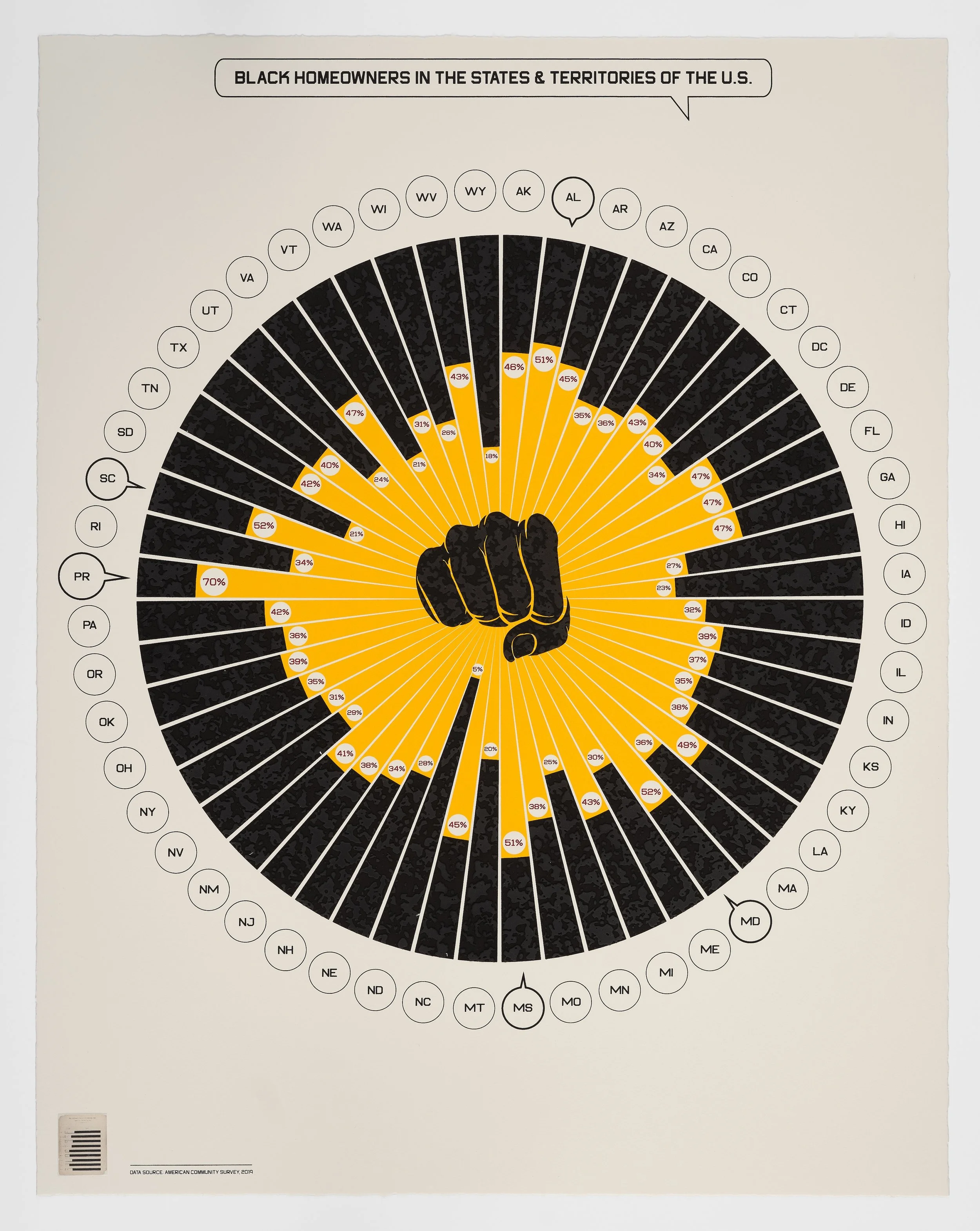
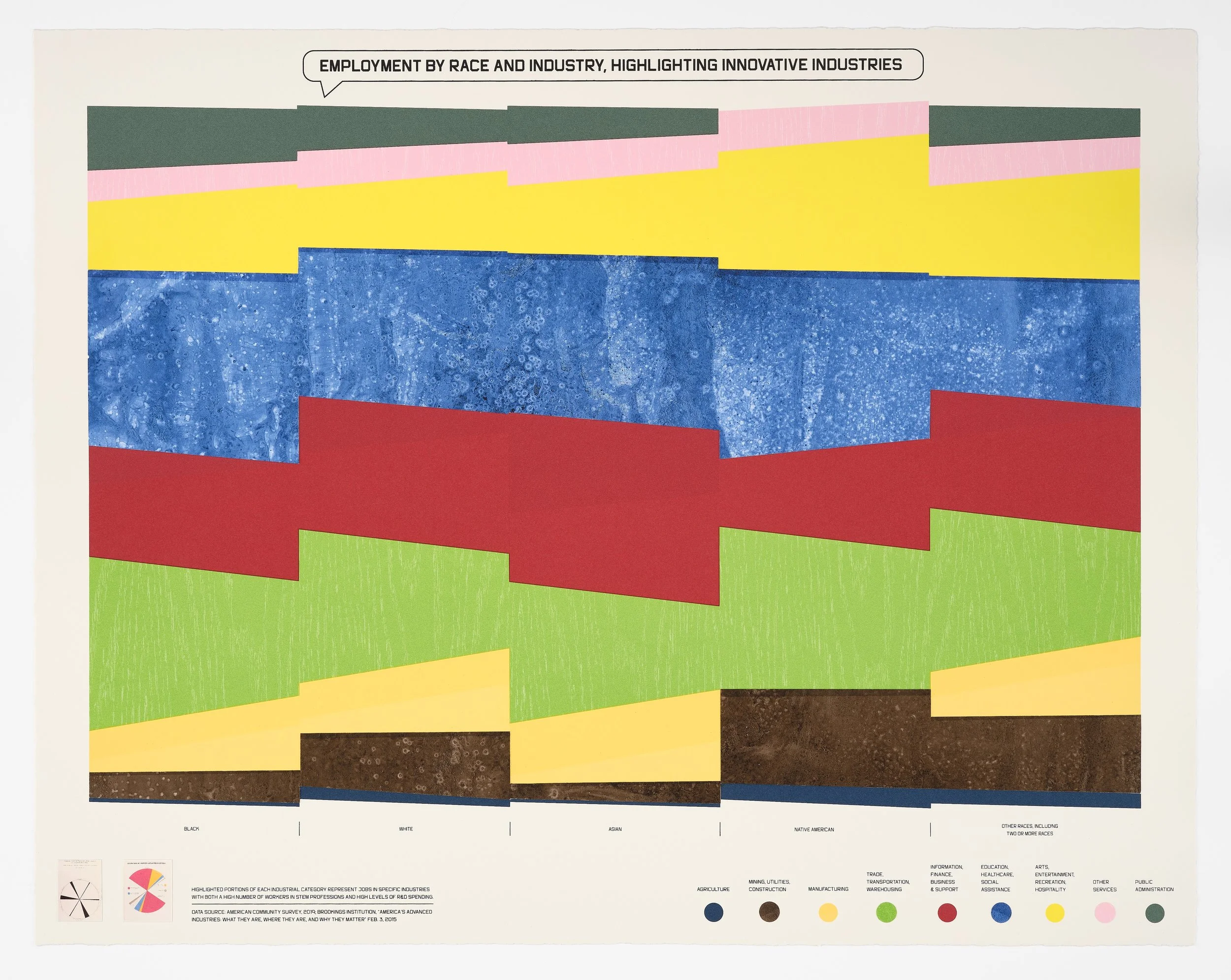
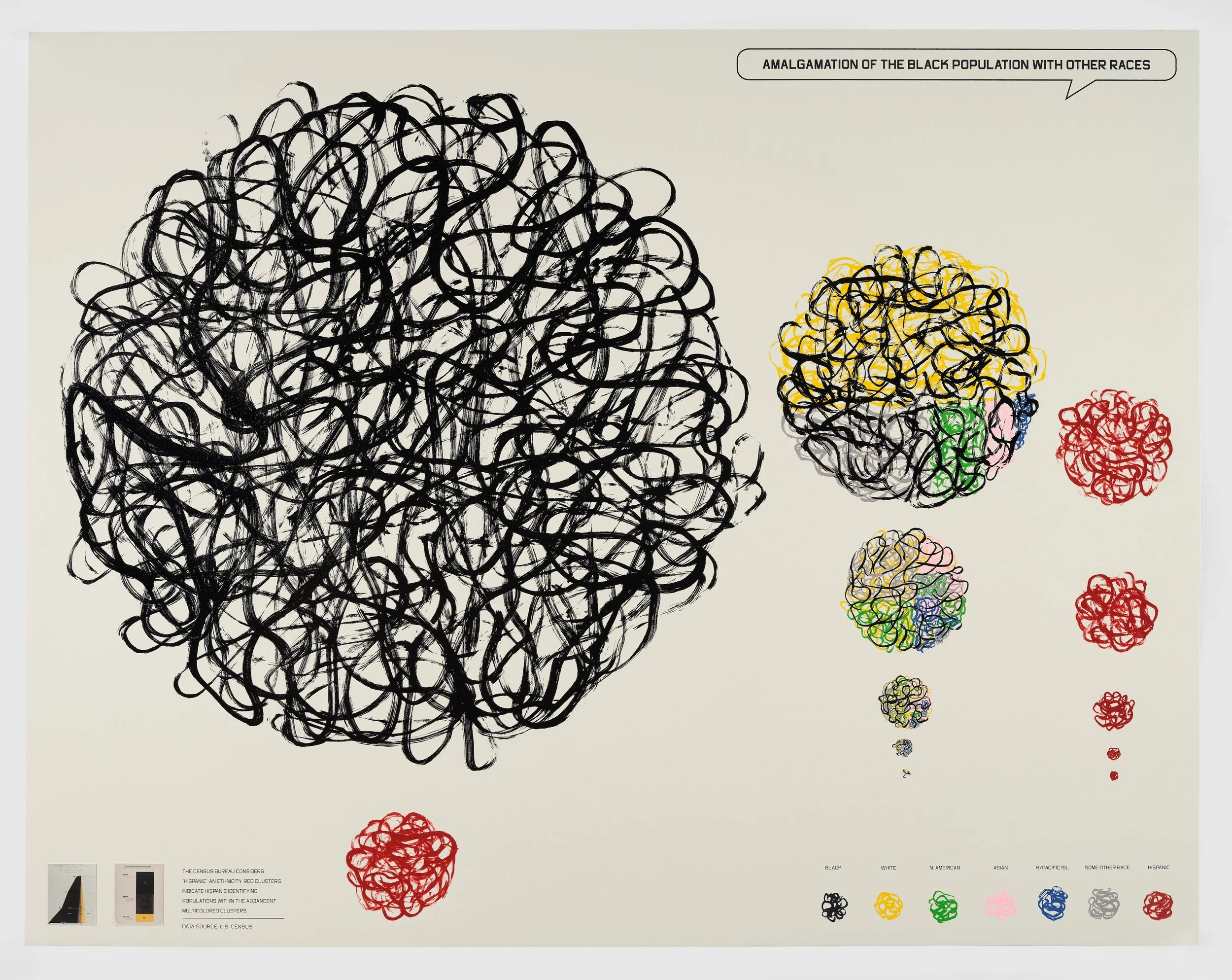
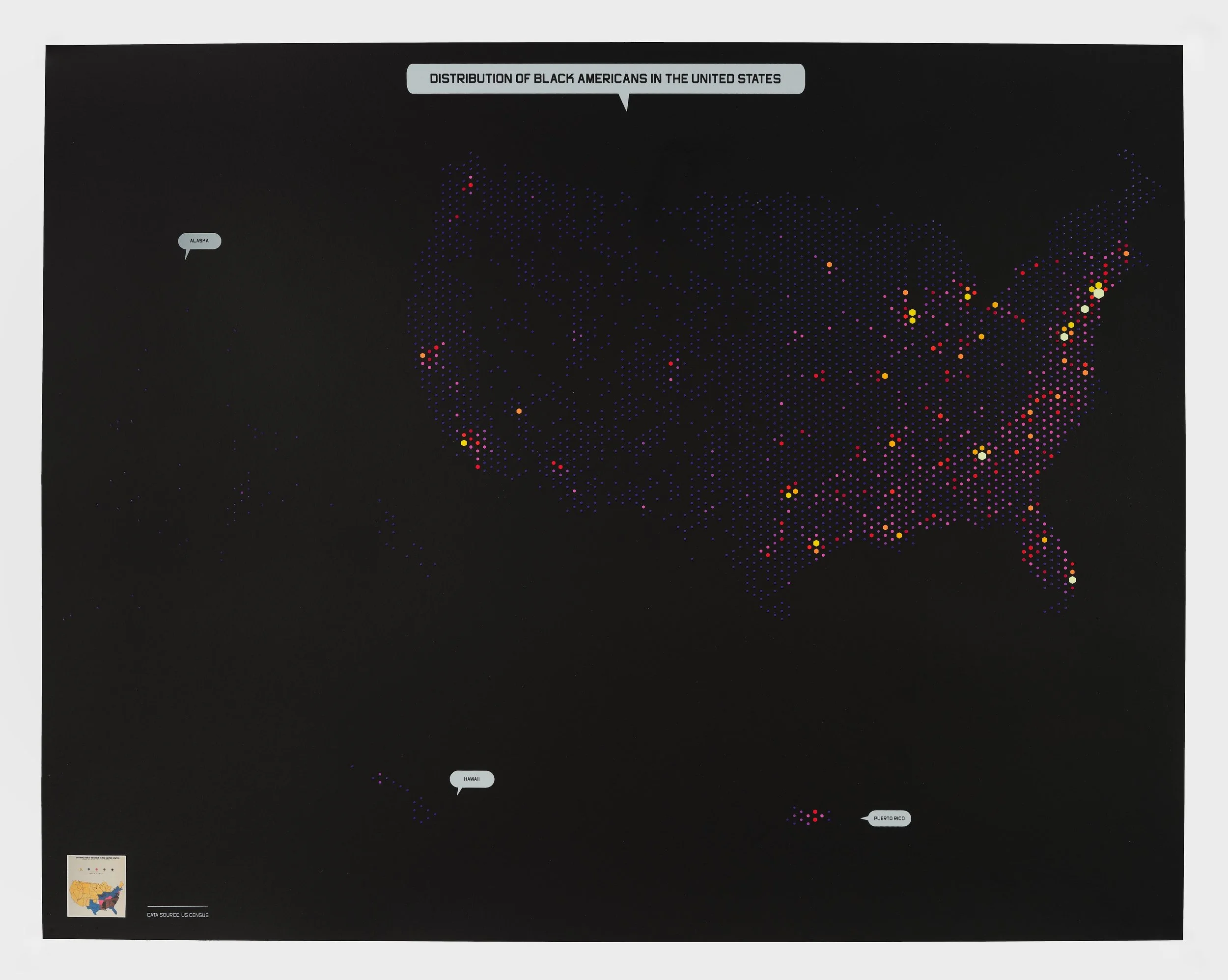
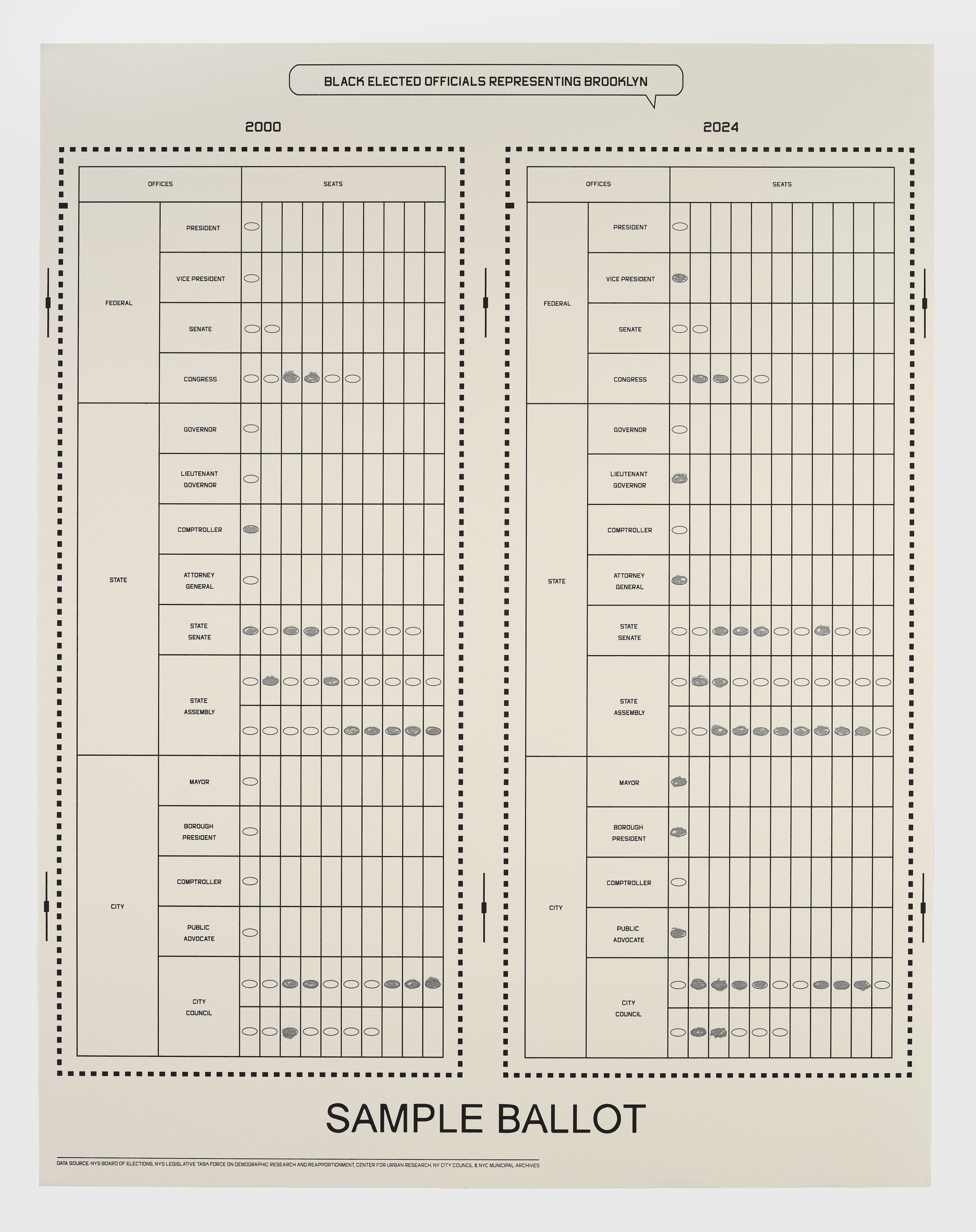
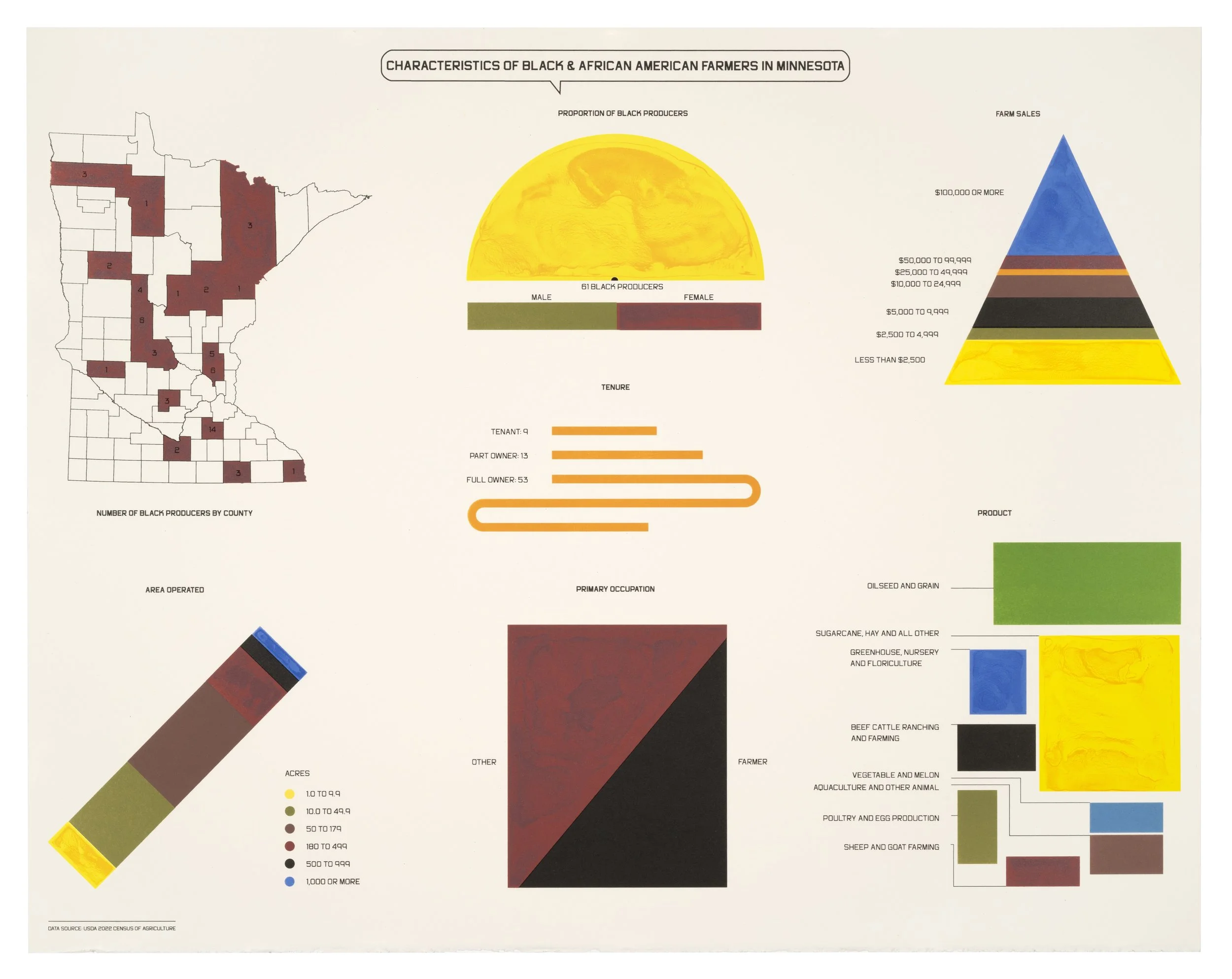
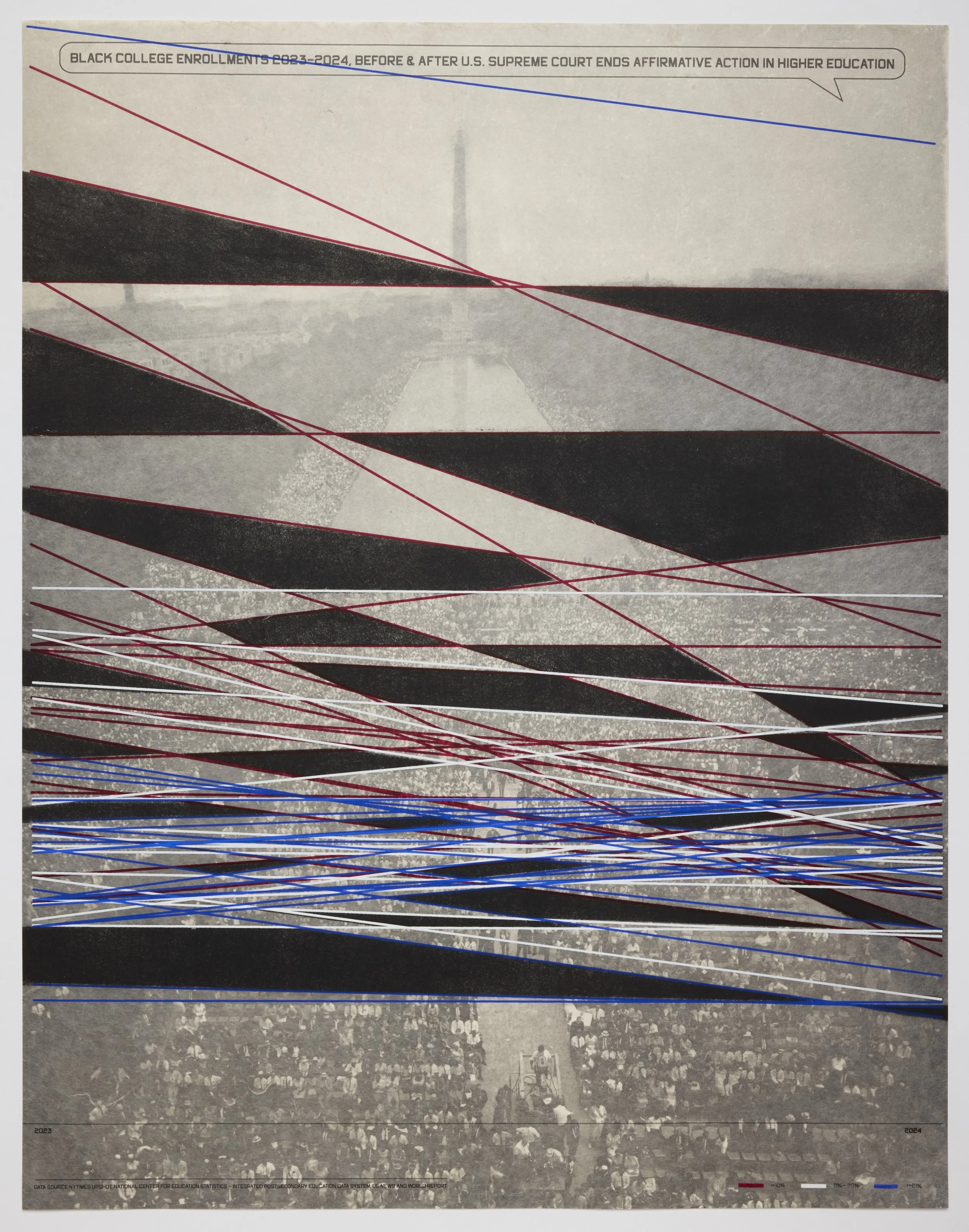
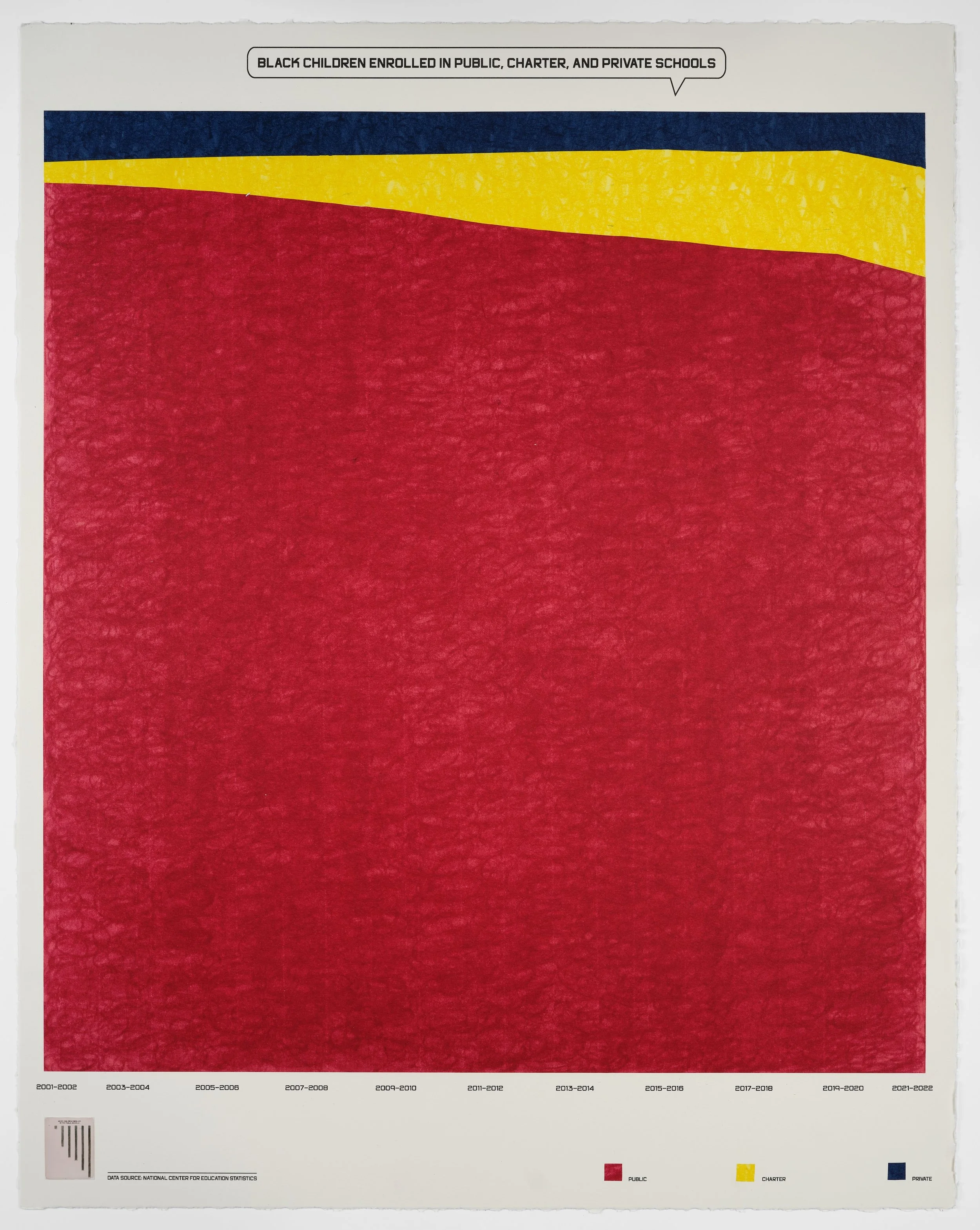
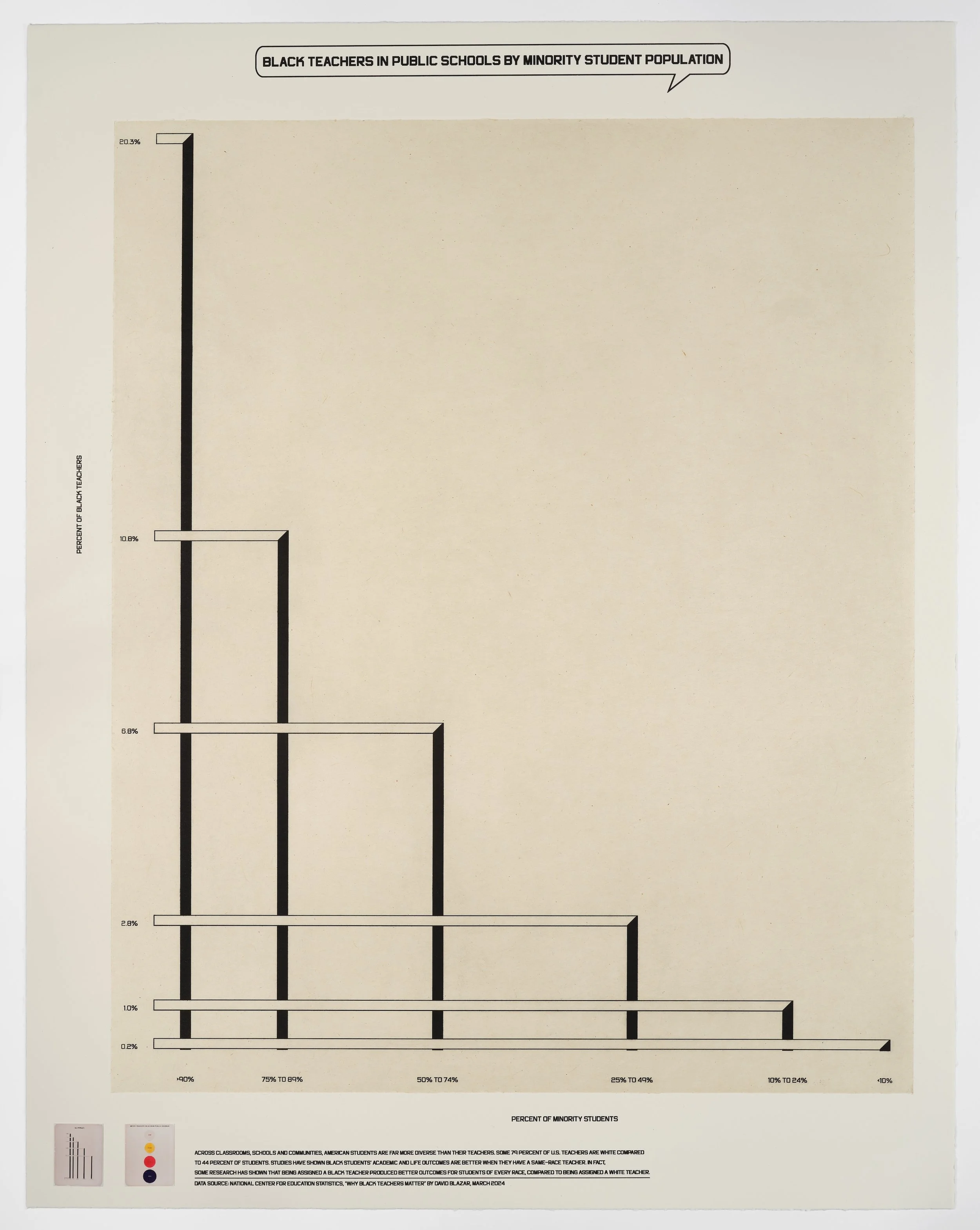
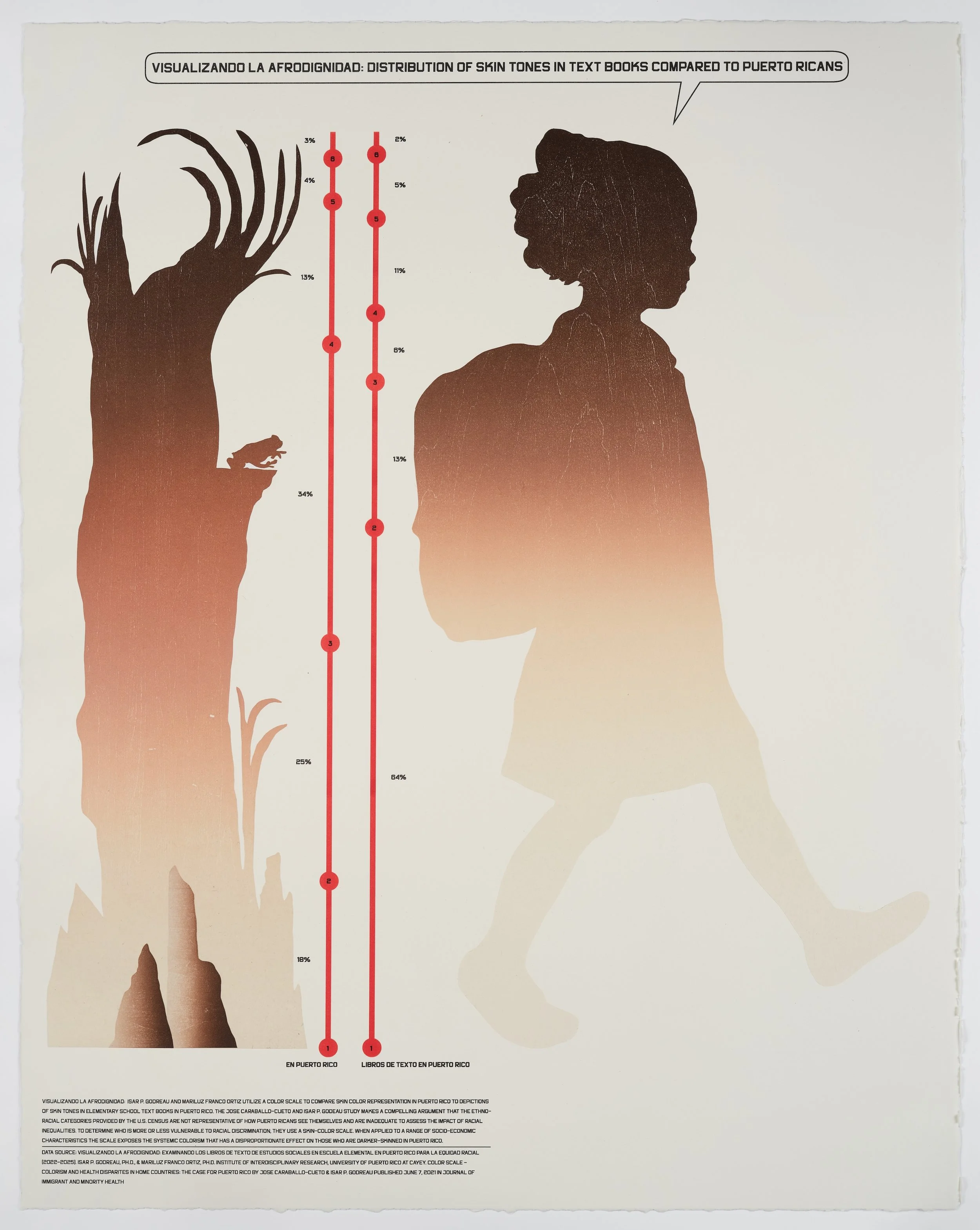
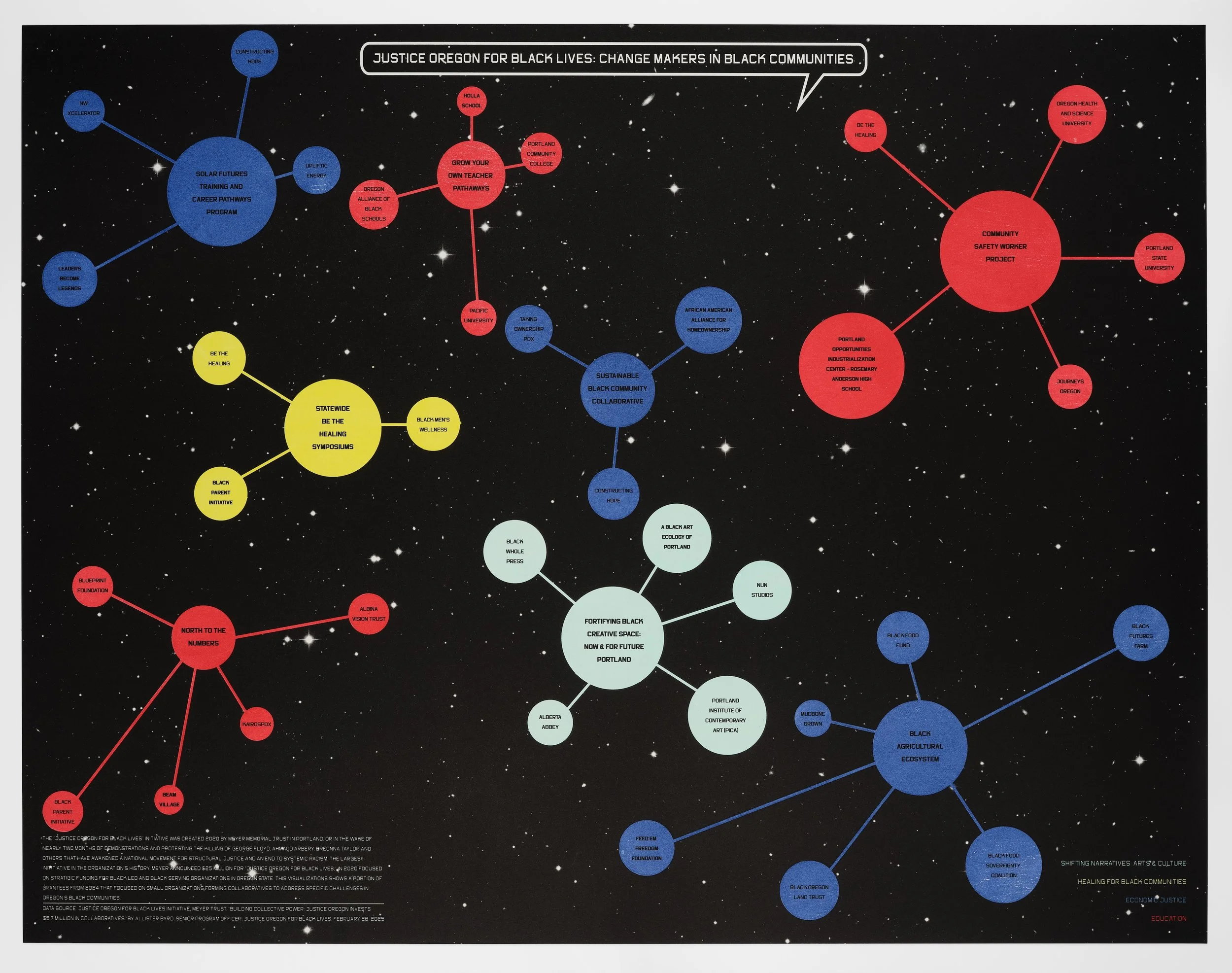
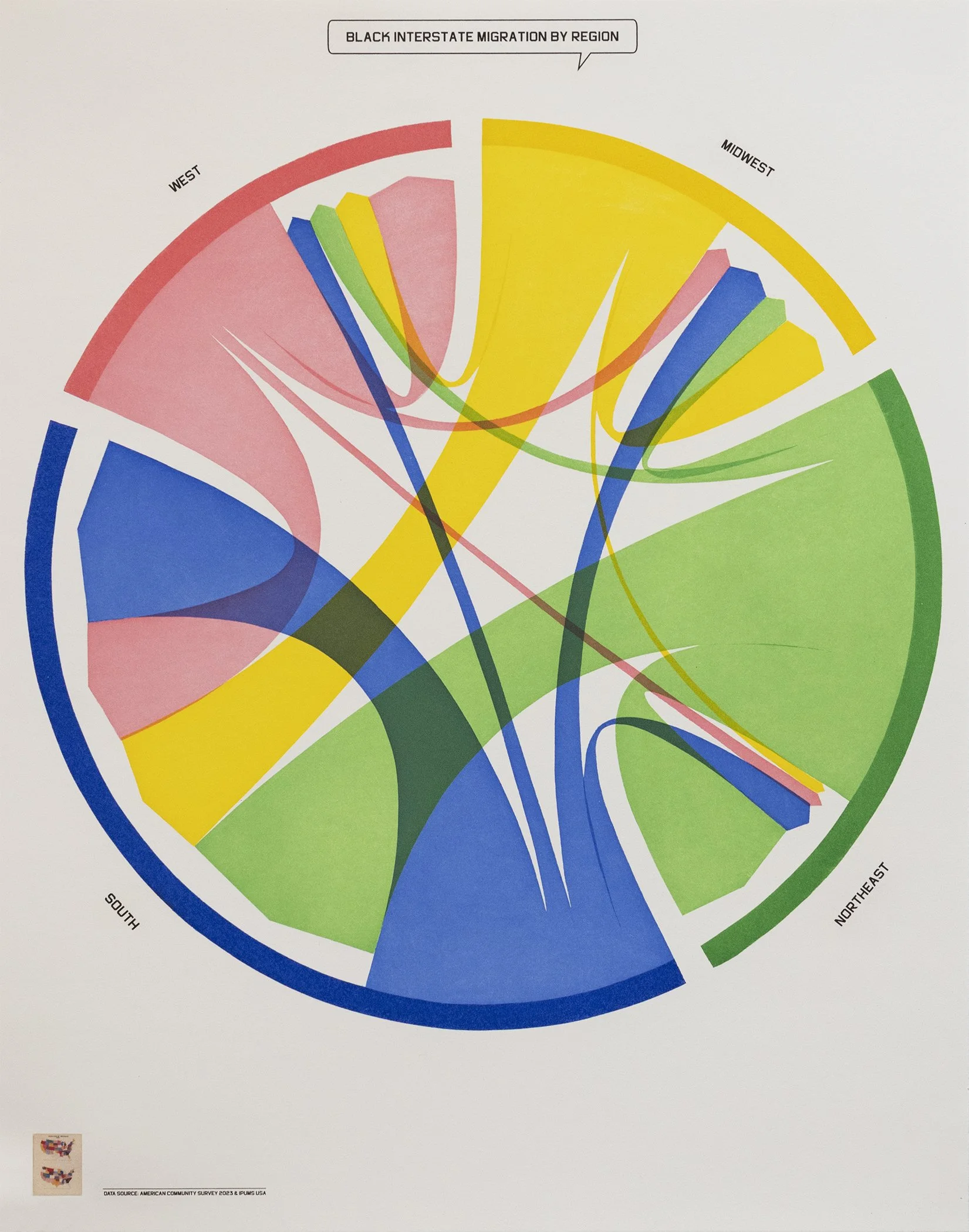
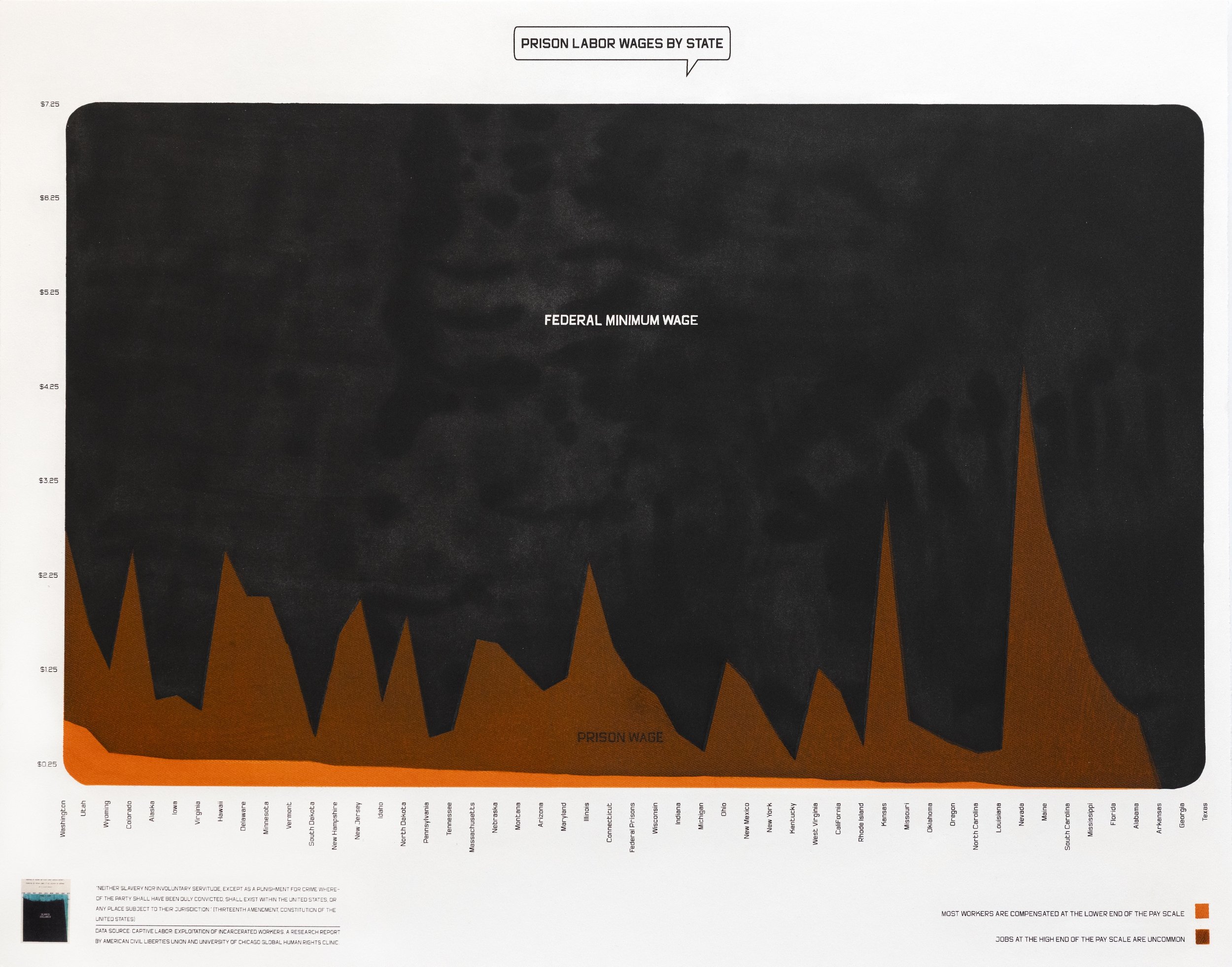
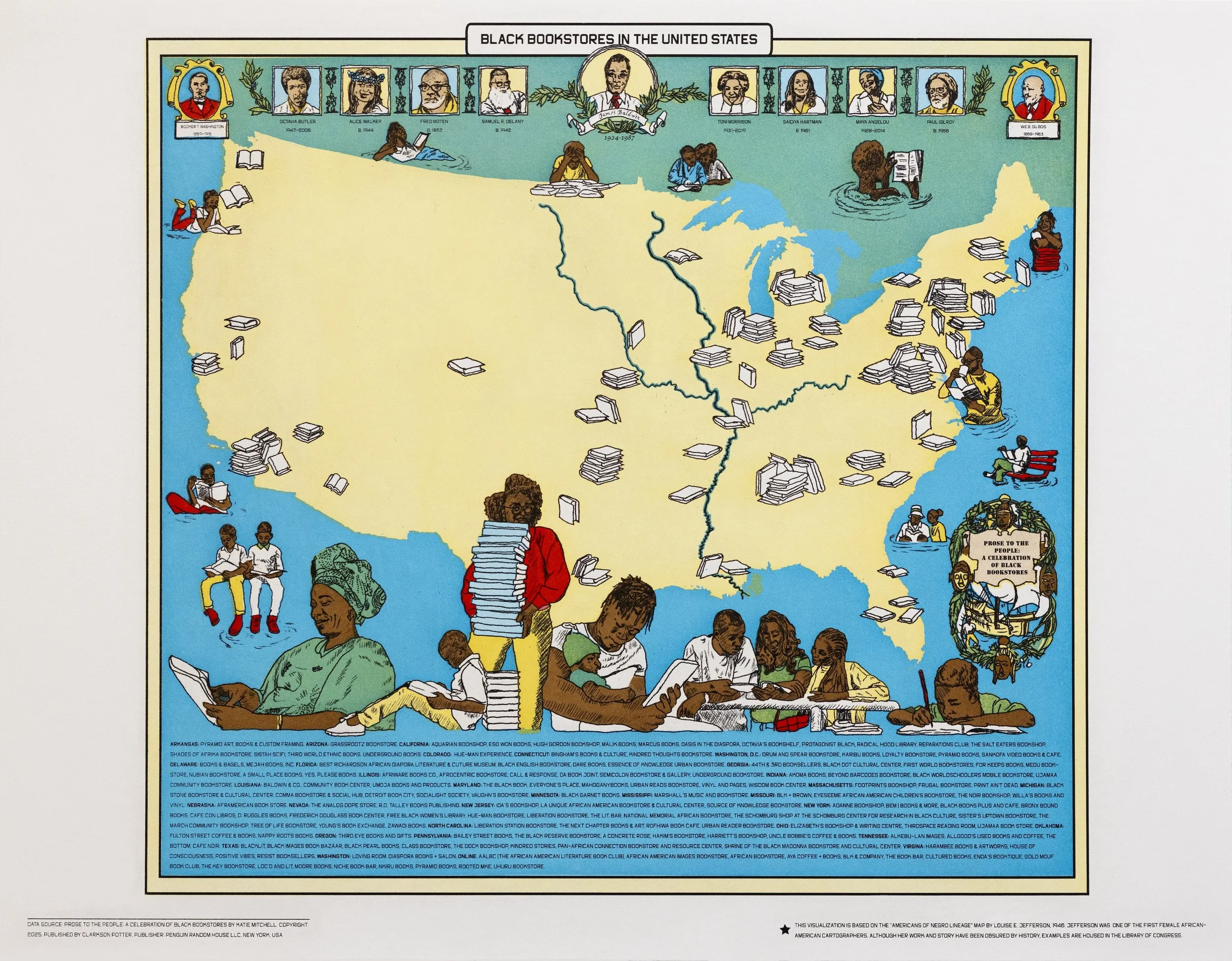
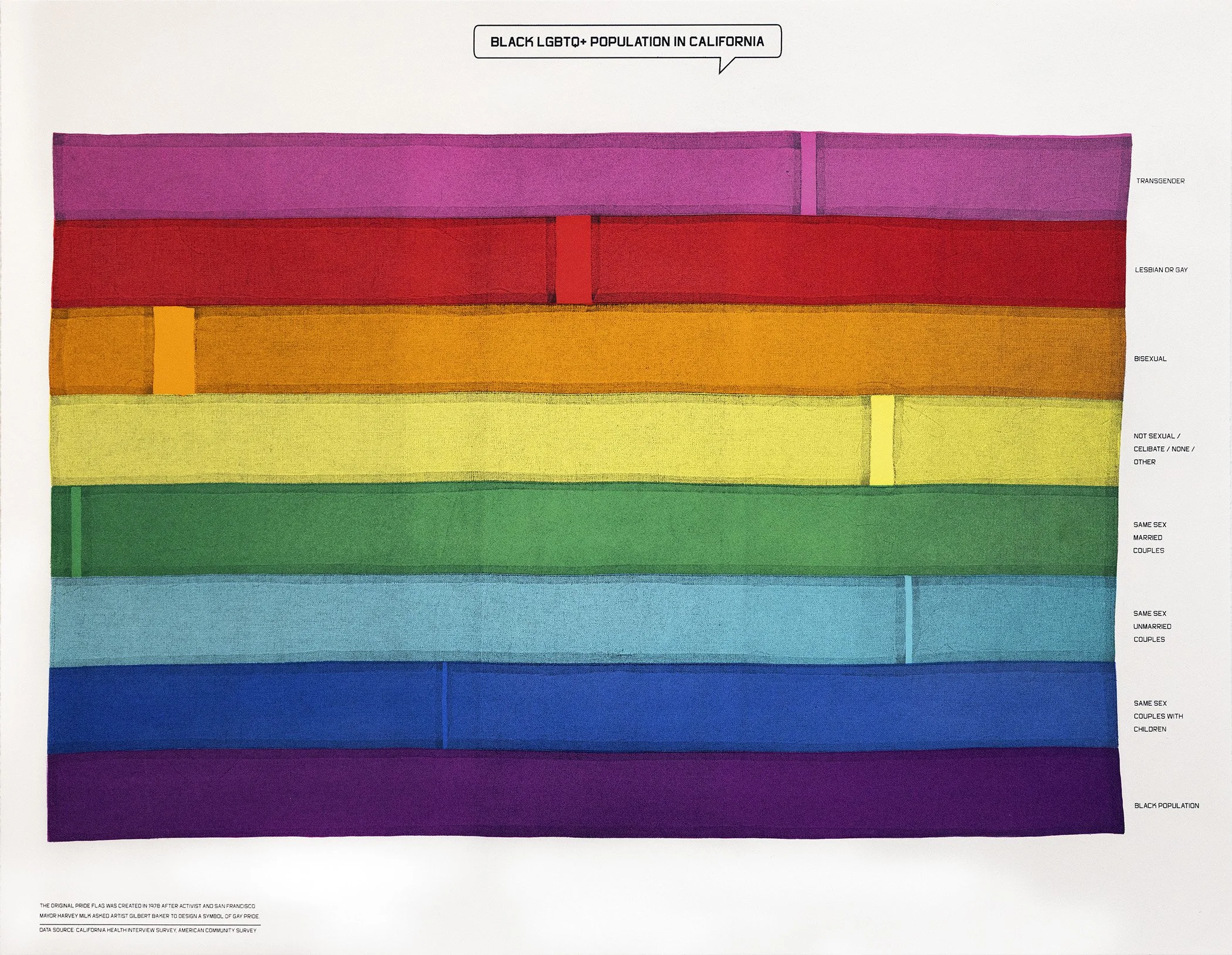
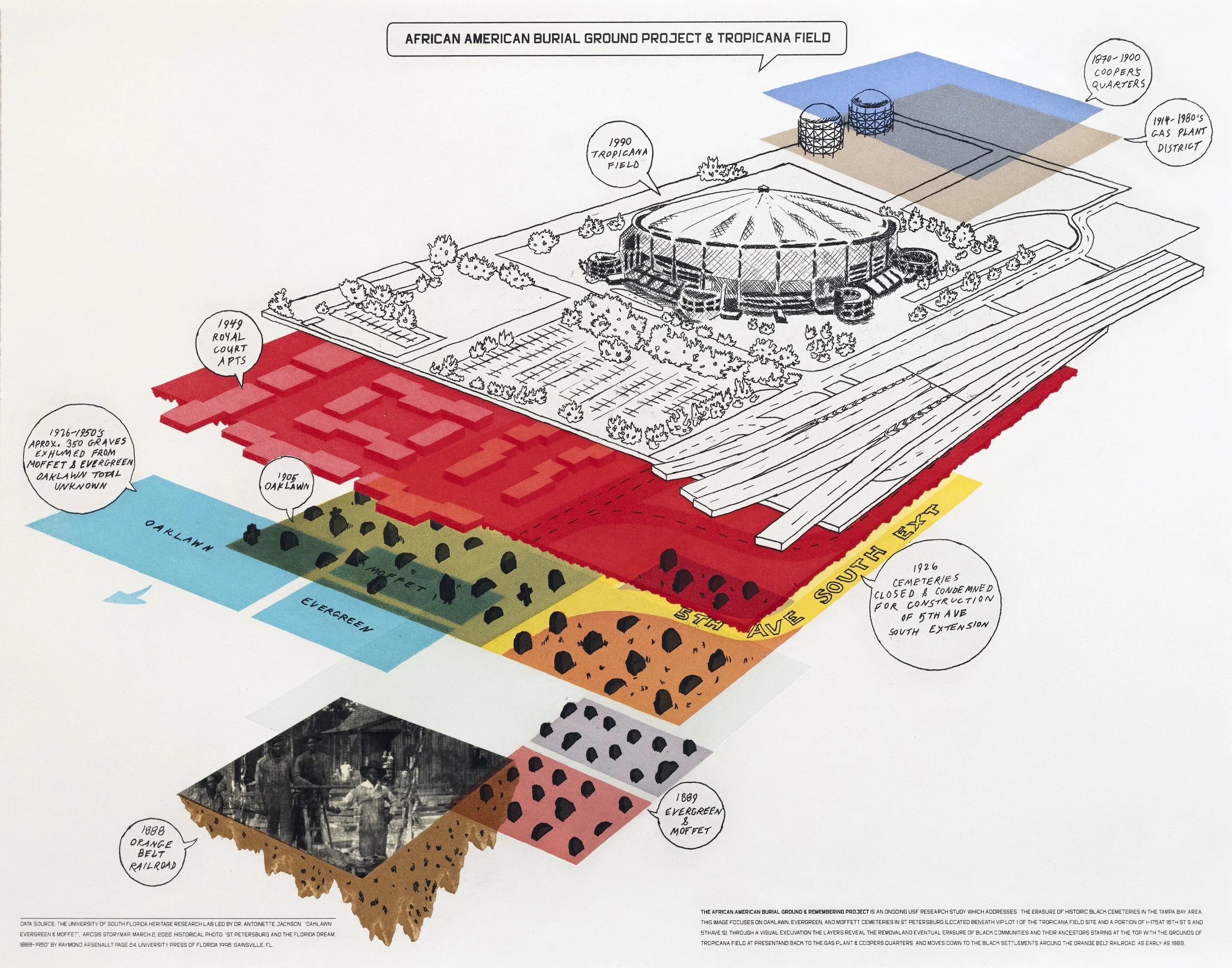
In Printing Black America, artist William Villalongo and urbanist Shraddha Ramani update and reimagine Du Bois's infographics. Printing Black America: Du Bois's Data Portraits in the 21st Century is a fine art print portfolio based on the project of Du Bois and his team for the contemporary moment. Villalongo and Ramani create new images or "data portraits" using a range of printmaking techniques, current data and living projects by Black scholars, social scientists and activists. To achieve this, Villalongo and Ramani worked in collaboration with printmaking studios in various regions of the United States and their communities. This project uses the original data portraits created for the American Negro Exhibit as a springboard for the critical possibilities found at the intersection of art and social science to render portraits of Black life in the 21st century.

Printing Black America is organized as six thematic portfolios published in editions of 20. Each portfolio holds 5 images. The complete project collection includes all 6 thematic portfolios for a total of 30 images.

Printmaking partners on the project are USF Graphicstudio, Tampa, FL; Powerhouse Arts, Brooklyn, NY; Island Press, Washington University, St. Louis, MO; Highpoint Editions, Minneapolis, MN; Paulson Fontaine Press, Berkeley, CA; and Mullowney Printing Company, Portland, OR.


EDITION INFORMATION

The Complete Printing Black America Collection

William Villalongo and Shraddha Ramani

Printing Black America: Du Bois's Data Portraits in the 21st Century, 2025

30 prints in six foil-stamped fabric-covered portfolios plus a screenprinted table of contents, foreword by Nell Irvin Painter, acknowledgements page, poem by Langston Hughes, and title pages for each portfolio.

Edition of 20

Published by USF Graphicstudio, Powerhouse Arts, Island Press, Highpoint Editions, Paulson Fontaine Press, and Mullowney Printing Company

$70,000

Impressions available: 10/20, 11/20, 12/20

Portfolio Four: Ownership

William Villalongo and Shraddha Ramani

Printing Black America: Du Bois's Data Portraits in the 21st Century, 2025

One foil-stamped fabric-covered portfolio containing five prints plus a screenprinted foreword by Nell Irvin Painter, acknowledgements page, poem by Langston Hughes, and title page.

Edition of 20

Published by Highpoint Editions

$12,500

Impressions available: 19/20, 20/20


Shraddha Ramani is an urbanist and researcher based in Brooklyn, NY. She uses data visualization and mapmaking as tools to make cities more resilient and equitable. Her work is centered around democratizing data to better equip communities to make informed decisions about their futures. She worked in multiple capacities in the Geographic Information Systems (GIS) department at New York City Emergency Management, finishing as the Director of the GIS Data Center. In this role she directed a team to make data-driven decisions for emergency planning, response, recovery, and mitigation. In earlier roles she developed online applications to help the public visualize and understand natural hazard risks in their communities. Previously, she worked on the development of the Future City Lab exhibition at the Museum of the City of New York. Shraddha Ramani is from Bangalore, India and her work is heavily informed by her own immigrant experience. She has participated in planning projects in India and Brazil and was a Peace Corps volunteer in Ecuador. She has a Master's degree in Urban Planning from Columbia University, and a BA in Environmental Studies from Oberlin College.

William Villalongo was born in 1975. He lives and works in Brooklyn, NY. He received his BFA from The Cooper Union School of Art, MFA from Tyler School of Art at Temple University and attended Skowhegan School of Painting & Sculpture. His figurative paintings, works on paper and sculpture are concerned with representing the Black subject against notions of race and exploring metaphors of mythology and liberation. His curatorial projects – American Beauty at Susan Inglett Gallery in 2013 and Black Pulp! touring nationally between 2016-2018 – explore the intersections of politics, history and art. Villalongo is the recipient of the prestigious Louis Comfort Tiffany Award and the Joan Mitchell Foundation Painters & Sculptor's Grant, and was the 2022 Jules Guerin & Harold M. English Rome Prize Fellow in Visual Art. His work is included in several notable collections including the Studio Museum in Harlem, The Whitney Museum of American Art and Princeton University Art Museum and El Museo del Barrio. His work has been reviewed in Art in America, The New Yorker and the New York Times. The artist is represented by Susan Inglett Gallery, New York and is an Associate Professor at The Cooper Union School of Art.

Adebummi Gbadebo Named as Participating Artist in 61st Venice-biennale

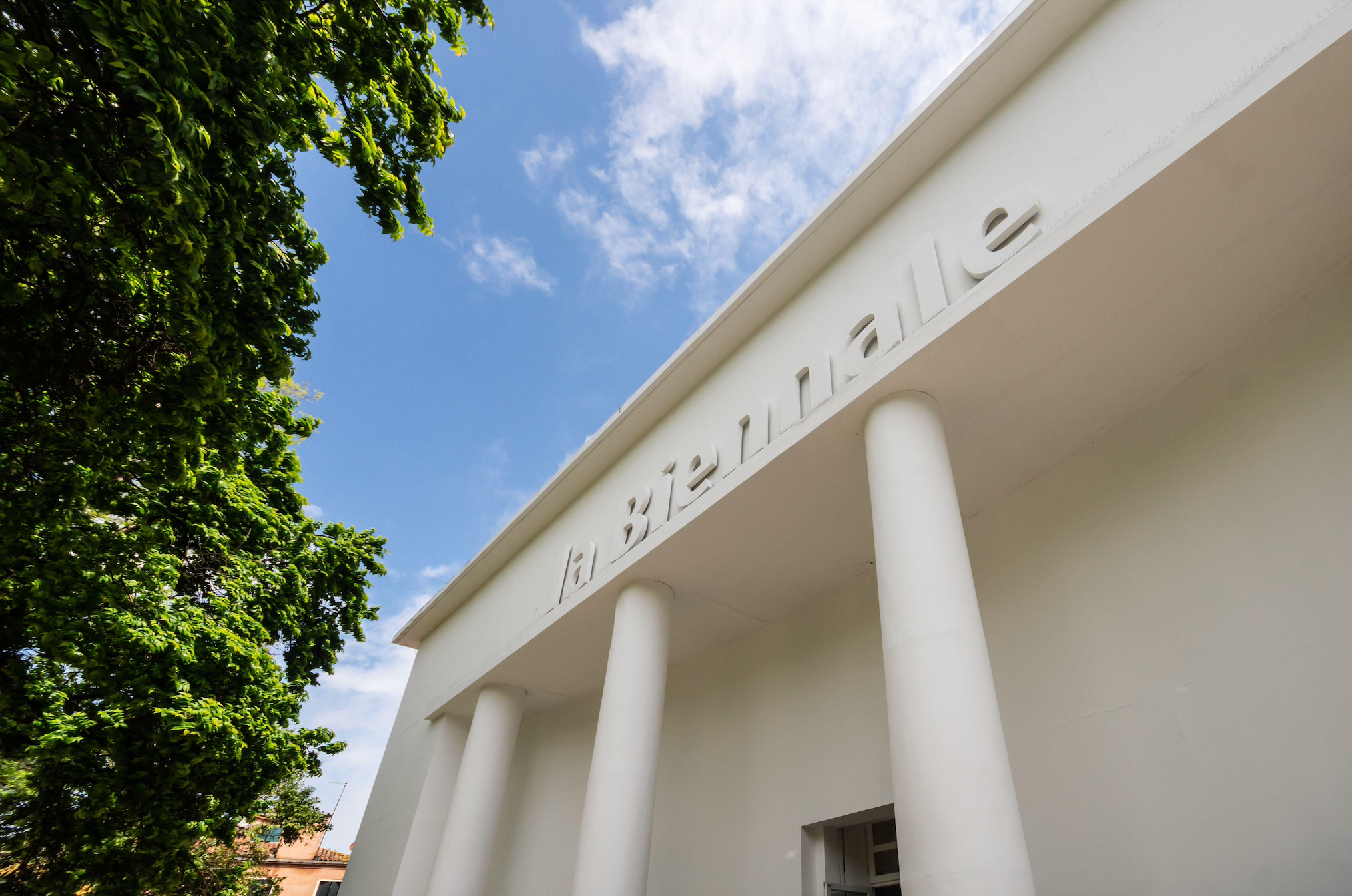
Adebunmi Gbadebo among the participating artists announced for “In Minor Keys,” the main exhibition at this year’s 61st Venice Biennale, curated by the team of the late curator Koyo Kouoh.

The Venice Biennale has revealed the 105 artists and collectives and six artist-led organizations participating in the main exhibition its sixty-first iteration, to take place May 9–November 22. The show was conceived by Cameroon-born curator Koyo Kouoh, who died last summer as she was putting it together. The exhibition is being realized by a team she assembled, comprising curators Gabe Beckhurst Feijoo, Marie Helene Pereira, and Rasha Salti; critic Siddartha Mitter, who is serving as the Biennale catalogue’s editor; and research assistant Rory Tsapayi.

“The sixty-first international art exhibition of La Biennale di Venezia intends neither a litany of commentary on world events, nor an inattention or escape from compounding and continuous intersecting crises,” said Tsapayi, speaking at a press conference at which the participants were revealed. “Rather, it proposes a radical reconnection with art’s natural habitat and role in society, that is the emotional, the visual, the sensory, the effective, the subjective.”

Spread across the Giardini’s Central Pavilion, the Arsenale, and other sites, “In Minor Keys” will additionally encompass outdoor installations, performances, and a procession of poets in the Giardini.

Learn more about the announcement on Artnet here and Artforum here!

Announcing the 2026 McKnight Printmaking Fellows

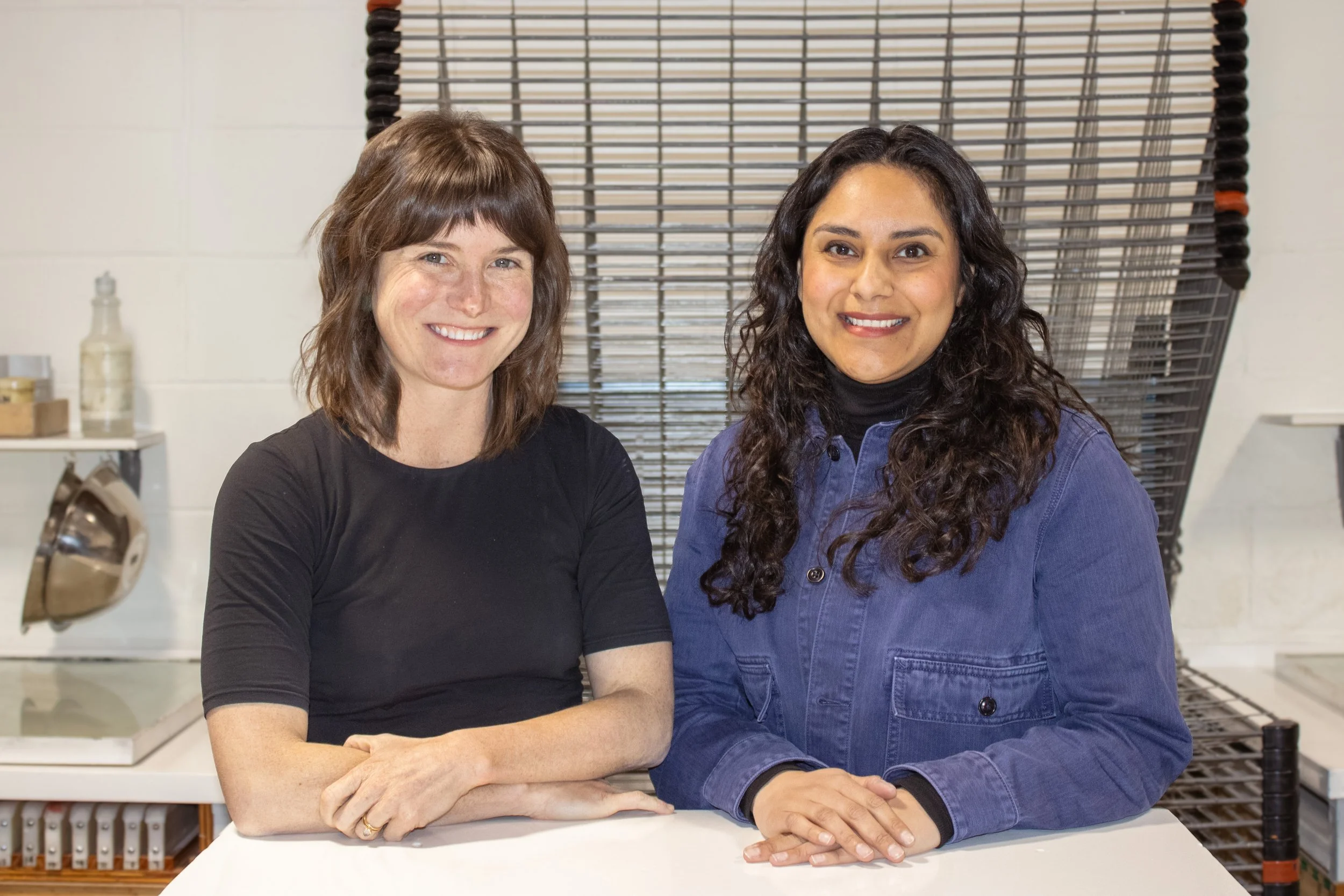
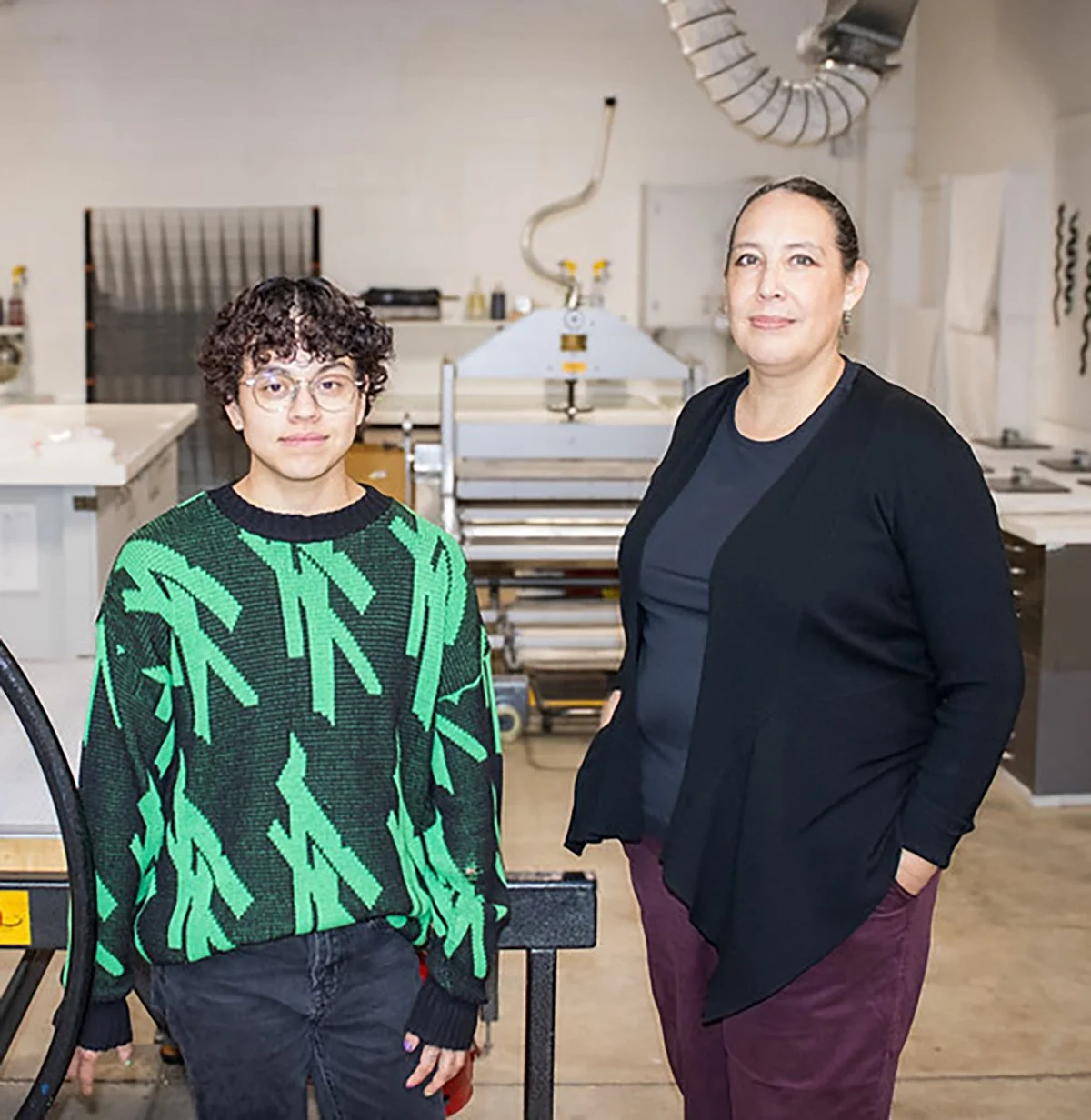
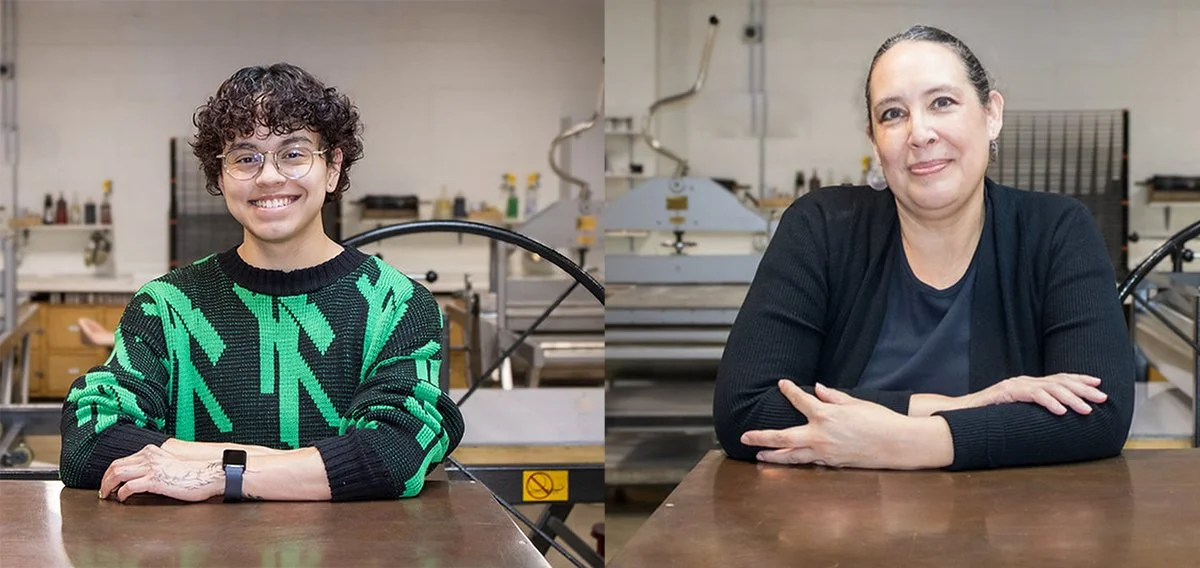
Lila Shull (left) and Nancy Ariza (right)

Please join us in congratulating Nancy Ariza and Lila Shull for being selected as the 2026 McKnight Printmaking Fellows? Highpoint is very excited to host them for this program in 2026.

Each year, two artists are awarded the fellowship following a thorough review process. The panelists Jazmine Catasús and Sean Caulfield engaged in extensive and careful evaluation of the robust applicant pool. Then they met with selected finalists and deliberated, ultimately awarding the fellowshipto Lila and Nancy.

The McKnight fellowship provides the artists with 12 months of access to the cooperative printshop at Highpoint, a $25,000 unrestricted award, a fellowship exhibition in Highpoint’s galleries, along with much more.

Both Lila and Nancy are already embedded into the community at Highpoint. For more than a decade, Nancy has been a co-op member, teaching artist, staff member, and she has developed and led artist programs. Shortly after relocating to the twin cities in 2021, Lila joined the co-op and has been a fixture ever since. Like Nancy, Lila has also shared her technical and conceptual expertise with the hIghpoint community through her teaching.

During the fellowship, Lila is excited to continue developing and expanding upon a series she began in 2025. She loosely describes these works as “paper quilts”, but she admits that term “doesn’t paint the whole picture.” She said “These pieces are ambitious because of the scale, and the variety of techniques I'm using for each one. I'm ready to dig deeper into these, conceptually and visually.”

Lila is excited by the opportunity to share this experience with another artist she admires, She believes it creates the possibility “to push each other in creative ways but also serve a supportive role through stages of experimentation, risk taking, and the unknowns of new work.”

When asked what the fellowship means for her, Lila responded “Receiving this fellowship provides leverage. Recalibration and risk taking is difficult to get funded and it is a rare thing to be able to protect those vulnerable moments at this stage of my career; the McKnight provides security. With this opportunity, I am able to be more expansive in my practice. This means, I do not have to downsize my ideas because of costs or logistics. I look forward to taking full advantage of all the support this fellowship offers to sustain and my practice beyond just the work.”

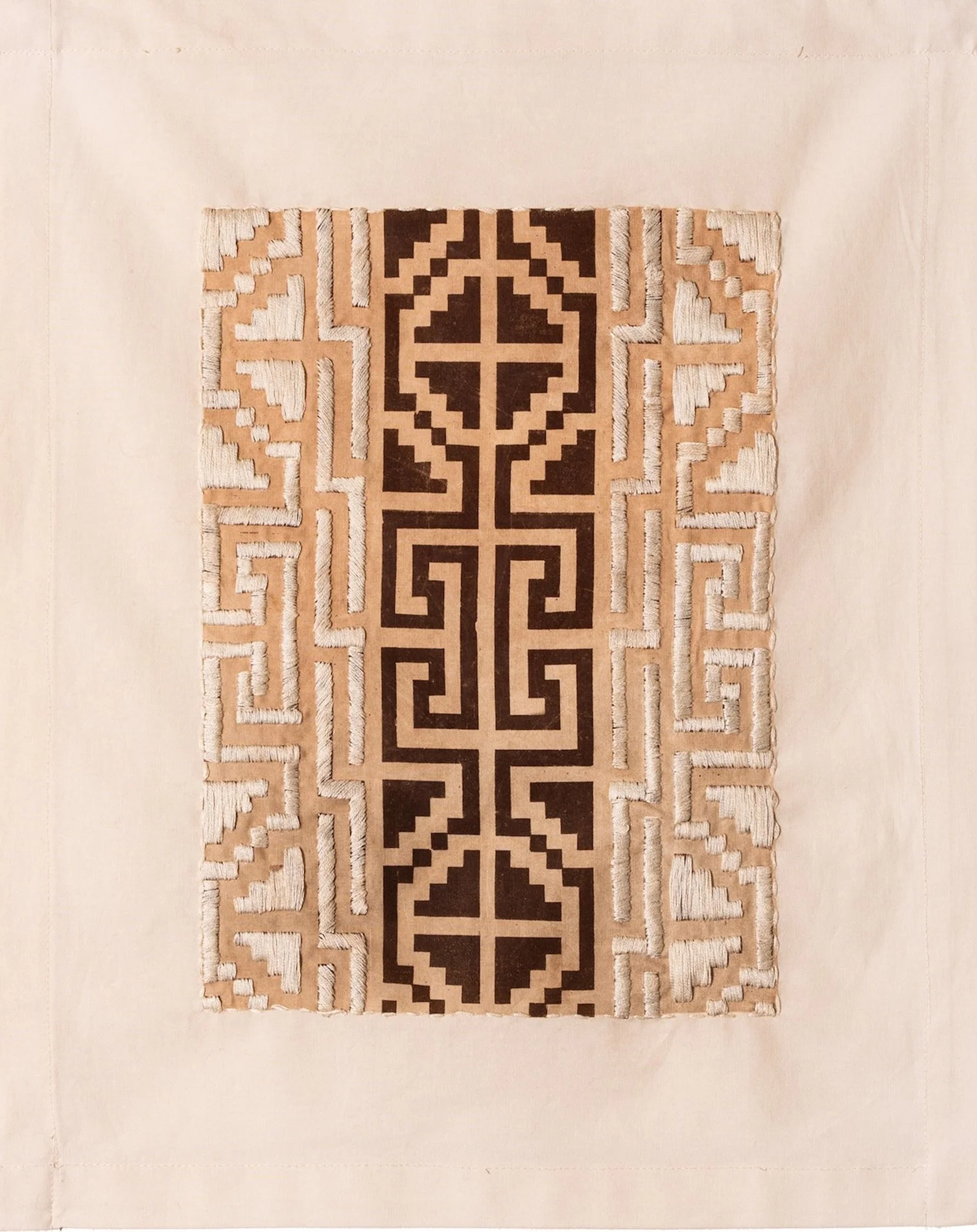
Oral histories and traditions have been an important part of Nancy’s practice for the last few years. She looks forward to continuing her exploration of these topics during the fellowship. She’s also excited about “engaging in thoughtful conversations with our guest critics and dedicating time in the studio for technical, process-based explorations. And to continue connecting with members of the Highpoint community and its expansive and generous network.”

“This award arrived at a truly exciting and transitional moment in my artistic career,” Nancy said “It will give me the space and resources to dedicate more creative energy to the development and sustainability of my studio practice.”

Oral histories and traditions have been an important part of Nancy’s practice for the last few years. She looks forward to continuing her exploration of these topics during the fellowship. She’s also excited about “engaging in thoughtful conversations with our guest critics and dedicating time in the studio for technical, process-based explorations. And to continue connecting with members of the Highpoint community and its expansive and generous network.”

“This award arrived at a truly exciting and transitional moment in my artistic career,” Nancy said “It will give me the space and resources to dedicate more creative energy to the development and sustainability of my studio practice.”

About the artists:

Nancy Ariza (she/her) is a Mexican American visual artist and educator. Drawing from her Mexican heritage, Ariza’s artistic practice explores the themes of cultural preservation and memory, familial ties, and storytelling, expressed through a combination of traditional and alternative printmaking processes, natural pigments, and textiles. 

Ariza has exhibited across the United States at Mission Cultural Center for Latino Arts, in San Francisco, CA; Janet Turner Print Museum at California State University in Chico, CA; Prospectus Gallery and Blanc Gallery in Chicago, IL; among others. She has received awards from the Jerome Foundation, Forecast Public Art, and Metropolitan Regional Arts Council. 

Outside of her studio practice, Ariza runs Amilado Press, a print studio dedicated to collaborative and community printing and artist residencies. She is an active member of the Twin Cities arts community, serving on the Leadership Council of Serpentina Arts, the board of directors of Chicago Avenue Fire Arts Center, and the Minnesota Artist Exhibition Program Advisory Committee at the Minneapolis Institute of Art. 

Ariza holds an MA in Education and Graduate Certificate in Culturally Responsive Teaching from Saint Mary’s University of Minnesota, as well as a BFA in Printmaking and BA in Art History from Minnesota State University, Mankato.

Lila Shull (she/her) is a printmaker based in St. Paul, Minnesota. Working in printmaking, painting, and drawing, her practice pays particular attention to the shift between objects and patterns related to memory. This work wrestles with the problems (and possibilities) that arise from unreliable personal narratives. 

Shull holds her MFA from the University of Tennessee-Knoxville and a BFA from Winthrop University in Rock Hill SC. She has been awarded residencies at In Cahoots, Arrowmont School of Crafts, and Eugeniusz Geppert Academy of Fine Arts in Wrocław, Poland. Her work has been shown nationally at the Foley and Unix Galleries in New York City, Coagula Curatorial in Los Angeles, CA, Mint Museum in Charlotte, NC, and the Devos Art Museum in Marquette, MI. Currently, she is a full-time faculty member in the College of Design Innovation, at the University of Minnesota in Minneapolis, MN.

About the review panelists:

Jazmine Catasús is Artistic Director and one of the Master Printers of the Robert Blackburn Printmaking Workshop (RBPMW) at the Elizabeth Foundation for the Arts (EFA). She has been involved with EFA RBPMW since 2013. Catasús works with community members and the public within the printshop facilities and the archive. She has collaborated on printmaking projects with artists such as Lizanina Cruz, Kameelah Janan Rasheed, and Dindga McCannon. Catasús has led printmaking workshops at several institutions, including the Center for Contemporary Printmaking (Norwalk, CT), Print Center New York, The Metropolitan Museum of Art, and The Museum of Modern Art (MoMA) in New York. She is also a Visiting Assistant Professor at Pratt Institute.

Sean Caulfield was named a Canada Research Chair in Fine Arts (Tier 2) from 2001 – 2011, Centennial Professor from 2011 – 2021, and is currently a Professor in the Department of Art and Design at the University of Alberta, living and working in Treaty Six territory, Amiskwaciy Waskahikan, Edmonton, Alberta, Canada. He has exhibited his prints, drawings, installations and artist’s books extensively throughout Canada, the United States, Europe, and Japan. Recent exhibitions include: Found Anatomies, Peter Robertson Gallery, Edmonton, Alberta, Canada (2022); The Flood, Art Gallery of Alberta, Edmonton, Alberta, Canada (2016); The Body in Question(s), UQAM Gallery, Montreal, Quebec, Canada (2012); Perceptions of Promise, Chelsea Art Museum, New York, USA/Glenbow Museum, Calgary, Alberta (2011).

Caulfield has received numerous grants and awards for his work including: The Special Award of the Rector of the Academy of Fine Arts in Warsaw, Krakow Triennial, 2015; SSHRC Dissemination Grant: Canadian Stem Cell Network Impact Grant; SSHRC Fine Arts Creation Grant; Canada Council Travel Grant; and a Visual Arts Fellowship, Illinois Arts Council, Illinois, USA. Caulfield’s work is in various public and private collections including: Houghton Library, Harvard University, USA; Fitzwilliam Museum, Cambridge, England; Blanton Museum of Art, University of Texas, Austin, Texas, USA. In 2017 Caulfield was elected to the Arts Division of the Academy of the Arts and Humanities of the Royal Society of Canada.


Skycatcher by Nicola López

Skycatcher

Nicola López, 2026

intaglio with chine collé

Edition of 8

Image: 17 ¾ x 17 ¾ inches

Paper: 25 ½ x 25 inches

$1,900 unframed

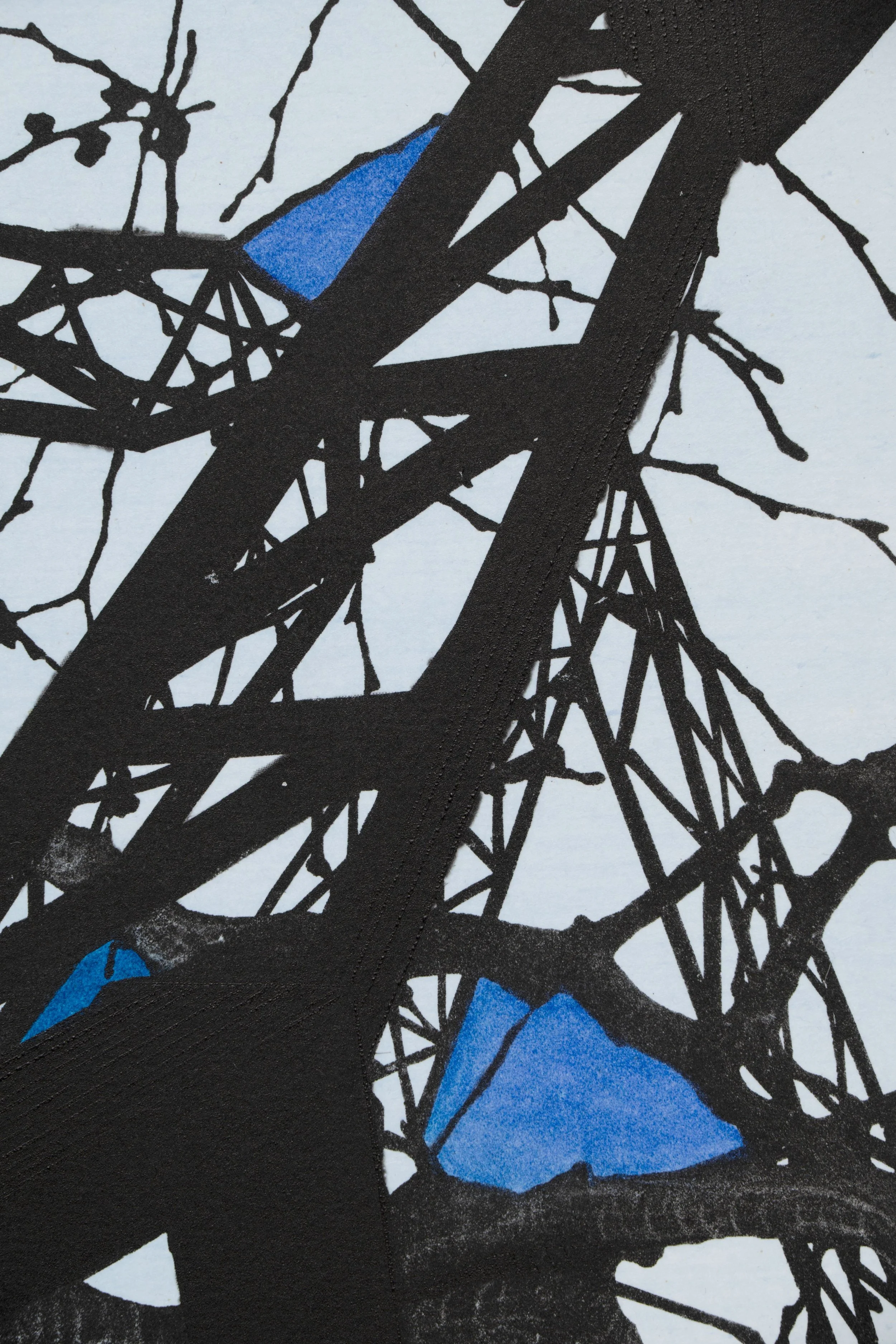
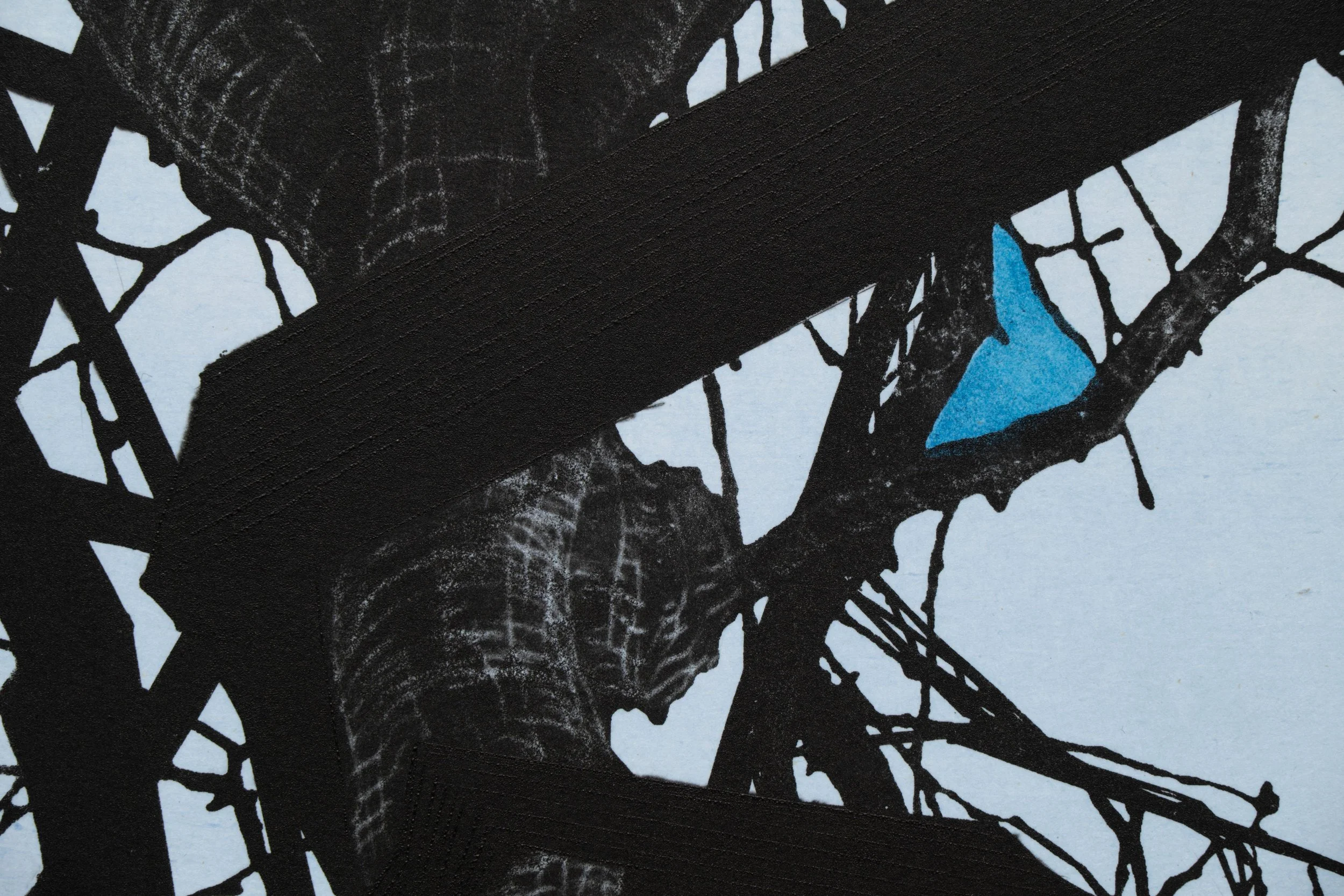
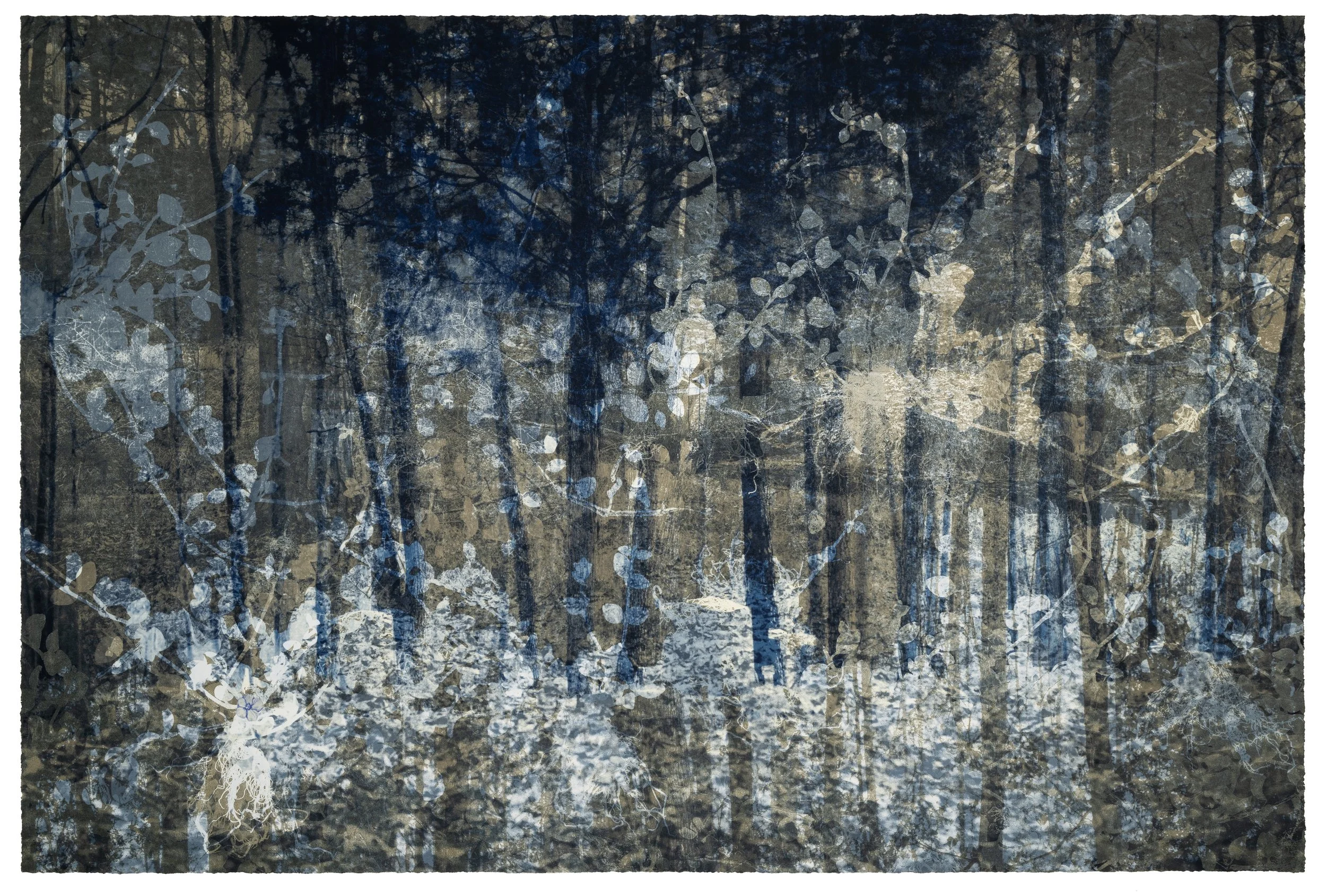
Highpoint Editions is pleased to release Skycatcher, a new print by New Mexico-based artist Nicola López. In this ambitious intaglio print, the hybrid landscape depicted reflects the impact of human intervention alongside nature’s tenacious ability to adapt.


Nicola López’s work exists at the intersection of human-built environments and “Nature,” exploring how these two realms collide, echo, and intertwine. Her landscapes reconfigure, distort, and merge familiar worlds—urban, technological, botanical, and geological—to create spaces that are at once mysterious, disorienting, beautiful, and unsettling.


In Skycatcher, López reflects on her place within a complex and overwhelming, yet deeply cherished world, examining the nature and consequences of human “progress,” and imagining what resilience might look like amid profound change. The print points to the fragility of the world we inhabit and have helped build, while also highlighting its mystery and tenacious beauty.

The composition of the piece emulates a perspective one might encounter when looking upward through a tree’s canopy, where intertwining branches merge with skeletal architectural forms. The relationship between tree and structure remains intentionally ambiguous: it is unclear whether one grew around the other, whether the form emerged as a hybrid, or whether each began independently before becoming inextricably entangled.

The conceptual tension in López’s work mirrors her approach to process. From the outset of her collaboration with Highpoint Editions, López was intent on immersing herself fully in intaglio techniques—drawing on extensive prior experience while pushing the medium through rigorous technical exploration. She experimented broadly, combining methods and utilizing different processes to achieve deep, expressive marks alongside curving, natural figures. The image’s dark, industrial framework was created using aquatint to produce a dense, velvety black. Engraved lines were added to raise the paper’s surface, deepening the tonal presence and enhancing the texture, and areas within the tree branches were selectively burnished to introduce organic nuance.

The black silhouette divides the sky into discrete shapes, forming a net in which fragments of sky are framed, caught, or cradled. The sky feels alive—pulsing with varied, intense shades of blue—yet also appears as if it could be shattered, its shards suspended midfall. To achieve these lozenges of color, López used watercolor on an early proof to help decide which tones of blue to accentuate. After initial attempts using lithography and pochoir proved challenging, the final solution emerged in intaglio and five separate blue ink colors. The blue of the sky is expansive: the image’s foundation lies in a collé sheet adhered with tinted wheat paste, producing a subtle, atmospheric hue that could not be achieved through dye or pigment alone.

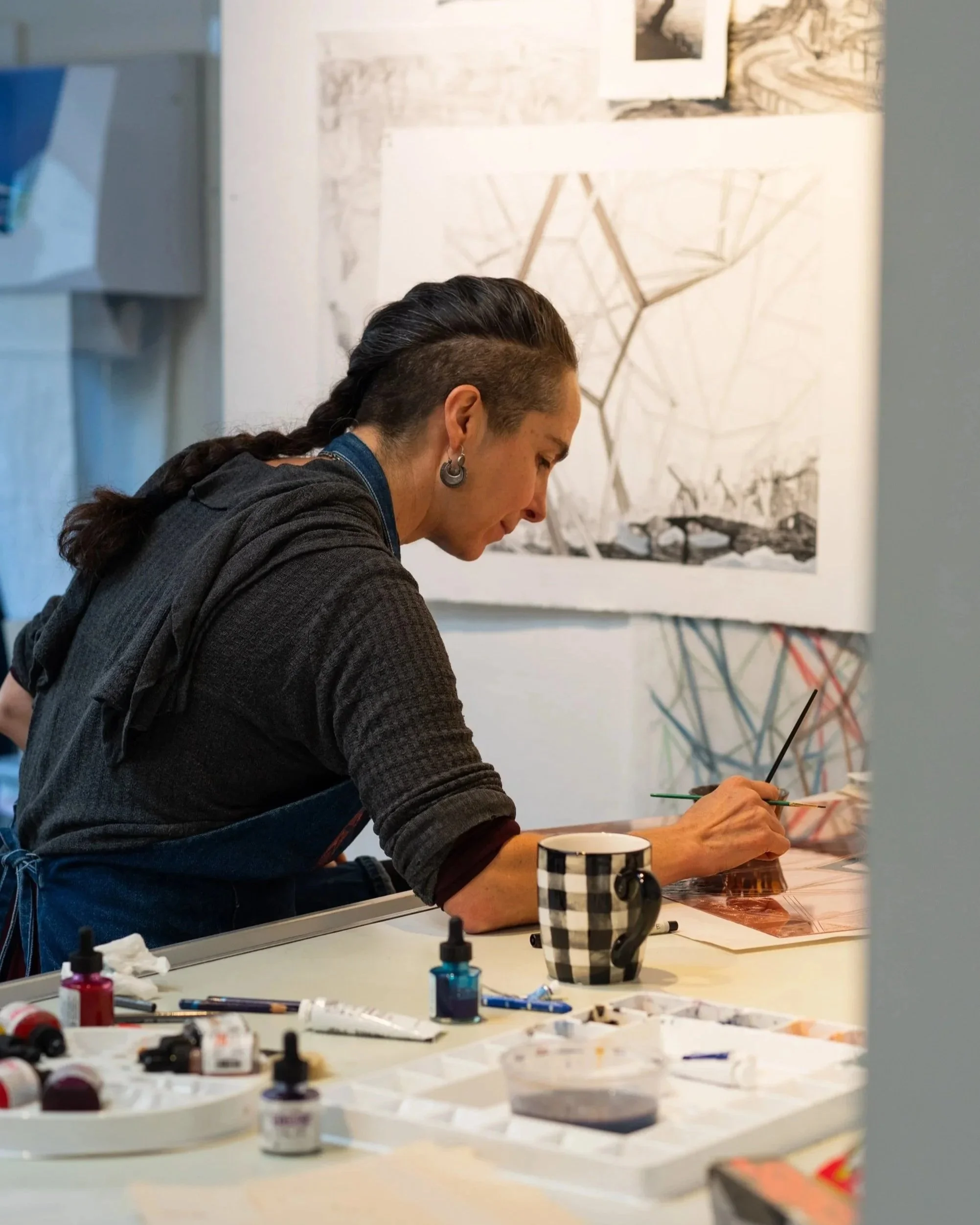
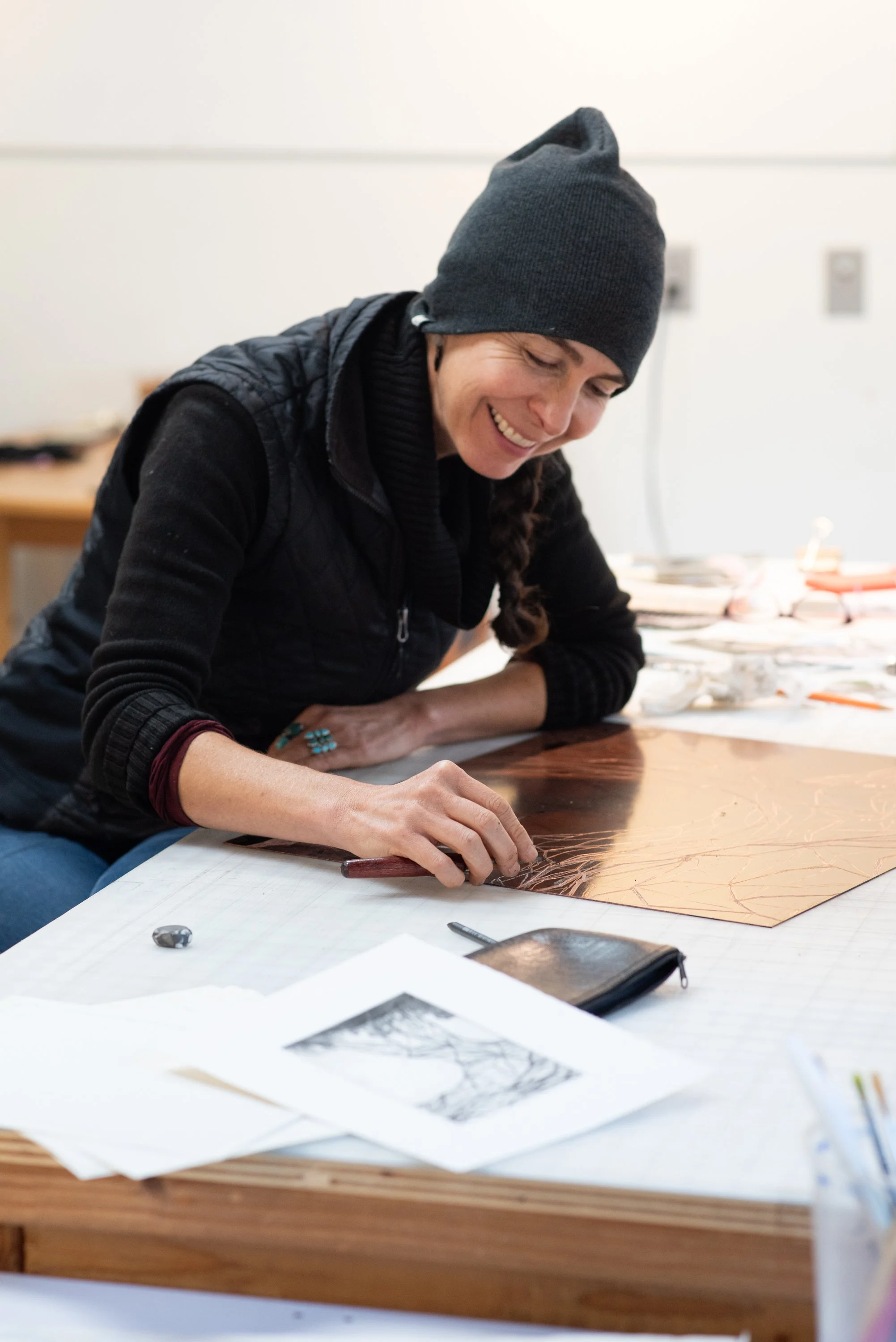
López working on a plate in the Highpoint Editions Studio

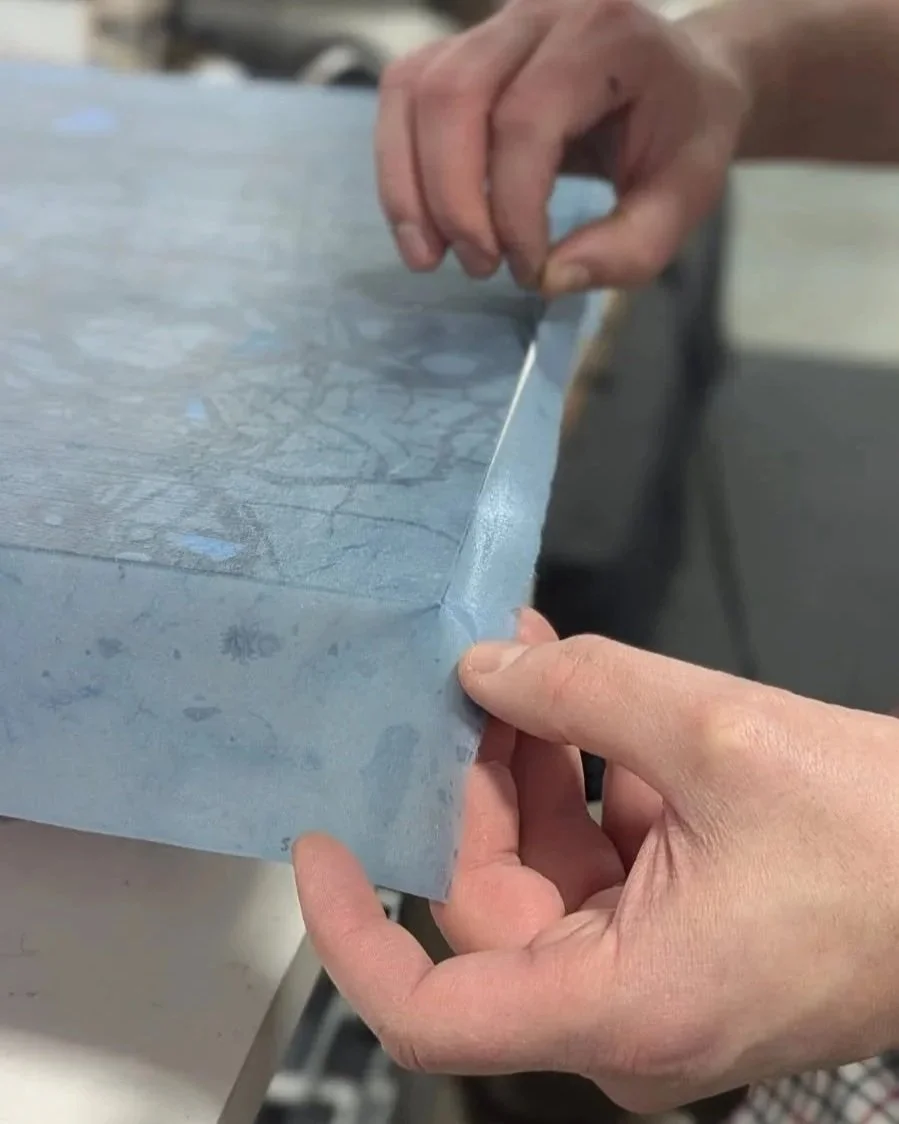
An early proof using a dyed chine collé sheet being cut to the size of the plate. This process created too dark and uneven of a tone in the sky.

López preparing a plate in the Highpoint Editions Studio

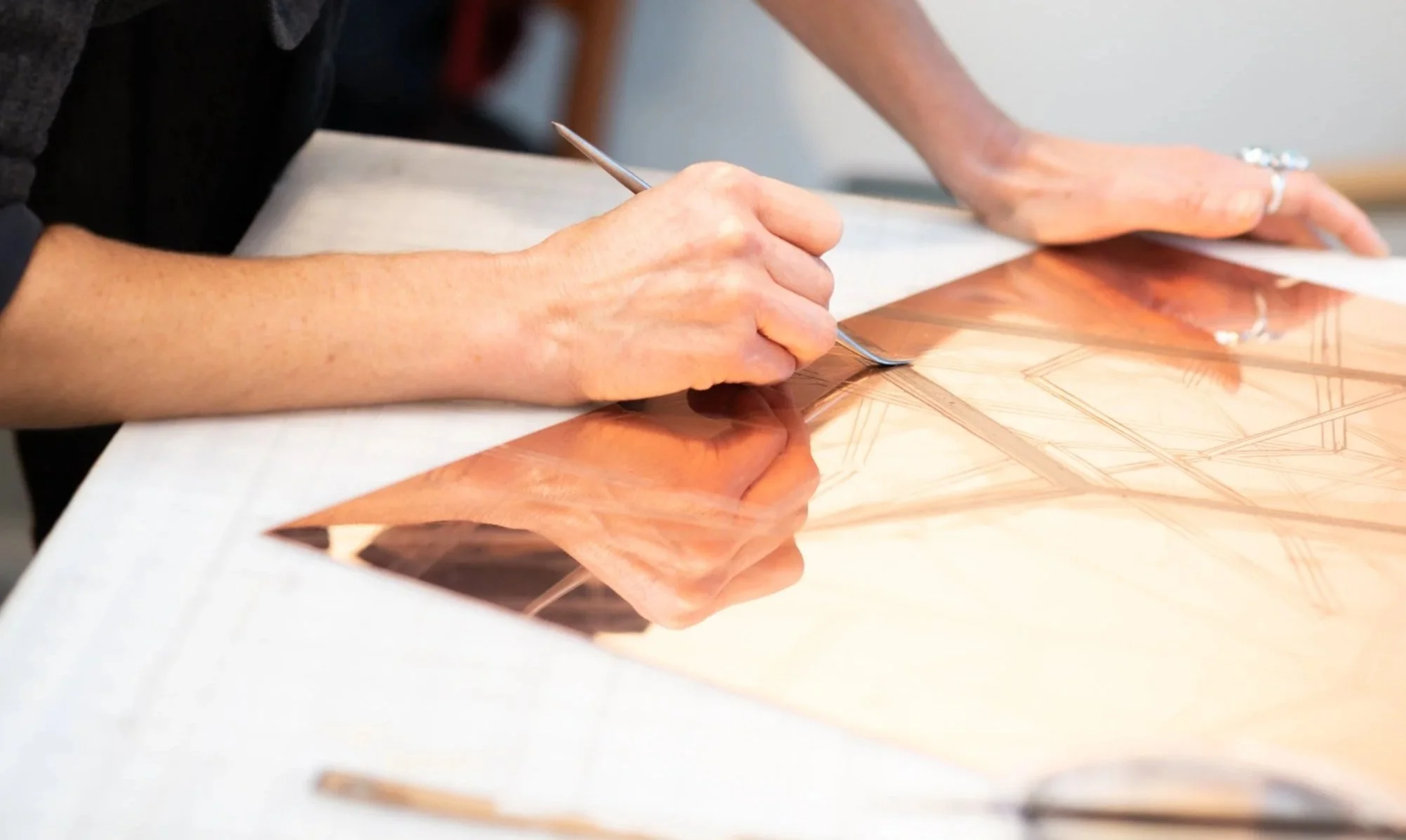
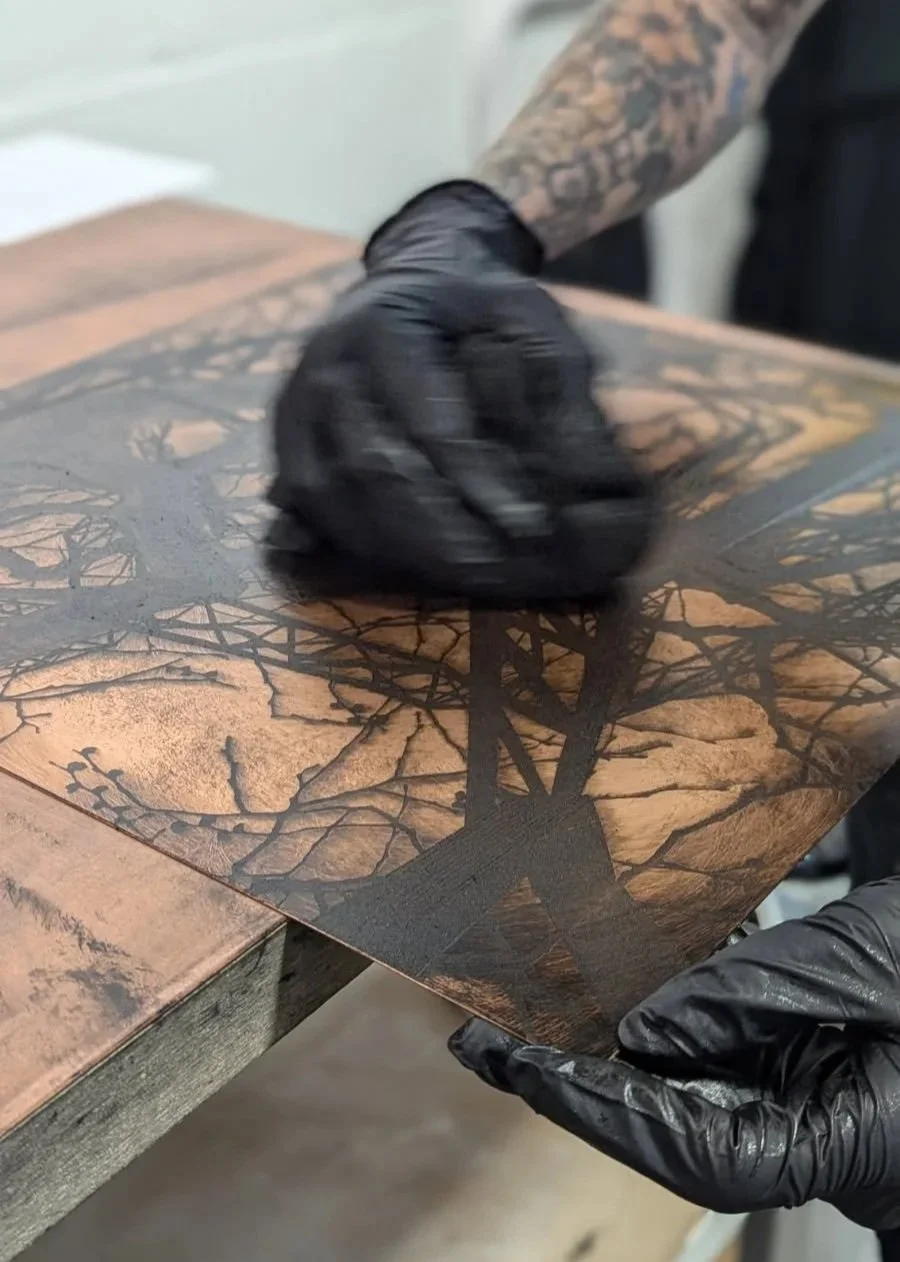
Every stage of Skycatcher’s development demanded meticulous attention, from the exacting marks made by López on the plate, to the complex inking and wiping process. The print’s substrate—Revere Polar White Suede— is now irreplaceable, as the Magnani mill was destroyed in an earthquake in 2016. The paper plays a crucial role in the print’s success, holding the engraved marks with exceptional clarity and depth.

Wiping of the copper plate after inking

Through both concept and process, the print embodies López’s ongoing exploration of the power of confrontation between nature and human-made systems: revealing beauty, vulnerability, and endurance in equal measure.


Nicola López examines and reconfigures contemporary landscapes through drawing, printmaking, site-specific installation, sculpture and video. Her work points to connections and rifts between our human-constructed world and the systems and cycles of nature. She engages architecture and urban structure as ever-accumulating evidence of human aspirations and failures, often contrasting and intertwining them with geological and organic formations. Her work draws on anthropology, architecture, urban planning and historical and fictional explorations of utopia/dystopia. It leans heavily into material process, intentionally bringing joy, improvisation, and care into the work as it reflects on human patterns of extraction and construction.

López has participated in several residencies and received grants and fellowships including a NYFA Fellowship in Drawing/Printmaking/Book Arts, a grant from the Joan Mitchell Foundation, a Fellowship at the American Academy in Rome, and a 2024 Guggenheim Fellowship. Her work is held in prominent institutional collections and has been exhibited throughout the United States and internationally, including at the Metropolitan Museum of Art, MoMA and the Guggenheim Museum in NY, the Los Angeles County Museum of Art, the Museo Rufino Tamayo in Mexico City, the Denver Art Museum, Nevada Museum of Art, the Albuquerque Museum, and the Inside-Out Museum in Beijing.


For availability and to purchase Skycatcher, email our Gallery Director Alex Blaisdell alex@highpointprintmaking.org

Announcing the 2025-2026 Jerome Early Career Printmakers

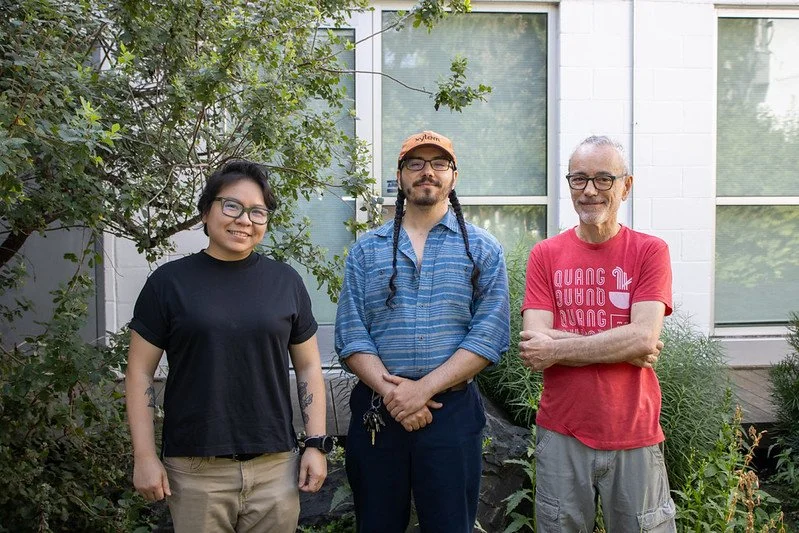
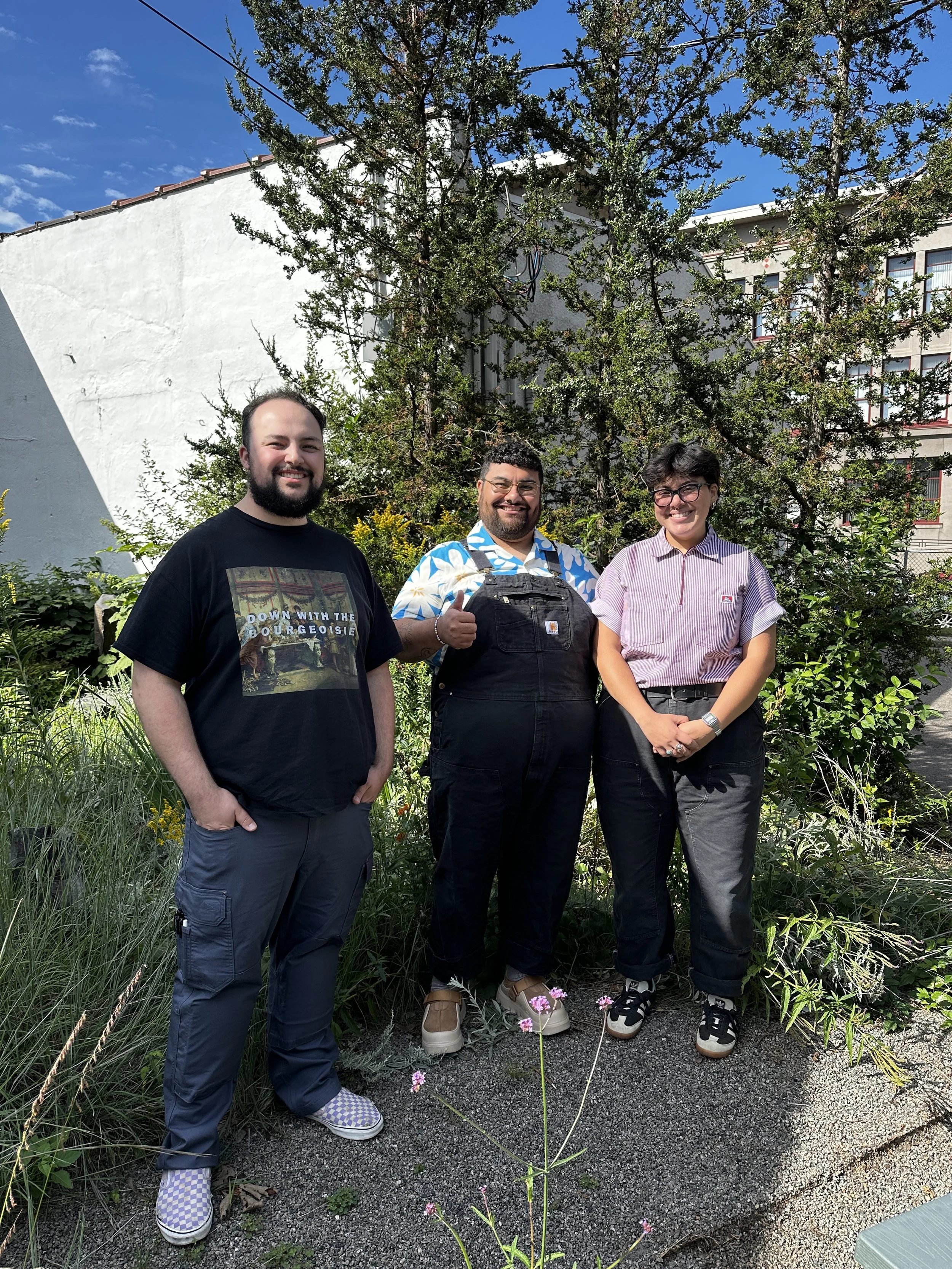
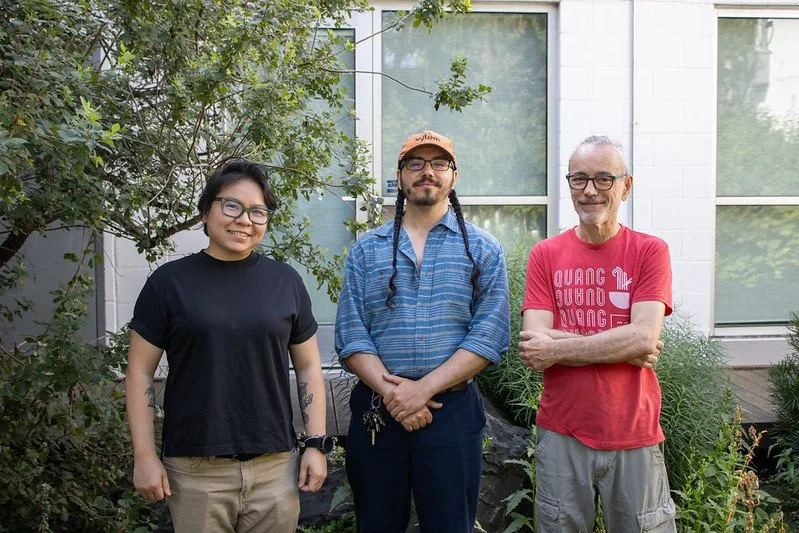
Left to right: Dalton Carlson, Edson Rosas, Gabi Estrada

Please join us in welcoming the 2025-2026 Jerome Early Career Printmakers Dalton Carlson, Edson Rosas, and Gabi Estrada!

Three artists are selected annually to participate in the Jerome Early Career Printmakers Residency at Highpoint. Thanks to the generous support of the Jerome Foundation, this program has existed since 2003 and has served more than 60 early career printmakers.

Beginning in September, the artists will have 12 months of access to the co-op studio to generate artowrk for their culminating exhibition, which will open in July 2026. In addition to studio access and their eventual exhibition, Dalton, Edson, and Gabi received a stipend for materials and will enjoy periodic studio visits with invited guests, along with learning and professional development opportunities.

The Jerome Residency program is open to early career Minnesota printmakers who already possess training in one or more traditional printmaking techniques. Early Career is defined here as an artist with a record of creating and exhibiting original work who has not received consistent development and production opportunities and significant recognition, awards, and acclaim regardless of age or recognition in other fields.

About the artists:

Edson Rosas (he/they) is a queer Mexican-American artist and educator based in Minneapolis, Minnesota. He is a printmaker, installation artist, soft sculpture maker, and casual writer. His autobiographical work is focused on exploring his Mexican roots through memory and how they play a role in his everyday life emotionally, physically, and politically. The work is often honest and open, making the personal become universal. 
Edson received his MFA in 2021 from Pacific Northwest College of Art and his BFA in 2019 from Minnesota State University, Mankato.

Dalton Carlson (he/him) is an interdisciplinary artist and educator working in Minneapolis, Minnesota. Carlson received his Master of Fine Arts in Studio Art from the State University of New York at Buffalo in 2024 and his Bachelor of Fine Arts in Studio Art from Colorado Mesa University in 2020. His work analyzes his role and how he interacts within larger societal systems. His work flows between 2D and 3D practices, often finding refuge in painting and printmaking. Carlson has recently shown in group shows in Buffalo, NY with shows at El Museo Gallery and CEPA Gallery and in Colorado at Mesa County Libraries and 437CO. He has presented solo exhibitions at the Triangle Gallery in Colorado, Western New York Book Arts Center in New York, and Fried Fruit Art Space in North Carolina. 

Gabi Estrada (they/them) is a Mexican-American printmaker and arts educator based in Minneapolis. Their practice is rooted in identity and storytelling, honoring their ancestors and elders. They believe in the power that art has to facilitate healing and community building, which they prioritize in their art and pedagogy.

Stay tuned for updates on the artists progress as they move through the Residency!

Special thanks to our esteemed panelists Emily Marsolek and Isa Gagarin for their careful review of the outstanding applicants.

About the review panelists:

Isa Gagarin is an artist based in Minneapolis, Minnesota. Her work draws from experiences of relating to her birthplace of Guåhan (Guam) through visual art, storytelling and Chamoru language revitalisation. Educated in painting and drawing, Gagarin’s practice has expanded to include writing and performance. Her work has been exhibited nationally and internationally, including Midway Contemporary Art (Minneapolis, MN), the Contemporary Arts Center (Cincinnati, OH), the Kemper Museum of Contemporary Art (Kansas City, MO) and Grimm Gallery (Amsterdam). Her solo exhibition I Hagan Sirena (The Daughter of Sirena) is currently on view at Pilele Projects (Los Angeles). In 2026, her work will be included in the group exhibition Imagining an Archipelago, curated by Jessamine Batario, which will take place at the Colby Museum of Art (Waterville, ME). Gagarin was born in Guam and was raised throughout the US including Hawai’i. Gagarin received an MFA in Painting and Printmaking from Virginia Commonwealth University (2018), and earned her BFA in Painting from the Minneapolis College of Art and Design (2008).

Emily Marsolek is the Assistant Director at Bockley Gallery in Minneapolis. She holds a BFA in Studio Arts and Psychology from Concordia College in Moorhead MN, and first encountered Highpoint Center for Printmaking as a studio intern and printer’s assistant in 2017-2018.


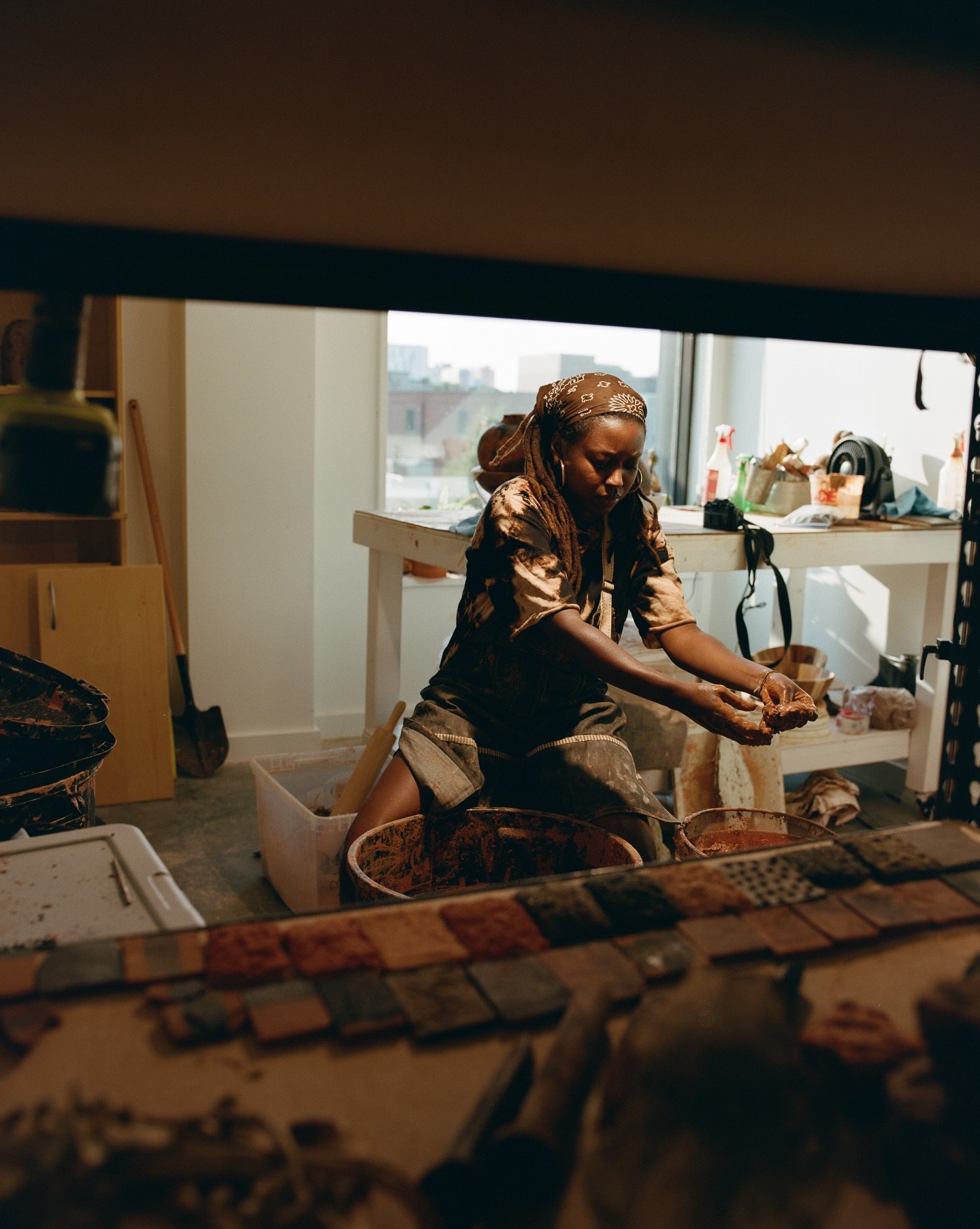
Adebunmi Gbadebo Featured in Exhibition at The Ford Foundation Gallery

Credit: Sebastian Bach

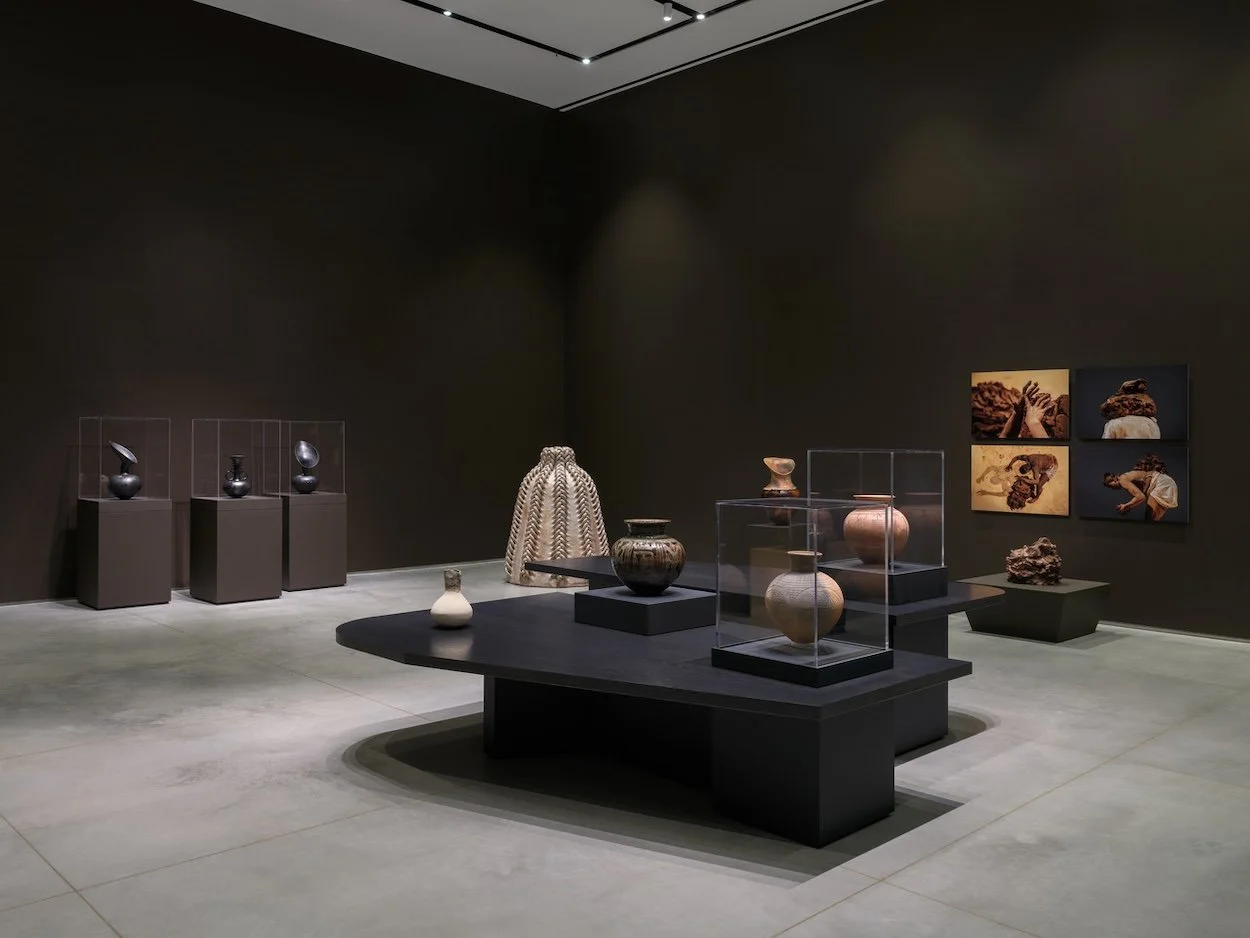
Highpoint Editions Artist Adebunmi Gbadebo is featured in an exhibition titled Body Vessel Clay: Black Women, Ceramics & Contemporary Art at The Ford Foundation Gallery in New York!

The exhibition unites “three generations of groundbreaking Black women artists whose work with clay explores the medium’s multilayered cultural and political significance.” Featuring a selection of more than fifty works across a large variety of mediums including ceramics, film, photography, and archives, “the exhibition draws connections between the legacy of renowned Nigerian potter Ladi Dosei Kwali (1925-1984) and contemporary artistic practice. Through these lines of influence and innovation, the show traces how Black women artists have transformed the field of ceramics over the past seventy years—disrupting conventions, challenging hierarchies, and expanding the possibilities of clay as a medium.

On view September 10th through December 6th, 2025.

Learn more about the exhibition here!

Nicola Vassell Presents Solo Exhibition of Adebunmi Gbadebo

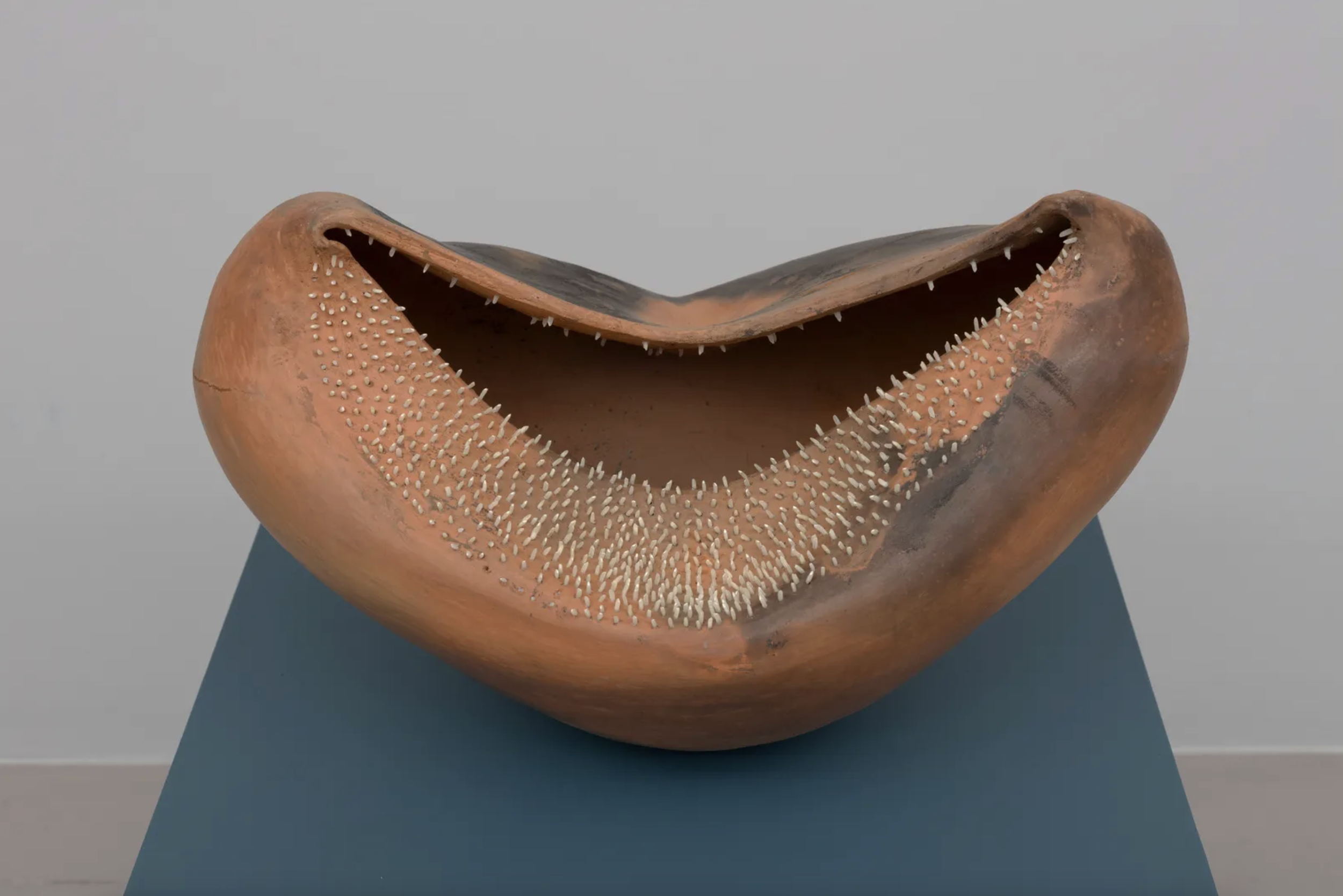
Adebunmi Gbadebo | Mary Weeks Bryant | 2025 | soil from True Blue Plantation (Fort Motte, South Carolina), Carolina Gold rice, pit-fired | 12 x 18 x 12 in

Highpoint Editions artist Adebunmi Gbadebo presents a new body of work in a solo exhibition titled Watch Out for the Ghosts at the Nicola Vassel Gallery in New York. “The title—a quote from Amiri Baraka’s poem The Why's and the Wise—echoes Gbadebo’s journey through loss, family history and reconnecting with the land they once inhabited. In bringing together works made in ceramic and paper along with a short film, this exhibition signals the evolution of the artist's conceptual practice and the deepening of her research into material and process.” - Nicola Vassel Gallery

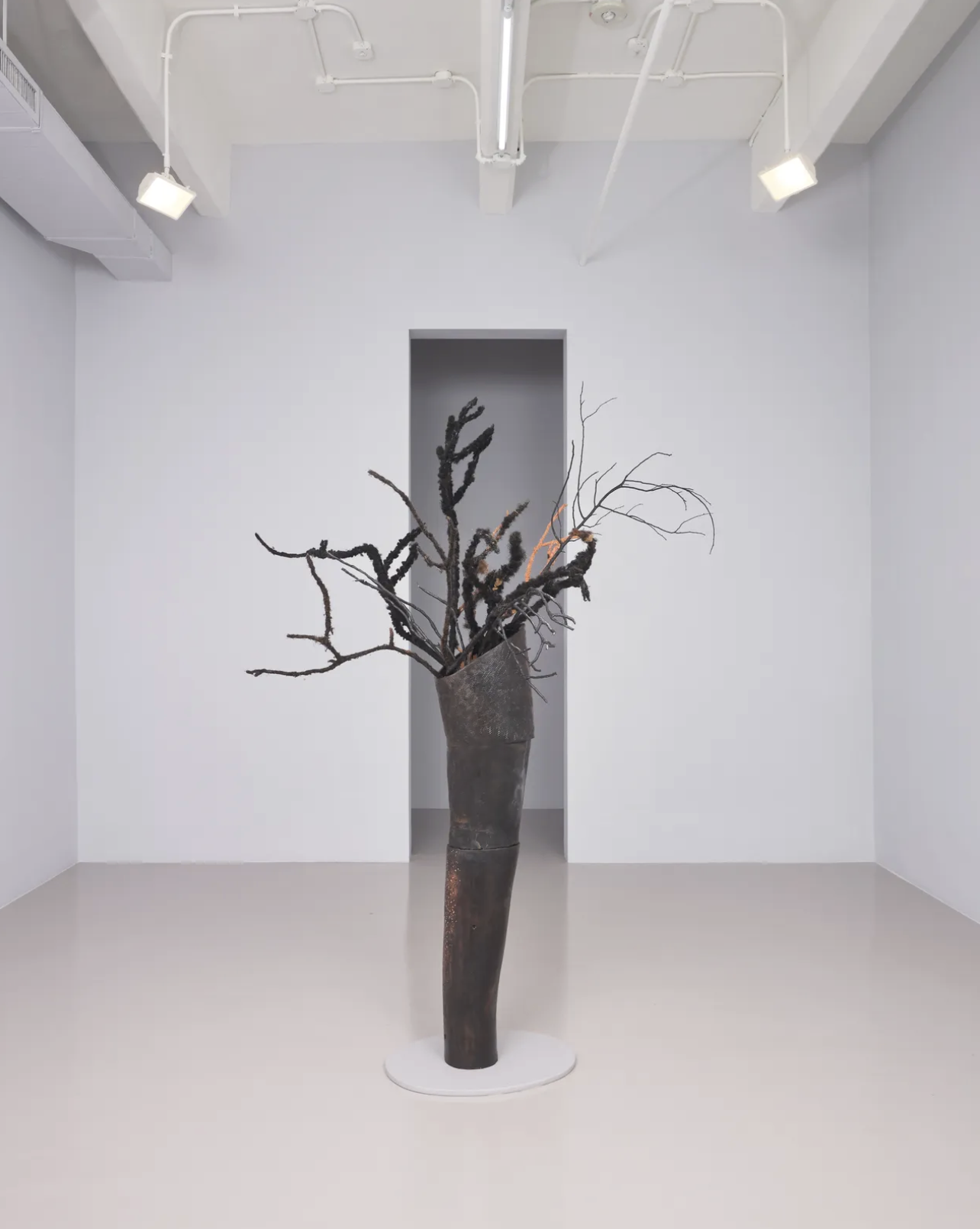
Adebunmi Gbadebo | Witness | 2025 | soil from True Blue Plantation (Fort Motte, South Carolina) human hair, cherry tree branches, shoe polish and Tung oil | trunk dimensions: 53 ½ x 13 in | overall dimensions: height 79 ½ in

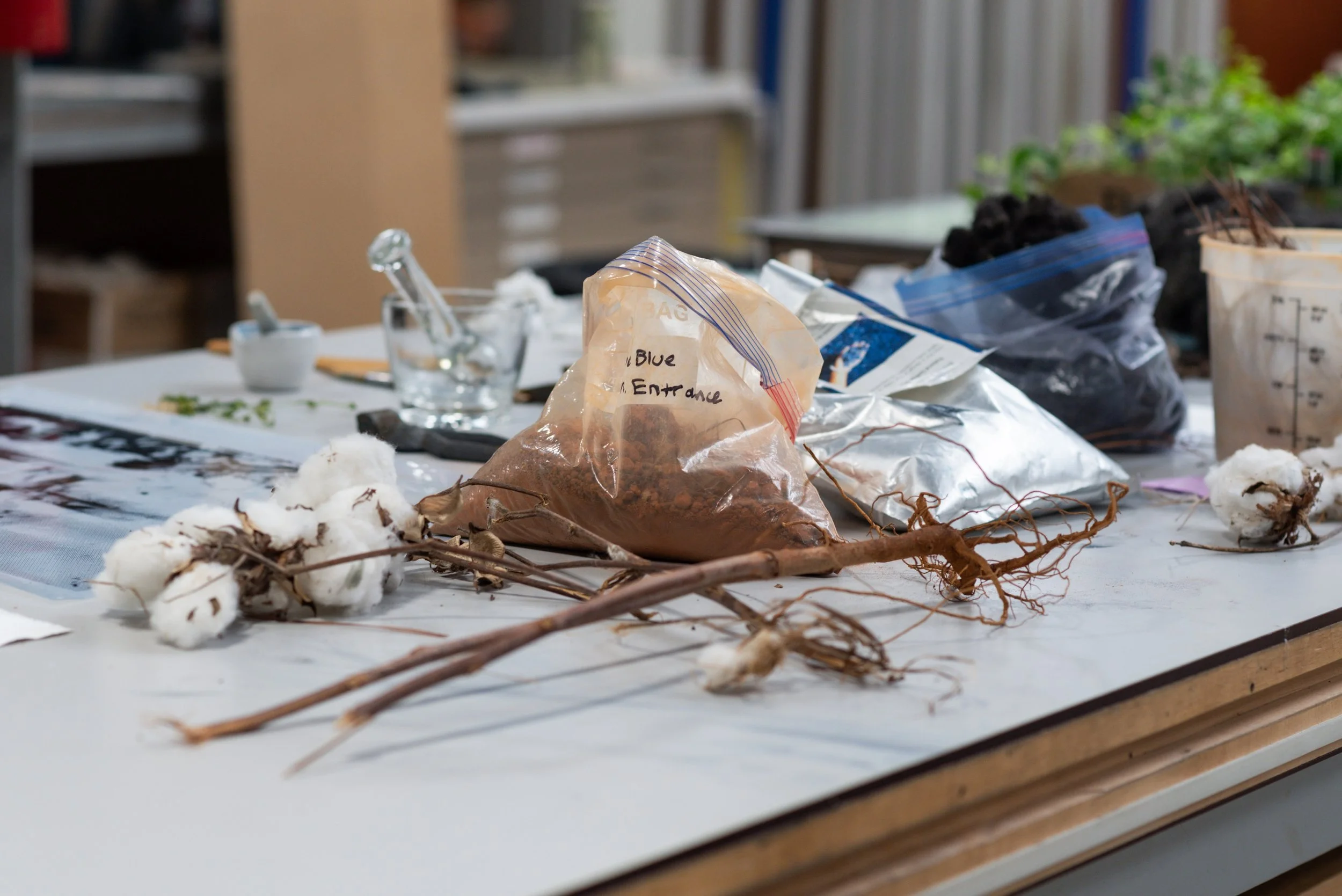
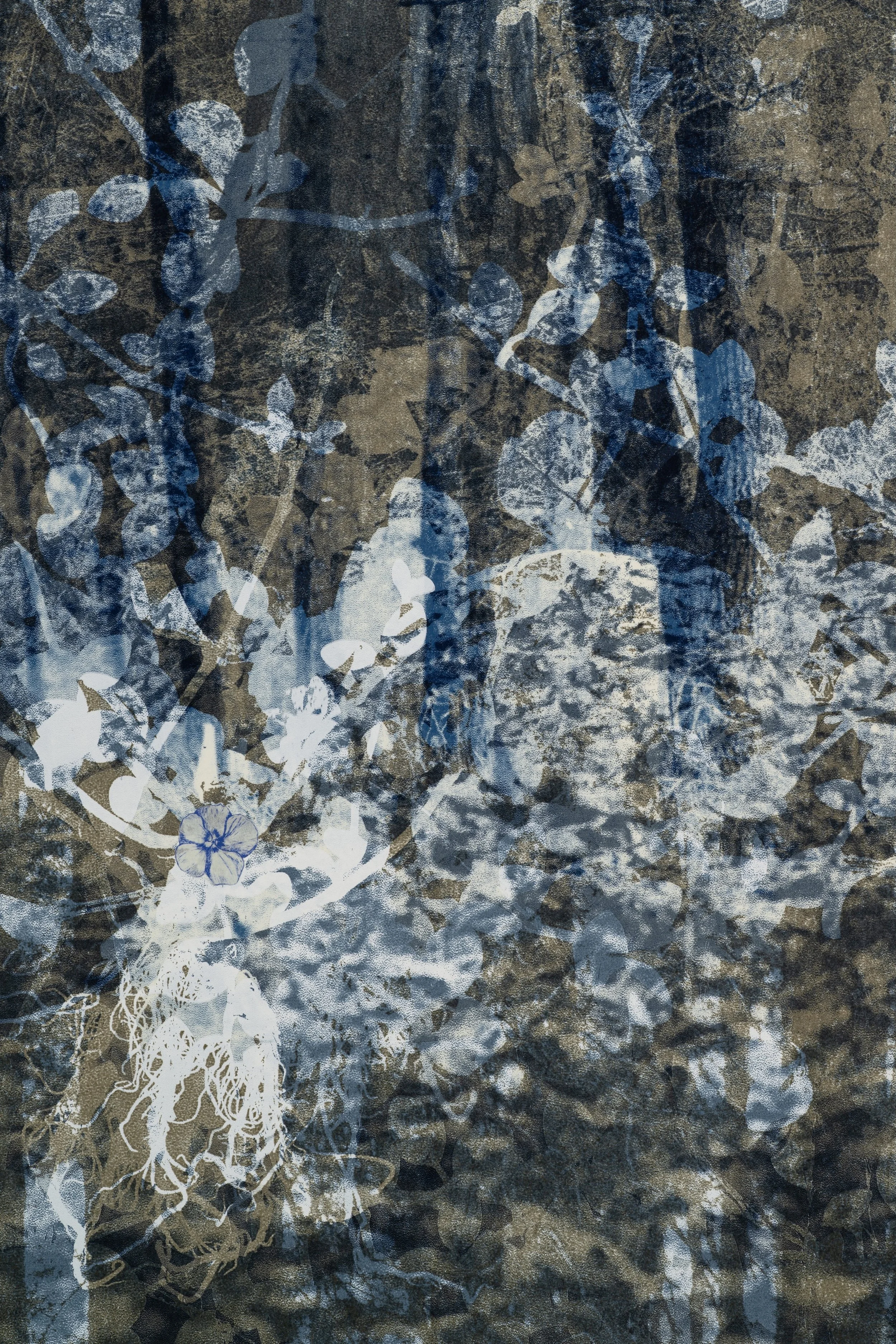
“Upon learning of her ancestors' enslavement on True Blue plantation in Fort Motte, South Carolina, Gbadebo made the site a focal point of her work. For the past three years, she has hand dug soil from the cemetery that she then transforms into clay for her ceramic vessels. The works' unique sizes and anthropomorphic shapes instinctively develop as she hand builds each of them using a Nigerian and Cameroonian coiling technique. Beyond the soil which they are made of, Gbadebo’s vessels carry—inside them or on their surfaces—invocations of True Blue’s landscape, sometimes being filled with pine needles, Carolina gold rice or woven segments of donated hair, all while acting as bodies occupying space.”

The exhibition is on view from September 4th to October 18th, 2025.

Learn more about the exhibition here!

Printing in Black America Featured in Print Center New York Exhibition

Ahead of the official release of Printing Black America: Du Bois’s Data Portraits in the 21st Century by William Villalongo and Shraddha Ramani anticipated for Spring 2026, this monumental collaborative portfolio will debut in the exhibition Data Consciousness: Reframing Blackness in Contemporary Print at Print Center New York. The exhibition, curated by Tiffany E. Barber, will be on view in New York from September 18-December 13, 2025.

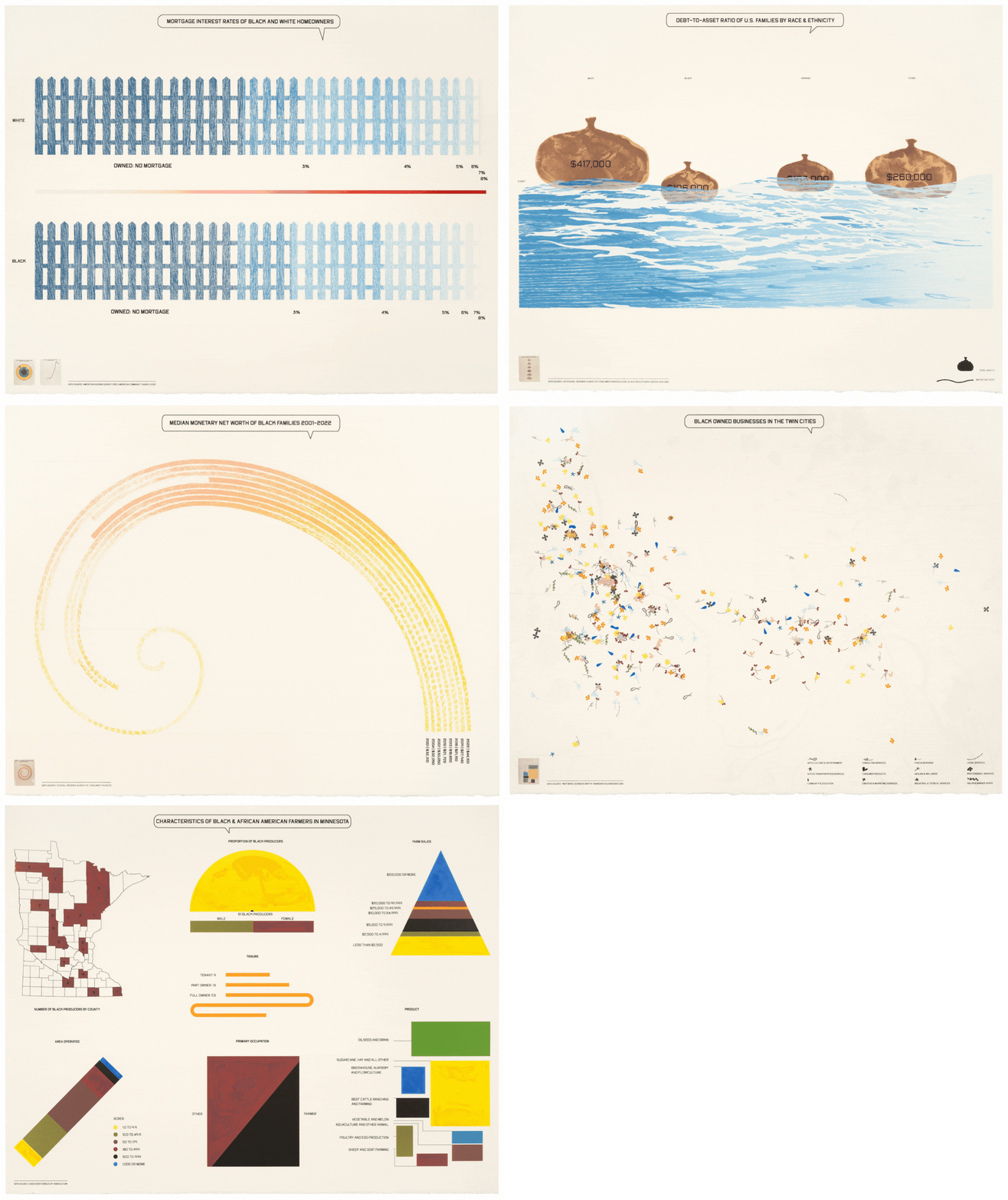
Sneak peek of the the prints published by Highpoint Editions.

Data Consciousness is conceptually and spatially anchored by this expansive, collaborative, and research-based print portfolio by artist William Villalongo and urbanist Shraddha Ramani. Their project, Printing Black America: Du Bois’s Data Portraits in the 21st Century, follows Du Bois’s ground-breaking approach to his iconic data visualization illustrations by using national data on Black life drawn from official records such as the 2020 U.S. Census as well as hyper-local oral testimonies and archives. The resulting portfolio of 30 images is produced in collaboration with six print publishers across the U.S.: Powerhouse Arts, Brooklyn; Graphicstudio, University of South Florida, Tampa; Island Press, Washington University, St. Louis; Highpoint Editions, Minneapolis; Paulson Fontaine Press, Berkeley; and Mullowney Printing Company, Portland, OR.

A select number of full portfolios of 30 prints and portfolios of prints published solely by Highpoint will be available in January. If you’d like to receive more information or reserve an edition, email our Gallery Director Alex Blaisdell at alex@highpointpritmaking.org.

Data Consciousness: Reframing Blackness in Contemporary Print brings together work by Black contemporary artists who explore expanded modes of printmaking to question the complex interplay between race, technology, and representation in our increasingly data-driven world. The exhibition features work by Tahir Hemphill, Julia Mallory, Silas Munro, Kameelah Janan Rasheed, and William Villalongo and Shraddha Ramani. It will run September 18—December 13, 2025 in the Center’s Jordan Schnitzer Gallery.

Data Consciousness is curated by Tiffany E. Barber, and its title references the concept of double consciousness articulated by the sociologist, historian, and activist W.E.B. Du Bois—the sensation and unreconciled striving of looking at and measuring oneself through the eyes of others. The exhibition also draws inspiration from Du Bois (1986–1963), who, at the 1900 Paris Exposition, presented a series of graphs, charts, maps, and photographs that visualized Black life after Reconstruction. Now considered important contributions to American design history and an early form of visual sociology and data science, Du Bois’s proto-modernist, hand-drawn infographics have had a profound impact in how we measure racial progress, and are of increasing relevance as the presence of data in daily life grows. The works on view in Data Consciousness—including prints, sculpture, installation, textile, and video—reframe Black contemporary art as a critical site for understanding how digital infrastructures amplify and constrain identity and autonomy.

Learn more about the exhibition here.


Events Surrounding the Exhibition

Opening Reception | Data Consciousness: Reframing Blackness in Contemporary Print

Thursday, September 18, 2025

6:00 PM 8:00 PM

Join us for the opening reception Data Consciousness: Reframing Blackness in Contemporary Print, an exhibition exploring how Black contemporary artists engage with expanded modes of printmaking to question the complex interplay between race, technology, and representation in our data-driven world. The exhibition features Tahir Hemphill, Julia Mallory, Silas Munro, Kameelah Janan Rasheed, and William Villalongo and Shraddha Ramani.

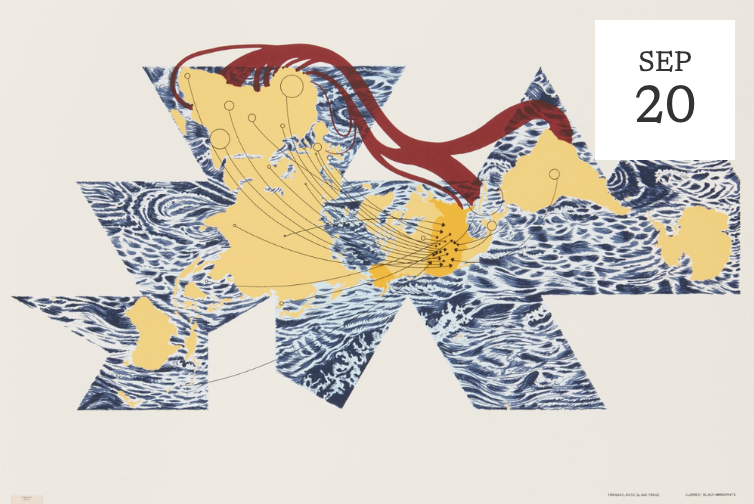
Data Consciousness Symposium

Saturday, September 20, 2025

2:00 PM 6:00 PM

The Cooper Union

On the occasion of the exhibition Data Consciousness: Reframing Blackness in Contemporary Print, this symposium gathers artists in the exhibition with multidisciplinary scholars to bridge past, present, and future thinking on the complex interplay of race, identity, data, and technology. Using the artworks and themes in the exhibition as a jumping off point, the symposium considers how Du Boisian legacies of art, design, literature, and sociology inflect contemporary cultural production, and explores the urgency of cultivating data consciousness in our present moment. The symposium is cohosted by Print Center New York and the Cooper Union School of Art.

Full program details will be announced on Print Center New York’s website in August.

IFPDA Print Month | Evening Viewing of Data Consciousness: Reframing Blackness in Contemporary Print

Thursday, October 9, 2025

6:00 PM 8:00 PM

Join us during IFPDA’s Print Month to celebrate the exhibition Data Consciousness: Reframing Blackness in Contemporary Print. The exhibition brings together work by Black contemporary artists who explore expanded modes of printmaking to question the complex interplay between race, technology, and representation in our increasingly data-driven world.

Remarks at 7pm will focus on the work that conceptually and spatially anchors the exhibition—an expansive, collaborative research-based print portfolio by William Villalongo and Shraddha Ramani called Printing Black America: Du Bois’s Data Portraits in the 21st Century.

Open to Print Center New York Members

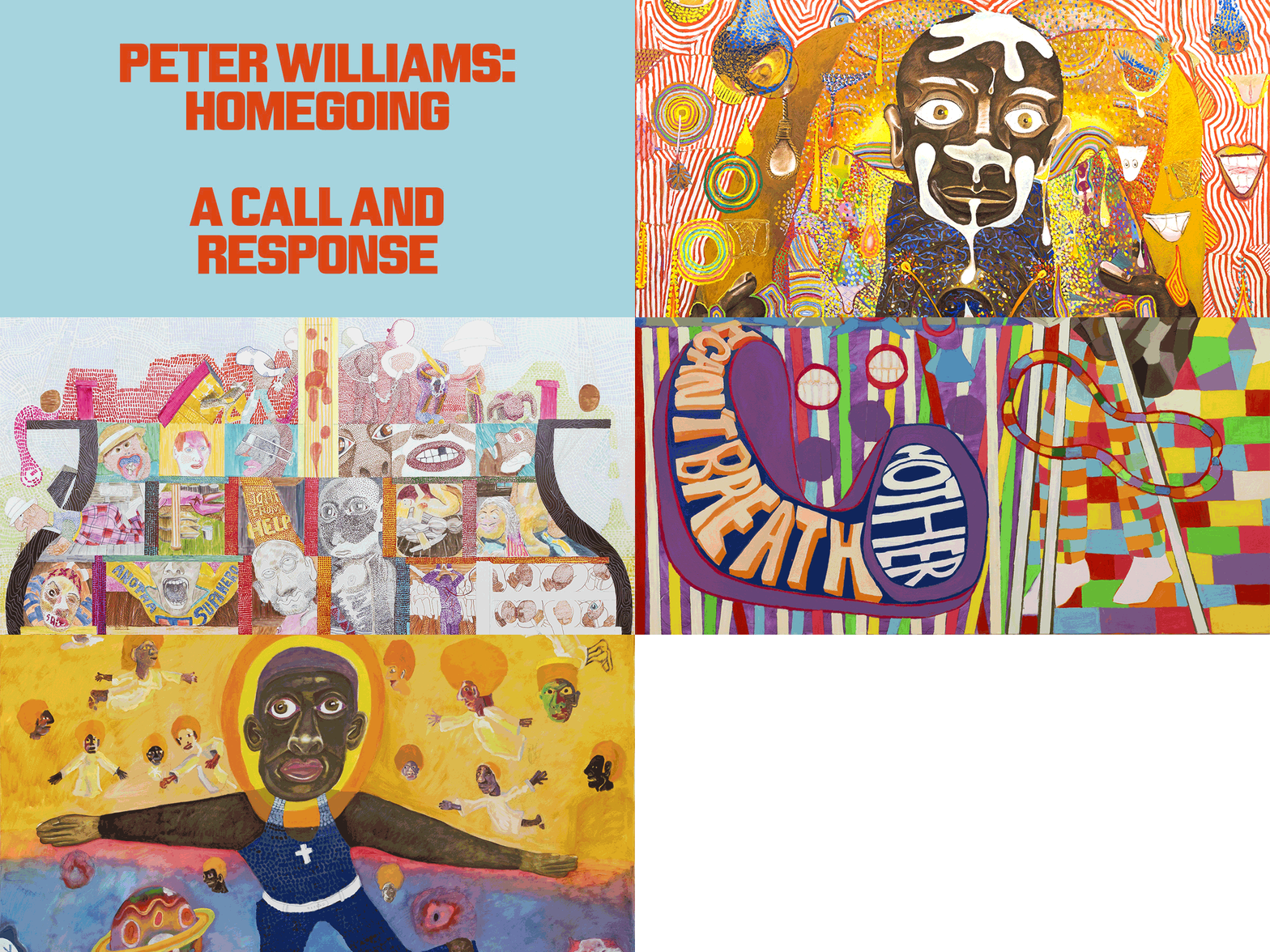
Seitu Ken Jones featured in Peter Williams: Homegoing–A Call and Response

Front Reflection and Side Reflection by Seitu Ken Jones will both be featured in Peter Williams: Homegoing–A Call and Response at Minnesota College of Art and Design from August 22 through Nov 1, 2025. Learn more about the exhibition here!

Opening Reception: Friday, September 5, 2025 6:00–8:00 p.m.

Peter Williams: Homegoing–A Call and Response celebrates the life, legacy, art, and motifs of artist and MCAD alumnus Peter Williams ’75 (1952–2021). To mark his recent passing and honor his life’s work, this group exhibition features a selection of Williams’ iconic paintings alongside those of fellow Black creatives, serving as a moment of remembrance and connection. Rooted in themes of history, presence, and liberation, Peter Williams: Homegoing moves beyond a retrospective into an active call-and-response through the cultural practice of “homegoing”–a memorial celebration of life, legacy, and freedom in the Black community.

Keisha Williams, Director and Curator of MCAD Gallery, states, “This exhibition marks the first time Williams’ work will be displayed in this context with fellow Black artists from Minnesota, which amplifies and serves as an offering for Williams' and our collective liberation. Through a chorus of artists' voices, it’s a symbolic and literal welcome back to MCAD, honoring his dedication to depict the presence and resilience of Black culture.”

Participating Artists include Ta-coumba T. Aiken ’74, Leslie Barlow MFA ’16, Sayge Carroll, Candice Davis ’18, Douglas R. Ewart, Russell M. Hamilton, Christopher E. Harrison, Maiya Lea Hartman, Leeya Rose Jackson, Seitu Ken Jones, Nia-Symonne, Lamar Peterson, Bobby Rogers ’14, seangarrison, Jovan C. Speller, and Peter Williams ’75.

Front Reflection and Side Reflection

Seitu Ken Jones, 2025

Lithograph on Rives BFK White paper

Edition of 7

Image: 33 ½ x 25 ½ inches

Paper: 40 ½ x 32 inches

Click here for availability or Email our Gallery Director Alex Blaisdell alex@highpointprintmaking.org

Learn more about Seitu’s prints here.

Nicola López is interviewed by Southwest Contemporary

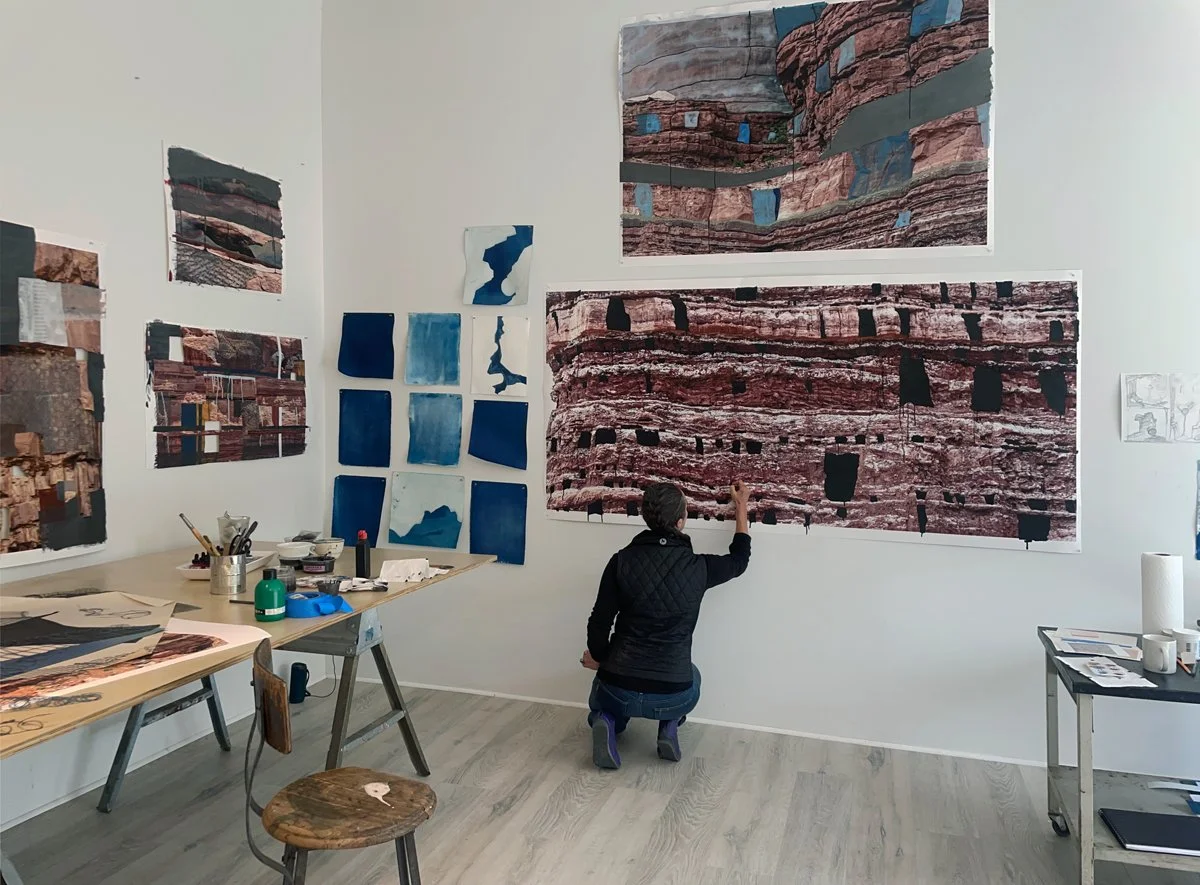
Nicola López at work in her studio. Courtesy the artist.

Highpoint Editions artist, Nicola López is interviewed for a Southwest Contemporary studio visit article. 

“Known for her expressive, graphic works that bring metallic urban landscapes to life, López’s often-architectural subjects twist and turn as if they might unfold off the paper, canvas, or hinges and bound towards the viewer. Think sharp geometry, cool tones, and being confronted by the formidable nature of many metropolitan structures—a quality one might otherwise grow numb to after living in cities.”

Nicola López working on Stratigraphy 5. Courtesy the artist.

After returning to her hometown In Santa Fe after nearly thirty years in New York, Lopez reflects on whether or not “the visual languages defining these two divergent places somehow exist in harmony.” Read more here!

Front Reflection and Side Reflection by Seitu Ken Jones

Front Reflection and Side Reflection

Seitu Ken Jones, 2025

Lithograph on Rives BFK White paper

Edition of 7

Image: 33 ½ x 25 ½ inches

Paper: 40 ½ x 32 inches

Click here for availability or Email our Gallery Director Alex Blaisdell alex@highpointprintmaking.org

Highpoint Editions is pleased to release Front Reflection and Side Reflection, two new lithographs by Minnesota-based artist Seitu Ken Jones. Inspired by the Zealy Daguerreotypes, these prints are Jones’s first with Highpoint Editions and exemplify a fierce dignity and resilience in response to a troubled history and continued adversity.


About Front Reflection and Side Reflection

Source imagery including an image of one of the Zealy Daguerreotypes and an image of the artist’s Great Grandfather.

In 1976, a set of photographs from 1850 was discovered in a Harvard University storeroom. The daguerreotypes were commissioned by Harvard Professor Louis Agassiz, who was an adherent of “scientific racism”, to prove the inferiority of Black people. The photographs were taken by Joseph T. Zealy and are now known as the Zealy Daguerreotypes. The seven subjects of the photographs were enslaved Africans who lived in South Carolina, and were posed in both clothed and nude positions.

For the last 10 years, Seitu Ken Jones has painted and created a series of self-portraits that recall the experiences of African American men over the last 400 years. Inspired by the Zealy Daguerreotypes, Seitu’s prints mirror the degrading and disturbing images captured by the photographer. “Each daguerreotype reveals an individual, deeply dignified and expressive. Their hurt, contempt, fatigue, utter refusal are unequivocal,” says Parul Sehgal of the original images.1 In each of Seitu’s self-portraits, he reveals himself in the most dignified and resilient manner of those whom he honors. Jones places himself as the subject and the documentarian, recontextualizing the images as a symbol of humanity, history, and a continued fight for freedom and liberty.

Detail of Front Reflection

Assistant Printer Brian Wagner preparing the stone for Side Reflection

Each layer of the 7-run lithograph calls attention to the process. The outer borders mimic the irregular edges of the lithographic stones the artist drew on to create the portraits. While the coloring of the background can also be viewed as referencing the sepia tones of an aged daguerreotype, each layer is an homage to the materials used in processing lithographic stones. The layers of brown were matched to both the liquid asphaltum used before inking the stone, and the color of the stone after a thin layer of gum arabic has been buffed in to preserve the image. The transparent grey layer that makes up the background echoes the cool grey of the lithographic stone. The black of the lithographic crayon drawing is also iconic to the lithographic process and legacy; furthering these prints’ place as a contemporary reflection of historical statements and processes.

Lead Printer-in-Residence Judith Baumann and Assistant Printer Brian Wagner printing one of the layers of Front Reflection.

Earlier proofs of Front Reflection and Side Reflection in the studio.

Seitu Ken Jones signing Side Reflection on May 6th, 2025


Seitu Ken Jones (b. 1951) is a Saint Paul, Minnesota based artist whose interdisciplinary practice works to restore our Beloved communities by blending art, food, conversation and beauty. Working on his own or in collaboration, Jones has created over 40 large-scale public art works. He's been awarded a Minnesota State Arts Board Fellowship, a McKnight Visual Artist Fellowship, a Bush Artist Fellowship, a Bush Leadership Fellowship, and a National Endowment for the Arts - Theater Communication Group Designer Fellowship. Seitu was awarded a Loeb Fellowship at the Harvard Graduate School of Design and was the Artist-in-Residence in the Harvard Ceramics Program. He was Millennium Artist-in-Residence for 651 Arts in Brooklyn, NY, and was the first Artist-in-Residence for the City of Minneapolis. In 2014, he integrated artwork into three key stations for the Greenline Light Rail Transit in the Twin Cities.

A 2013 Joyce Award, from Chicago's Joyce Foundation allowed Seitu to develop CREATE: the Community Meal, a dinner for 2,000 people at a table a half a mile long. The project focused on access to healthy food and community conversation. Beyond art making, Seitu worked with members of his neighborhood to create Frogtown Farm, a 5-acre farm in the heart of the City of Saint Paul. He is the recipient of the 2017 Distinguished Artist Award from the McKnight Foundation. His 2017 HeARTside Community Meal in Grand Rapids, MI was awarded the Grand Juried Prize for ArtPrize Nine. A retired faculty member of Goddard College in Port Townsend, WA. Seitu has a BS in Landscape Design and an MLS in Environmental History from the University of Minnesota.

For availability and to purchase Front Reflection and Side Reflection, email our Gallery Director Alex Blaisdell alex@highpointprintmaking.org


Highpoint Editions Heads to IFPDA Print Fair 2025

Join us from March 27 through March 30 at the Park Avenue Armory for the 2025 IFPSDA Print Fair! Highpoint Editions is delighted to present a selection of new editions by Njideka Akunyili Crosby, Julie Mehretu, Andrea Carlson, Leslie Barlow, and Seitu Ken Jones.


IFPDA Print Fair 2025

LOCATION

Park Avenue Armory 643 Park Avenue, New York, NY


VIP PREVIEW

Thursday, March 27, 5-9 pm


PUBLIC HOURS

Friday, March 28, 11 am - 7 pm

Saturday, March 29, 11 am - 7 pm

Sunday, March 30, 11 am - 5 pm


MORE INFORMATION

FineArtPrintFair.org

Images of IFPDA Fair by Annie Forrest

Rolling Head by Andrea Carlson

Rolling Head

Andrea Carlson, 2025

22-run screenprint on Coventry Rag paper

Edition of 20

36 ¼ x 48 ½ in.

Click here for availability or Email our Gallery Director Alex Blaisdell alex@highpointprintmaking.org

Highpoint Editions is pleased to release Rolling Head, a new screenprint by Minnesota-based artist Andrea Carlson. This 22-run screenprint is Carlson’s third print with Highpoint Editions and touches on stories of misogyny and its pervasiveness within indigenous narratives, art history, and mythology.


About Rolling Head

Andrea Carlson unmoors images to confront and reframe history as a battle for land and the ways it is imagined. In her densely layered prints, visual referents move across turbulent landscapes organized by the consistent horizon line of Lake Superior. Imagery, including mica hand and talon forms from ancient Woodland earthworks, horses and cowboys, masks from the 1962 film Mondo Cane, bent land marker trees, Joseph Beuys’s 7000 Oaks project, and more fills these prints to draw attention to histories of erasure and dispossession.

Andrea Carlson’s other prints with Highpoint Editions - Anti-Retro (2018) and Exit (2019)

Her new print, Rolling Head, references a common figure in Woodlands and Plains narratives, “Rolling Head,” said to be the roving head of a woman decapitated by her husband for infidelity in one of the first acts of domestic violence on Turtle Island. Her head continues to roll through the world, chasing her children, either out of a cannibalistic hunger to consume them or, in some tellings, to be with them in an act of endless love. Carlson places two headless female forms—the Niké of Samothrace and the blue imprint of a woman’s nude body from Yves Klein’s Anthropométries series (1960)—in front of a roiling lake waters, and two woodpeckers, the bird that in the version of the story recounted to Carlson was the adulterous partner of Rolling Head, fly forth as if emerging from their necks. The textual reference to Orion at the center of the print, another mythical perpetrator of sexual violence against women nonetheless heroized in the stars, notes that even the sky is full of imagined misogynists and that the origins of such narratives of violence against women can be located anywhere, even as they endlessly follow Indigenous communities into the present.

–Statement by Christopher T. Green, adapted from the exhibition “The sky loves to hear me sing: Woodland Art in Transmotion” on view September 12 – October 29, 2024, The List Gallery at Swarthmore College. An early trial proof of Rolling Head was on display in the exhibition. Read the larger statement from Christopher T. Green here.


Andrea Carlson painting a film over a test print.

Since her first print with Highpoint Editions in 2018, Andrea Carlson has taken to the process of screenprinting naturally. The artist hand-painted each large film separation prior to handing them off to the printers to expose onto screens and painstakingly chose each color to infuse the composition with energetic tension and brilliant intensity. Carlson and the Highpoint Editions team evaluated each layer’s color to ensure the finished print communicated her vision as she intended.

Like her paintings, Carlson’s prints are densely layered with reference and pattern –commenting on the tactics of colonialism as well as her family and peers, Ojibwe culture, and Indigenous sovereignty. Rolling Head creates a whirlpool of dialogue amongst vivid hues and stunning line-work.


Andrea Carlson (Grand Portage Ojibwe/European descent, b. 1979) is a visual artist working in northern Minnesota. Carlson works primarily on paper, creating painted and drawn surfaces with many mediums. Her work addresses land and institutional spaces, decolonization narratives, and assimilation metaphors in film. Her work has been acquired by institutions such as the Whitney Museum of American Art, The Walker Art Center, the Museum of Contemporary Art in Chicago, The British Museum, the Denver Art Museum, the Minneapolis Institute of Art, and the National Gallery of Canada.

Carlson has been the recipient of numerous grants and fellowships including those awarded by the Carolyn Foundation, the Joan Mitchell Foundation, the Minnesota State Arts Board, The LeRoy Neiman and Janet Byrne Neiman Foundation, the United States Artists Fellowship, and the McKnight Foundation. Carlson has exhibited in Canada and has had solo exhibitions at the Minneapolis Institute of Art, La Centrale at the Powerhouse (Montreal, QC), and the Plains Art Museum (Fargo, ND), among others. In addition to the many reviews and articles on her work, Carlson has worked as a writer and curator, and is an accomplished lecturer.

For availability and to purchase Rolling Head, email our Gallery Director Alex Blaisdell alex@highpointprintmaking.org

On Rolling Head, Essay by Christopher T. Green

Andrea Carlson (Grand Portage Ojibwe/European descent, b. 1979) recontextualizes images to confront and reframe history as a battle for land and the ways it is imagined. Her paintings and prints reproduce seemingly disparate images, objects, and textual references across recurring horizons and shorelines. Her referents meander through these visual territories as roving characters inquiring into the tension between forced colonial absence and the deeply etched presence of a land base.

In densely layered prints, such as Exit (2018) and Anti-Retro (2018) pictured above, visual referents move across these turbulent landscapes. Diverse images—including mica hand and talon forms disinterred from ancient Woodland earthworks; horses and cowboys; masks from the 1962 exploitive documentary film, Mondo Cane; shells such as miigis; bent land-marker trees; and Joseph Beuys’s 7000 Oaks project—fill these prints to draw attention to histories of erasure and dispossession. Many of the objects and references evoke the movements of stories and migrations across ancestral territories; others recall the violence against Indigenous communities inherent in Western films, as in Anti-Retro, or the destruction to Indigenous monuments and earthworks through the construction of highways like I-94, as in Exit. Throughout, Carlson examines the settler impulse to erase past histories in order to make long-inhabited land appear otherwise unoccupied when taken over, redeveloped, and consumed.

Carlson’s works are frequently organized around a consistent horizon line. Some of these landscapes are based on the Lake Superior shoreline and her home in northern Minnesota, Gichi Bitobig, or “Great Double Bay,” in Ojibwemowin, also known as Grand Marais. Other landscapes are imaginary. Her play of shifting, layered imagery unfolds to the viewer over time. She builds her compositions gradually through multiple layers, evoking temporal and geological strata. “Land changes, it has to change,” Carlson declares, and her prints contain not only symmetries but also resplendent variety, shifting “like the wake behind a boat or waves on a lake.” 1 The prints organize space but also break up static and stereotypical depictions of land, peoples, and cultures. The shining mica hands in Exit, for example, printed with a pigment that contains mica silicate dust, are held up as if to indicate “STOP.” Pictorially, they interrupt the linear recession into the horizon line and deny the viewer easy entry into the visual space, suggesting these layered landscapes require permission, or at least contemplation, to access.

For Carlson, printmaking is a medium that can be responsive to the fear of the loss of land, life, and livelihood that undergirds Indigenous communities. In their seriality and multiplicity, prints are resilient to loss and counteract historic attempts at dispossession and erasure. 2 As she recently described for the Museum of Contemporary Art Chicago, “I use the iteration to give it some movement, to give it a multiple existence in the same space. You can't hold it all in your head at the same time. You are forced to make decisions with what you are looking at in a way where you are not able to possess it all at once.” 3 Her landscapes are thus what scholar Kate Morris describes as “anti-invitational”—layered with imagery that is neither easily digestible nor accessible to occupation by the viewer. 4 Indeed, not only do the prints unfold over time, but Carlson sometimes embeds private communal meanings within her work, intended only for insiders.

In her new print Rolling Head (2025), Carlson references a figure common to Woodlands and Plains narratives, a woman from the early history of the world known as “Rolling Head,” who was one of the first victims of domestic violence on Turtle Island. After being discovered committing infidelities with a snake or, in the Ojibwe version of the story that Carlson knows, a woodpecker, the woman is decapitated by her husband. Her head continues to roll through the world, chasing her children, either to be with them in an act of endless love or, in some tellings, out of a cannibalistic hunger to consume them.

Two headless female forms fill the center of the print in front of turbulent lake waters: the Niké of Samothrace and the blue imprint of a woman’s nude body from Yves Klein’s Anthropométries series (1960), a “living paintbrush.” The bodies frame the name “ROLLING HEAD” and the words “Orion just outside my window” at the center of the print. The textual reference to the Orion constellation, named another mythical perpetrator of sexual violence against women nonetheless heroized in the stars, notes that even the sky is full of imagined misogynists. 5 Carlson thus deploys varied imagery to show that the origins of such narratives of violence against women can be located anywhere, even as they follow Indigenous communities into the present. Yet two woodpeckers also fly forth from the bodies as if emerging from their necks. Ecologically, woodpeckers are known as healers for their ability to quickly and efficiently clear invasive insects from stands of trees. Here, their wings echo those of Niké and the out-flung arms of the headless blue Anthropométrie, suggesting the possibility of freedom or an escape from such cycles of violence.

In prints like Rolling Head, Carlson is thus engaged in a form of storytelling that takes place across narrative and temporal space, moving through cultural referents to find a shared language. Her approach to visual space and itinerant art historical motifs match pictorial and narrative movement. As Vizenor notes, “Carlson creates great layers of conceptual scenes, silhouettes of cultural absence and presence, and converted landscapes of time, space, and course of memories.” 6 Images are redeployed to new memorial functions as their place in such narratives shift conceptual positions. Thus, the shifting nature of Carlson’s visual treatment of images and their layers are, as she describes, "alive and ever-changing or ever shimmering.”7

–Excerpt from Christopher T. Green, “Woodland Native Art in Transmotion,” in The sky loves to hear me sing: Woodland Art in Transmotion, Christopher T. Green, ed., exhibition catalog produced in conjunction with the exhibition of the same name on view September 12 – October 29, 2024 at The List Gallery at Swarthmore College. Courtesy of the author. An early trial proof of Rolling Head was on display in this exhibition.

Christopher T. Green is a writer and scholar whose research, curating, and teaching focus on modern and contemporary art, Native North American art and material culture, and the interrelation of Indigeneity, primitivism, and Euro-American art within global histories of modernism. He recently curated “Space Makers: Indigenous Expression and a New American Art” (Crystal Bridges Museum of American Art, April 13-September 30 2024) and “The sky loves to hear me sing: Woodland Art in Transmotion” (List Gallery, Swarthmore College, September 12-October 29 2024). He received his PhD in Art History from the CUNY Graduate Center, and currently serves as Visiting Assistant Professor of Art History and Environmental Studies at Swarthmore College.

Rolling Head

Andrea Carlson, 2025

22-run screenprint on Coventry Rag paper

Edition of 20

36 ¼ x 48 ½ in.

Click here for availability or Email our Gallery Director Alex Blaisdell alex@highpointprintmaking.org


Andrea Carlson (Grand Portage Ojibwe/European descent, b. 1979) is a visual artist working in northern Minnesota. Carlson works primarily on paper, creating painted and drawn surfaces with many mediums. Her work addresses land and institutional spaces, decolonization narratives, and assimilation metaphors in film. Her work has been acquired by institutions such as the Whitney Museum of American Art, The Walker Art Center, the Museum of Contemporary Art in Chicago, The British Museum, the Denver Art Museum, the Minneapolis Institute of Art, and the National Gallery of Canada.

Carlson has been the recipient of numerous grants and fellowships including those awarded by the Carolyn Foundation, the Joan Mitchell Foundation, the Minnesota State Arts Board, The LeRoy Neiman and Janet Byrne Neiman Foundation, the United States Artists Fellowship, and the McKnight Foundation. Carlson has exhibited in Canada and has had solo exhibitions at the Minneapolis Institute of Art, La Centrale at the Powerhouse (Montreal, QC), and the Plains Art Museum (Fargo, ND), among others. In addition to the many reviews and articles on her work, Carlson has worked as a writer and curator, and is an accomplished lecturer.

For availability and to purchase Rolling Head, email our Gallery Director Alex Blaisdell alex@highpointprintmaking.org

Interview with Jasper Duberry

This month, we had the opportunity to interview Jasper Duberry, co-op member, recent Full Color Print Fellow, artist, and new dad (!!!), about their creative practice, inspiration, and what being a part of Highpoint has meant to them.

I am a printmaker who lives in Minnesota, where I grew up most of my life.  My printmaking is focused primarily on the form of relief through woodcuts.  Art has been a passion of mine for as long as I can remember.  As a kid, I would draw the Rugrats and provide coloring sheets for my kindergarten class. My love for printmaking, however, didn’t start until I learned the art form in college.  I graduated with a Bachelor of Fine Arts from Viterbo University in La Crosse, Wisconsin (Go V-hawks!). The themes that I like to explore are those encompassing the black experience – pain, joy, excellence, healing, and resistance, to name a few. Exploring these themes has provided an avenue for me to reflect and express personal emotions, thoughts, and feelings of being a black male in America.

Can you tell me more about your current exhibition in the Threshold gallery at Highpoint?

Absolutely. First of all, I am extremely grateful and fortunate that Highpoint makes this available for it’s members to have this fantastic opportunity.  I think every artist dreams of having their own show at some point so opportunities like this are fantastic to come upon. 

The woodcuts in my show explore themes from my experiences and encompass the Black experience – pain, joy, excellence, healing, and resistance, to name a few.  As I have been working on my pieces, along with curating my show, I wanted to tell a story that ranges from pain and struggle through resistance and rallying to creating the future we want to see and victory.  I have also been drawn to using the medium and my pieces towards educating on Black history, topics and moments as well.  With that, you will see my piece “Just Us,” which is focused on the Voting Rights Acts of 1965 – which helped give Blacks and other marginalized groups protection to be able to vote in America.

I believe that the viewers, no matter what walk of life they are from, will be able to resonate with the pieces.

You've been involved with Highpoint in several capacities, including co-op member and Full Color Print Fellow. Could you talk about your experience?

My experience with Highpoint started with the Full Color Print Fellowship. It was truly timing and stars aligning that brought me to Highpoint. After being gone for several years, I had just moved back to Minnesota and was looking around for a printmaking studio.

What drew me to Highpoint was their state-of-the-art studio, availability of many different printmaking styles, and a clear commitment to diversity and community.

When I reached out to check it out, I was introduced to the Full Color Fellowship and told about it.  That confirmed my prenotion on how Highpoint showed its commitment to diversity and community.  My experience with the fellowship and time after it has been nothing short of amazing.  My favorite part of being at Highpoint through these experiences has been the opportunity to meet many visiting artists, getting to explore many different techniques and classes along with non-stop continual support from staff and other members on whatever venture or idea that I want to explore from themes to materials or research to help foster my thoughts and ideas. I would say my highlight so far has been the opportunity to hang my pieces in the Threshold Gallery.  Special shoutout to Josh, who is always available for questions and ideas and helping make this show physically happen. 

Highpoint is a community where everyone belongs. A place where everyone is able to be themselves both personally and artistically and has the freedom to explore whatever idea or theme they would like to without fear and provided the tools and guidance along the way to help them get there.

Obviously, being part of the Full Color Print Fellowship, I would say that this is something I am very passionate about and would love to see continued and for others to know about.  I would also challenge those who don’t think about representation in art to take some time to educate themselves on it.  This can be seen and not seen on many different levels, from the art that we are shown (and again not shown) in museums to deciding who dictates what messages and art should be seen, and at its smallest scale, it is programs like this that start to turn the tide with some of these ideas and concepts. 

Highpoint has been a huge help with both my creative process and my early career as a printmaker.  From a creative process standpoint, Highpoint has been instrumental not just in the equipment and space it provides as far as co-op but also in the continual education in the form of classes and access to visiting artists, shows, and resources as well. 

Some of the best magic about Highpoint is how all the artists here are on similar journeys of wanting to improve, help one another, and be successful. There hasn’t been a single day that I am in the studio where a fellow co-op member hasn’t asked what I was working on or made a suggestion for technique or simply an artist to check out.  This magic also carries over into our careers as far as getting the opportunity to meet possible patrons and collectors at the many different co-op shows and gatherings. 

instagram.com/jasperduberry
jasperduberryprints.bigcartel.com

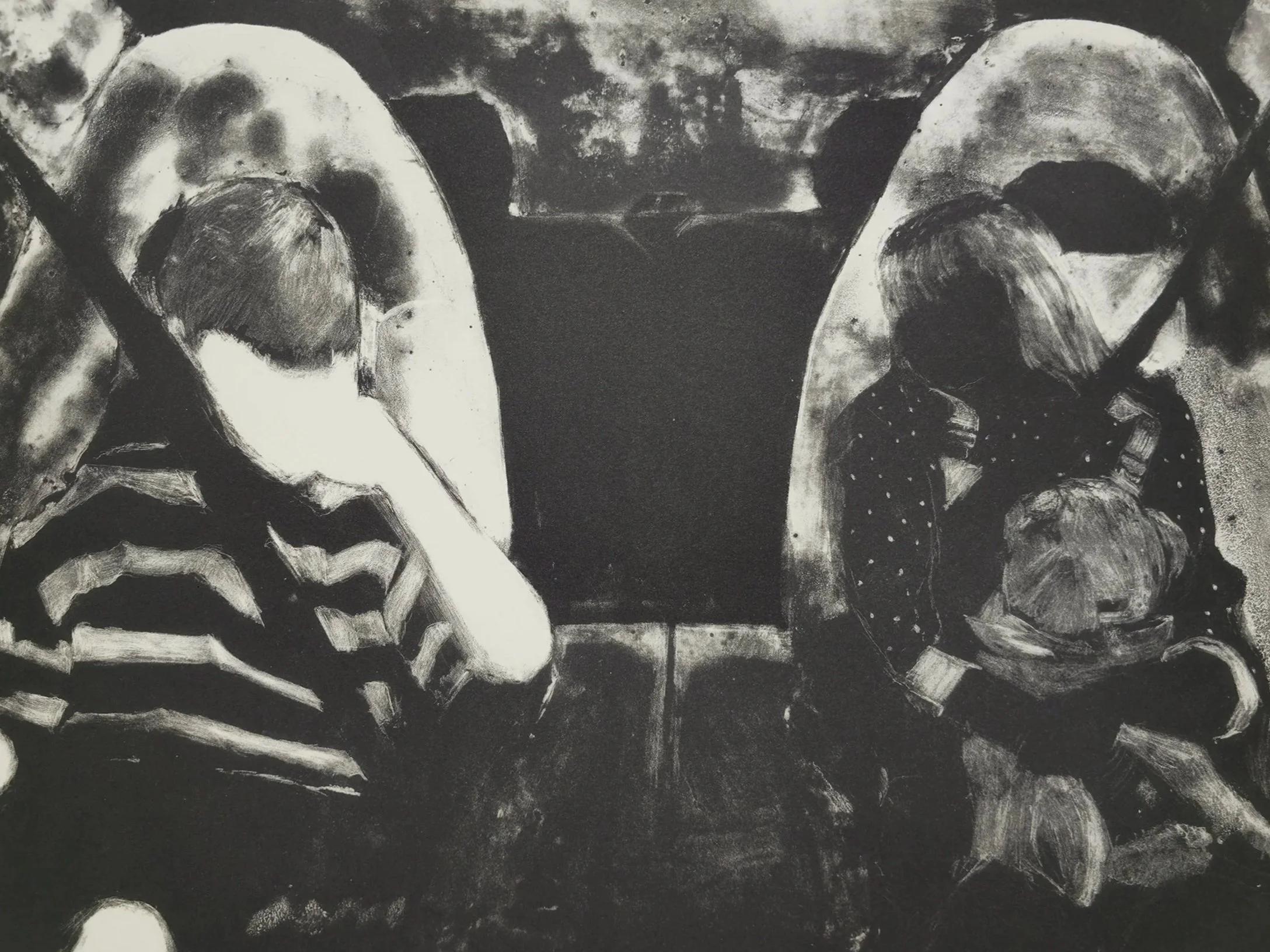
From the Back of the Bus, now on display through December 31, 2024.

Nicola López featured in Tamarind Exhibition

Above: Nicola Lopez, Parasites, Prosthetics, Parallels and Partners (7), 2017 | Photo: Courtesy of Artsy.net

Highpoint Editions artist Nicola López featured in a Tamarind group show titled Home Again: Artists on NM. The exhibition “comprises a selection of works on paper created by artists who are either based in or inspired by New Mexico, including Andrew Dasburg, Judy Chicago, Jim Dine, Rose B. Simpson, and Emmi Whitehorse, among others. The exhibition is an expanded and extended showing of Tamarind at El Zaguán.”

The exhibition is on view from December 6, 2024 through January 18, 2025. Learn more here!

Interview with Grace Sippy

My name is Grace Sippy and my primary method of creating art is through printmaking. I earned a BFA in Printmaking at the University of Iowa and an MFA in Printmaking at the University of Alberta. For over 15 years, I have explored all the print disciplines, whether through my own practice or by way of teaching at the university level, workshops, and demos. Though my primary art form has been printmaking, over the years, different mediums have been part of my practice, such as drawing, photography, and artists' books.

 If I had a double of myself, they would have learned all the disciplines of book arts (paper making, book forms/binding, letterpress, etc.); I have done a little of each of these things and have taught them, but I have never gone through a lot of formal training.

We recently asked Grace about their experiences at Highpoint and what it has meant for their creative practice.

Can you tell us about some of your current projects/ideas/inspiration?

My current work pursues a completely new exploration of concept, technique, and methodology, compared to what I have previously concentrated on for over a decade. Loss, grief, the ephemeral, and a deep longing for the past are themes sometimes experienced in Motherhood. It began with an artist book, 7 Seconds, that I printed and made imagery for while a Grand Marais Art Colony Juried Artist in Residence in 2020. Starting the book was a process of healing and processing a loss I had suffered a year before. Over the next two to three years, I slowly bound the book, ultimately completing it in 2023.

Since receiving the McKnight Artist & Culture Bearer Fellowship in Printmaking, I have been working on some paper sculptures and a collagraphic series incorporating text from 7 Seconds. Using garments once worn by my young children, I have transformed them into collagraphs and explored several ways of creating prints from them. Some exist as embossments, others inked and printed. Chine-collé and embroidery are used for other elements in the print: mimicking fabric, text on tags, or small garment details. The transformation of the garment to a printing matrix is a paradox, destroying the garment in the process but creating something new, a remnant of what was there. This currently untitled series presents a reflection of loss and grief: of hopes of having a child, of a child since grown, and the loss of a child.

Can you tell me more about your goals/process during your current McKnight Printmaking fellowship and what growth/changes/inspiration you have found along the way?

I have been highly motivated to get as much work done during the fellowship as possible for a few reasons. One is that the course of making this work is one of healing for me and of processing different aspects of Motherhood. These are things that cannot be forced or rushed, but the fellowship is a period where I get to have a lot of time to devote to it through artmaking. There is a dichotomous aspect to the work where part of me wants to feel heard, and part of me wants to hold a secret. Another reason to explore as much as I can is that I likely will not have as much time to devote to my practice after the fellowship ends.

The framework of graduate school keeps coming to mind—time, resources, support, starting a new vein of work, the spirit of exploration, etc. The work I’ve been creating during the fellowship has been very different than what I’ve been doing for a long time, so naturally, there’s been a lot of investigations. Paper, for example, a range of weights, textures, colors, etc. I’ve also been working on some paper sculptures, something I haven’t done in over a decade, and collagraph, a printmaking technique I haven’t done in a long time. Working with text and images created some challenges with the collagraphs. One was figuring out how to integrate them together in a way that made sense for the concept while considering aesthetics. For this series, I’ve used embossment, embroidery, letterpress, and chine-collé, among others. Collagraphs are wonderful because you can print them as intaglio plates, relief plates, or both at the same time. I’ve also been able to capture lots of detail with just embossing (also called blind embossing: running plate through the press with no ink on it.)

You've been involved with Highpoint in several different capacities. Could you talk about your experience, what it means to you, and the lessons learned?

I’ve gotten to experience many aspects of what Highpoint has to offer: co-op membership and exhibiting opportunities, receiving the Jerome Early Career Residency and McKnight mid-career fellowship, as well as teaching demos, samplers, workshops, and classes, so it has been very rich for me as an artist and individual. Community is one of the biggest benefits of being at Highpoint, and it feels like a special blend of workplace and family. I’ve been involved with HP for six years now; some friends have come and gone, and some remain. I remember a “regular gang” of co-op members—we all sat in more or less the same places at the work tables—and me feeling welcome. We’d have conversations while we worked, and I’d get to know them while they got to know me. That group has shifted somewhat, but it remains a warm memory for me.

Being able to scratch the teaching itch has also been very impactful. Before we moved to the TC, I was an assistant professor in printmaking at the University of Wisconsin-Stevens Point; I taught all levels and areas of printmaking and courses in typography and basic drawing. I even taught a broad course on book arts, with paper making, artist books, and printing. After a couple of years, I was let go due to major budget cuts, which left me discouraged and disillusioned. I had worked so hard and so long for that “dream job,” had done all the right things, and was still let go. It was one of several types of losses I experienced within a short period, and I learned nothing is guaranteed and to not put anything or anyone on too high of a pedestal. When I came to HP, I began teaching demos, samplers, and, eventually, full classes and workshops. It is not the same as teaching at the university level, but it’s still an outlet for my desire to help others, share knowledge, and connect through a common love of art. I don’t know what teaching and artistic practice will look like for me going forward, but I’m trying to keep an open mind.

HP provides so many great programs. The educator in me has a heart for all education-related programs. Anything that helps folks learn about and experience printmaking gets me excited. Being able to teach at HP is always so rewarding; I love to engage with students.

Has Highpoint or the co-op impacted your creative process or career?

Highpoint has definitely impacted my career as an artist and educator. Through the co-op, I’ve been able to continue my printmaking practice with more technical options than my home studio; I’ve also gotten to sell some work and gain some visibility, both as an artist and educator. The various programs I’ve been part of have led to further opportunities. In terms of impacting my creative process, having the space and equipment to explore what you could otherwise not afford through HP is huge. As I mentioned earlier, the McKnight alone has been an explosion of creative investigation for me.

Highpoint is. . . an epicenter—a major resource with a resounding impact.


gracesippy.com
Instagram.com/grace.sippy

Current/Upcoming Exhibitions:
McKnight Printmaking Fellowship Exhibition, opening March 7, 2025, at Highpoint

I will have a piece at Rosalux Open Door 19 at Rosalux Gallery. It runs from December 7th to 29th, with an opening reception on Saturday, December 7th, from 7 to 10 p.m. 

Interview with Melissa Sisk

This month, we had the opportunity to interview Melissa Sisk, co-op member and active community member, about their creative practice, inspiration, and what being a part of Highpoint has meant to them.

My name is Melissa Sisk, and with over a decade of experience in directing, designing,  and creating visual graphics, I’ve built a career focused on both educating and entertaining through visual art. My journey began with creating medical illustrations and animations, transitioned to managing and developing board game art, and more  recently, teaching graphic design classes at Dunwoody College of Technology. I’ve also enjoyed engaging in portfolio reviews, speaking events, and art panel moderation. More recently, I’ve been expanding my practice into the world of traditional printmaking,  specifically silkscreen printing.

Part of my creative practice is motivated by my love of the natural world and a desire to help others, which led me to earn a Master of Science in Biomedical Visualization. After graduating, I worked at the National Institutes of Health, where I created graphics for publications, marketing materials, and research. Here, I learned how to practice merging creativity with utility, using design to educate and inform while remaining visually captivating and aesthetically strong. 

A career-changing opportunity led me to Minnesota, where I joined my dream medical animation company. Here I got to further explore the intersection between art, science,  and storytelling while bringing client’s visions to life. I believe that the most powerful visuals are those that marry beauty with precision. This experience taught me how taking risks can lead to incredible rewards. 

Today, I combine my passions and experiences by teaching at the college level and creating at Highpoint Center for Printmaking. For me, creative practice is about pushing boundaries—experimenting with new techniques, materials, and ideas. I’m always looking for ways to grow, learn, and refine my work to better communicate the messages I’m passionate about. It also brings me great joy to amplify the work and voices of others. 

Can you tell me about some of your current projects/ideas/inspiration? 

I’ve recently taken a short break from creating new art after completing a significant project earlier this year: my first solo art show. This project came to life after I spent the summer of 2023 in the south of France. I was inspired by my experience of being an outsider and reflecting on what “otherness” means, both literally and metaphorically. I  began thinking about how I could reflect that in my work, and before the plane landed back in Minnesota, I learned about an open call from Alliance Francaise for artists to host their own exhibitions. 

This experience deepened my passion for screen printing, and I’m now reflecting on new directions for my work, including expanding my creative practice further into other printmaking techniques and exploring new themes of identity, belonging, and cultural perspectives. At the heart of my work is a desire to spark curiosity and inspire reflection. Whether I’m creating educational visuals or personal artwork, I aim to create pieces that resonate with the viewer long after they’ve seen them.

What drew you to printmaking? Which processes speak to you? 

I’m drawn to the versatility of printmaking, where each technique—whether it’s screen printing, etching, or lithography—offers a unique way to tell a story. My original goal in learning screen printing was to create my own graphic novel. Both graphic novels and screen printing allow me to transform intricate designs into tactile, expressive works that resonate visually and physically. Although I’m still in the early stages of developing this graphic novel, I’m gathering experiences and knowledge that will serve as stepping stones, guiding me toward that goal in the future.
You've been involved with Highpoint in several different capacities. Could you talk about your experience?

One of the most valuable lessons I’ve learned from screen printing is the importance of letting go of control and embracing the unpredictability of the process. Unlike other mediums, screen printing often requires a balance between precision and chance, and  I’ve come to appreciate how mistakes can lead to unexpected discoveries that push the boundaries of my work. 

Equally important was learning the courage to ask for help. The kindness and expertise shared by the co-op community helped me embrace the process in new ways and encouraged me to view my strategies differently. As a result, I was able to grow both personally and artistically while steadily moving forward in my work.

As an educator, I believe the Jerome Residency is one of the most important programs offered at Highpoint, as it supports the artistic and career development of early-career printmakers.  Artists in this program are not only encouraged to demonstrate imagination and rigor in producing new work, but also embrace curiosity and eagerness to learn technical  proficiency and craft. Their practice embodies a distinctive vision and authentic voice,  pushing the boundaries of convention through innovation, creative risk-taking, and  thoughtful inquiry. By supporting these artists, we help cultivate not only a dynamic and  forward-thinking artistic landscape but also a generation of empathetic, open-minded,  and inquisitive individuals who will engage with the world in meaningful and  transformative ways. 

Being a co-op member of Highpoint has profoundly impacted my mind and soul,  providing me with invaluable access to a vibrant artistic community and resources that have enriched my practice. The collaborative environment has allowed me to learn from fellow artists, expand my technical skills, and refine my creative vision. Additionally, the opportunity to work in a professional studio has strengthened my confidence, giving me the space to experiment, take risks, and push the boundaries of my work. This experience has not only deepened my artistic growth but has also broadened my professional network and opened doors for future opportunities in the field. 
melissasisk.com 
Instagram & X: @sisk_meli

Interview with Mads Golitz

My name is Mads, and I am an artist and educator in the Twin Cities. I received a BFA in Sculpture from the University of Puget Sound in Tacoma, WA. After graduating in 2020, I moved back to the Midwest and have found a home in Minneapolis’s arts community these past few years. Since moving here, I have grown as a teaching artist through various roles at Highpoint, starting as an Education Intern and currently as the Education Programs Assistant. 

We are pleased to introduce and celebrate Mads Golitz, our newest addition and Education Programs Assistant. We recently asked Mads about their experiences at Highpoint and what it has meant for their creative practice.

Can you tell us more about your current work:

Recently I have been reviving a past art style that depicts playful dancing figures. They originated as expressions of joy during hard times. Lately, I’ve been drawing inspiration for them from queer love and community. I am enjoying applying this old work to new print techniques, as well as exploring their connection to other themes in my life that I am hoping to explore more through my work this coming year. In short, I am a bit all over the place right now but excited about the direction I am heading. 

What drew you to Highpoint?

Highpoint was on my radar since moving to Minneapolis. It was exciting to see the various opportunities that were consistently being offered. Even now, I appreciate the range of levels of experience that Highpoint programming accommodates. It was encouraging to see classes for folks new to printmaking alongside grants for mid-career artists. For that reason, I saw Highpoint as a place where an artist, at any point in their career, could join and grow.

I might be biased here, but I feel most passionate about Highpoint’s education programs, especially for the youth. When students come to Highpoint for field trips, it is often the first time they have tried printmaking. I believe it is important to show kids spaces where people make art as a community and that they can see themselves making art in those spaces. The same is true for adults. I love to teach introductory classes to see folks who would not consider themselves artists discover or rekindle a love for creating.

Has Highpoint impacted your creative career/practice?

I am incredibly grateful for what Highpoint has done for my career. It has given me the space, resources, and opportunities to grow as an artist. From my time here, I have strengthened old printing techniques and learned new ones. Most importantly, Highpoint connected me to an arts community from which I can seek support, inspiration, and guidance. It has also allowed me to give back as a member of that community, taking on more responsibility as I step into new roles.