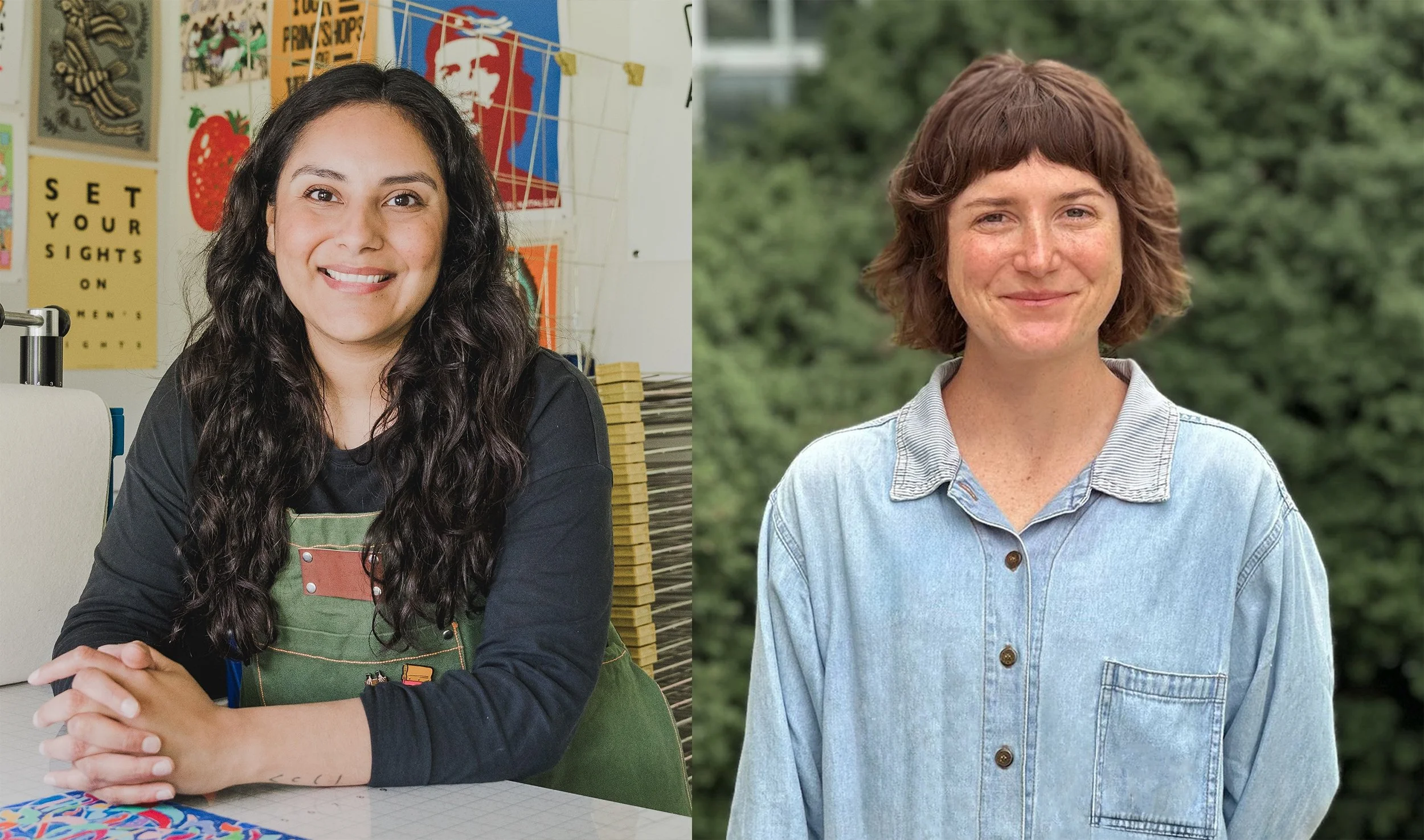
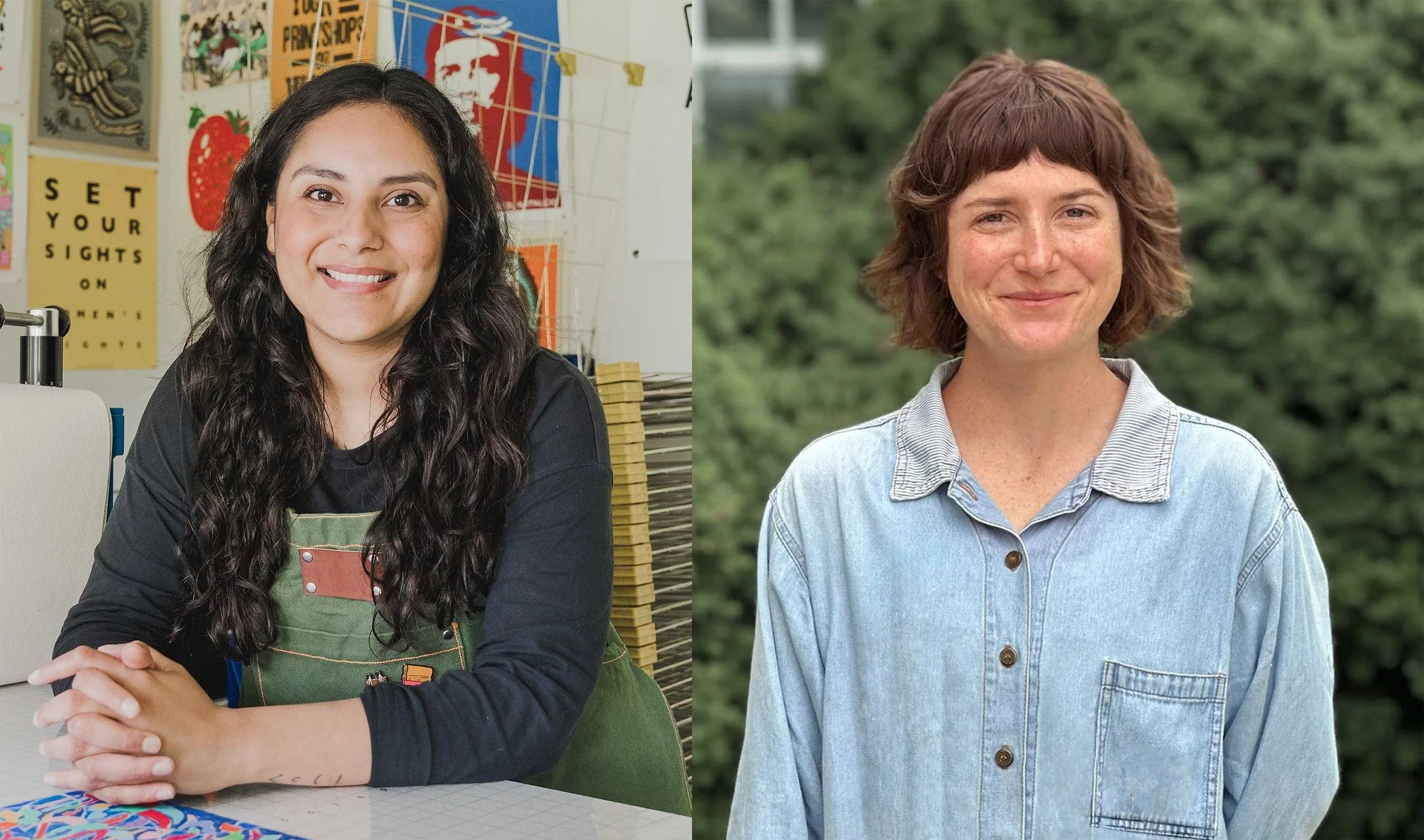
Nancy Ariza (left) and Lila Shull (right)
Meet the 2026 McKnight Fellows in Printmaking Lila Shull and Nancy Ariza! Lila and Nancy began their fellowship in February and have been feverishly working toward their exhibition that will open to the public on February 5, 2027. Please read on the learn more about the artists as well as this year’s review panelists.
Lila Shull (she/her) is a printmaker based in Minneapolis, Minnesota. Working in printmaking, painting, and drawing, her practice pays particular attention to the shift between objects and patterns related to memory. This work wrestles with the problems (and possibilities) that arise from unreliable personal narratives.
Shull holds her MFA from the University of Tennessee-Knoxville and a BFA from Winthrop University in Rock Hill SC. She has been awarded residencies at In Cahoots, Arrowmont School of Crafts, and Eugeniusz Geppert Academy of Fine Arts in Wrocław, Poland. Her work has been shown nationally at the Foley and Unix Galleries in New York City, Coagula Curatorial in Los Angeles, CA, Mint Museum in Charlotte, NC, Devos Art Museum in Marquette, MI, Janet Turner Print Museum at California State University in Chico, CA and at Boston University in Boston, Massachusetts. Lila is the Marketing & Proposal Coordinator for a native-owned general contractor, Woodstone Inc.
Nancy Ariza (she/her) is a Mexican American visual artist and educator. Drawing from her Mexican heritage, Ariza’s artistic practice explores the themes of cultural preservation and memory, familial ties, and storytelling, expressed through a combination of traditional and alternative printmaking processes, natural pigments, and textiles.
Ariza has exhibited across the United States at Hecho a Mano, Santa Fe, NM; Mission Cultural Center for Latino Arts in San Francisco, CA; Janet Turner Print Museum at California State University in Chico, CA; Prospectus Gallery in Chicago, IL; among others. She has received awards from Center for Craft, McKnight Foundation, Jerome Foundation, and Forecast Public Art. Her work can be found in the collections of the Museum of Fine Arts in Boston, MA and National Museum of Mexican Art in Chicago, IL.
Ariza holds an MA in Education and Graduate Certificate in Culturally Responsive Teaching from Saint Mary’s University of Minnesota, as well as a BFA in Printmaking and BA in Art History from Minnesota State University, Mankato.
About the Review Panelists:
Jazmine Catasús is Artistic Director and one of the Master Printers of the Robert Blackburn Printmaking Workshop (RBPMW) at the Elizabeth Foundation for the Arts (EFA). She has been involved with EFA RBPMW since 2013. Catasús works with community members and the public within the printshop facilities and the archive. She has collaborated on printmaking projects with artists such as Lizanina Cruz, Kameelah Janan Rasheed, and Dindga McCannon. Catasús has led printmaking workshops at several institutions, including the Center for Contemporary Printmaking (Norwalk, CT), Print Center New York, The Metropolitan Museum of Art, and The Museum of Modern Art (MoMA) in New York. She is also a Visiting Assistant Professor at Pratt Institute.
Sean Caulfield was named a Canada Research Chair in Fine Arts (Tier 2) from 2001 – 2011, Centennial Professor from 2011 – 2021, and is currently a Professor in the Department of Art and Design at the University of Alberta, living and working in Treaty Six territory, Amiskwaciy Waskahikan, Edmonton, Alberta, Canada. He has exhibited his prints, drawings, installations and artist’s books extensively throughout Canada, the United States, Europe, and Japan. Recent exhibitions include: Found Anatomies, Peter Robertson Gallery, Edmonton, Alberta, Canada (2022); The Flood, Art Gallery of Alberta, Edmonton, Alberta, Canada (2016); The Body in Question(s), UQAM Gallery, Montreal, Quebec, Canada (2012); Perceptions of Promise, Chelsea Art Museum, New York, USA/Glenbow Museum, Calgary, Alberta (2011).
Caulfield has received numerous grants and awards for his work including: The Special Award of the Rector of the Academy of Fine Arts in Warsaw, Krakow Triennial, 2015; SSHRC Dissemination Grant: Canadian Stem Cell Network Impact Grant; SSHRC Fine Arts Creation Grant; Canada Council Travel Grant; and a Visual Arts Fellowship, Illinois Arts Council, Illinois, USA. Caulfield’s work is in various public and private collections including: Houghton Library, Harvard University, USA; Fitzwilliam Museum, Cambridge, England; Blanton Museum of Art, University of Texas, Austin, Texas, USA. In 2017 Caulfield was elected to the Arts Division of the Academy of the Arts and Humanities of the Royal Society of Canada.
The McKnight Printmaking Fellowships are open Minnesota artist/printmakers who are at a career stage that is “beyond emerging” — defined here as artists who demonstrate a sustained level of accomplishment, commitment, and artistic excellence. Fellows are selected on the basis of the artistic merit of their work, and their dedication, interest, and contributions to Minnesota’s arts ecosystem.